

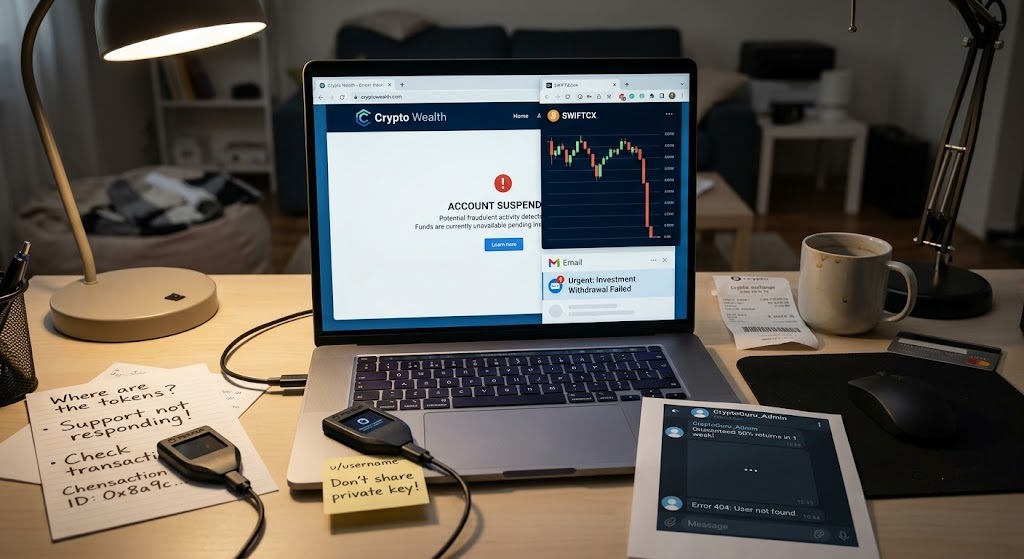
Crypto scams are fraudulent schemes that use cryptocurrency, or claims about it, to take money, digital assets or wallet access from people through deception. They take many forms: fake investment platforms, imitation exchanges, impersonation, relationship-driven investment fraud and bogus “recovery” services. What links them is a convincing story, a professional-looking front and pressure to send funds.
Fraudsters use fake platforms, investment promises, social engineering and impersonation because they work. A polished website, a friendly contact and a dashboard showing rising balances can make a fraudulent operation look like a real business. Verifying a company before sending cryptocurrency matters for a practical reason: transfers are usually irreversible, and no bank or card network will step in to reverse them.
A common misconception is that because blockchain transactions are publicly recorded, stolen funds are easy to retrieve. A ledger shows where assets moved, not who controls the receiving wallet, and it does not compel anyone to return anything. Tracing can be valuable evidence, but recovery depends on the facts of each case.
Victims should also be alert to secondary scams after a loss, particularly offers from strangers who claim they can retrieve the money.
This guide explains the main types of crypto fraud, warning signs, a step-by-step verification process, reporting steps, regulator warnings and how investigations can help establish what happened. It is general information and not legal advice.
What Are Crypto Scams?
A crypto scam is a fraudulent scheme that uses cryptocurrency or crypto-related claims to obtain money, digital assets or wallet access through deception. Common forms include fake investment platforms, fake exchanges, romance-driven investment fraud and fake recovery services. Because crypto transfers are usually irreversible, checking a business before sending funds is essential.
The terms crypto fraud and cryptocurrency fraud are often used interchangeably with crypto scam. In practice, “scam” usually describes deception that persuades someone to send funds voluntarily, while “fraud” is the broader legal concept and also covers theft and unauthorised access.
Cryptocurrency suits fraudsters for several reasons. Transfers are fast, cross-border and hard to reverse. Wallets can be created anonymously. Many people are still learning how exchanges, wallets and blockchains work, and scammers borrow the technical vocabulary to sound credible.
How scammers build trust. Most schemes rely on social engineering rather than technical hacking. Scammers may impersonate a broker, a well-known figure or a support agent. They show apparent proof of profits, respond quickly and adopt a friendly tone. Fake websites can be built cheaply, complete with live-looking charts, “compliance” pages and invented licence numbers.
How they find people. Approaches come through social media, messaging apps, email, dating platforms, online advertisements and sponsored search results. Contact often begins publicly and quickly moves to private channels such as WhatsApp or Telegram.
A professional-looking platform proves nothing about legitimacy. Appearance is easy to copy. Independent verification is not.
Common Types of Crypto Scams
The categories below overlap. A single scheme might begin as a romantic contact, lead to a fake trading platform and end with a recovery scam. Each type has its own supporting guide.
Crypto Investment Scams
Crypto investment scams promise profit from a supposed opportunity that either does not exist or is misrepresented. Typical features:
- Guaranteed or unrealistically high returns
- A “fund manager” or “analyst” the victim cannot independently verify
- Endorsements falsely attributed to celebrities, business figures or public officials
- Fabricated testimonials and screenshots of profits
- Pressure to invest before an “opportunity closes”
- Requests for further deposits, and restrictions when withdrawal is attempted
- Advance-fee demands, such as a “tax” or “unlock fee” to release funds
A dashboard can display any number the operator chooses. The balance shown is simply data on a screen, not evidence that assets exist or can be withdrawn. Before investing, check whether the business is registered or authorised for the relevant activity in the applicable jurisdiction. An offer that claims to be “regulated” without naming a regulator, or that cannot be found in the regulator’s own register, deserves scepticism.
Fake Crypto Exchanges
A legitimate exchange lets users buy, sell or hold digital assets, and regulated ones generally carry out identity checks and disclose their corporate details. Fake crypto exchanges imitate that experience through cloned websites, counterfeit mobile apps, simulated trading balances and scripted “customer support.” Problems usually surface at withdrawal, when the victim is told to pay additional deposits, taxes, verification payments or fees.
Impersonation is common. Scammers register lookalike domains, copy the branding of real exchanges and display fabricated licences or certificates. Website appearance alone cannot establish legitimacy.
Checklist before depositing on an exchange:
- Confirm the exact legal entity and where it is incorporated
- Search the relevant regulator’s official register (not a link supplied by the platform)
- Check the domain’s spelling, age and registration details
- Download apps only from official app stores and the exchange’s verified links
- Test a withdrawal with a small amount before committing more
- Read the terms on fees, withdrawals and dispute handling
- Look for regulator warnings naming the platform
Cloud Mining Scams
Legitimate cloud mining generally means renting computing power from a real mining operation and receiving a share of the rewards, minus fees and electricity costs. Cloud mining scams mimic this while providing no real infrastructure. They tend to feature guaranteed daily returns, fake dashboards and “mining contracts,” and referral schemes that reward recruiting others, which can resemble a Ponzi structure. Profitability claims are often unrealistic, and payouts stall when withdrawals are requested.
Before paying, examine who operates the service, whether mining facilities can be independently verified, how contract terms and fees are written, how returns are calculated against network difficulty and power costs, and whether there is a verifiable withdrawal history. Vague answers to these questions are informative.
Pig-Butchering Scams
A pig-butchering crypto scam combines social engineering with fraudulent investment activity. The name comes from the idea of “fattening” a target before the fraud is completed, but the people affected are victims of organised deception, and none of it reflects on their intelligence or judgment.
The pattern is usually:
- Contact starts through social media, a dating app, a messaging app or a seemingly wrong-number text
- Weeks of friendly conversation build trust
- The contact mentions successful crypto trading and offers to “help”
- The victim is directed to a fake platform
- A small early withdrawal succeeds, building confidence
- Larger deposits are encouraged, and the dashboard shows large profits
- Withdrawals are blocked or subjected to “taxes” or “fees”
- The contact disappears
Recovery Scams
Crypto recovery scams target people who have already lost money. A person who has already lost money should be especially cautious about unsolicited offers to recover those funds.
Typical tactics include impersonating lawyers, investigators, regulators, exchanges or government agencies; claiming the funds have “already been located”; demanding upfront payments framed as tax, release, processing, blockchain or verification fees; asking for private keys or wallet credentials; and supplying fake legal documents, recovery certificates or blockchain “tracking reports.”
Legitimate professionals differ from anonymous recovery promoters in several ways: they are identifiable and verifiable, explain scope and limits honestly, put terms in writing, never ask for private keys or seed phrases and do not guarantee results. Anyone who promises guaranteed recovery should be treated with caution.
Fake Trading Platforms
A fake crypto trading platform presents itself as a place to trade cryptocurrency, forex or both. Common features include manipulated dashboards, invented profits, assigned “account managers,” claimed automated or AI-powered trading systems with guaranteed profits, pressure to deposit more, and blocked withdrawals with scripted support replies.
Sophisticated software does not indicate legitimacy. Interfaces, live-looking charts and trading tools can be purchased or copied. What matters is whether the operator is verifiably identifiable, properly authorised and able to process real withdrawals.
How to Identify a Crypto Scam
These crypto scam warning signs frequently appear together. Any single one justifies a pause.
- Guaranteed returns or profits presented as risk-free
- Profits far above normal market expectations
- Pressure to act immediately
- Unsolicited investment offers
- Anonymous or hard-to-identify operators
- Company information that cannot be verified
- Fake or questionable licences and regulatory certificates
- Domain inconsistencies or lookalike web addresses
- Manufactured testimonials and celebrity impersonation
- Requests to send crypto to personal wallets
- Additional payments demanded before withdrawals
- Refusal to provide clear withdrawal terms
- Unclear ownership and no verifiable physical presence
- Poor or inconsistent legal documentation
- Conversation moving quickly to private messaging apps
How to Verify a Crypto Company
Learning how to verify a crypto company means checking independent sources rather than the company’s own claims. Professional due diligence services follow a similar logic at greater depth.
1. Check the legal company name. A website brand often differs from the legal entity that contracts with users. Find the full registered name in the terms and conditions or privacy policy.
2. Check the company’s registration. Incorporation in a jurisdiction only means a company exists. It does not mean the company is authorised to offer financial services.
3. Verify the financial licence. Go to the relevant regulator’s official database directly. Do not rely on a licence number, logo or certificate displayed on the company’s site.
4. Verify the domain. Check domain age, spelling and lookalike variations. Recently created sites, or registration details that do not match the claimed company, are worth noting. A domain ownership investigation can help examine these details more thoroughly.
5. Verify contact information. Emails should use the official domain rather than free webmail. Phone numbers and physical addresses should be verifiable and consistent with regulatory records.
6. Check regulatory warnings. Search regulators’ warning lists and notices for the company name, domain and any similar names.
7. Examine withdrawal conditions. Unusually complex withdrawal steps, hidden fees or conditions that change once you try to withdraw are warning signs.
8. Do not rely only on reviews. Reviews, testimonials and social media comments can be purchased or fabricated.
| Check | What to look for | Red flag |
| Legal entity | Full name and jurisdiction | Brand only, no entity |
| Registration | Corporate registry entry | Not found, or mismatched |
| Authorisation | Listed in regulator’s register | Only self-declared |
| Domain | Age, spelling, ownership | New, lookalike, hidden |
| Contact details | Official domain, real address | Webmail, virtual address |
| Warnings | Regulator warning lists | Named in a notice |
| Withdrawals | Clear, consistent terms | Extra fees or delays |
How to Report a Crypto Scam
How to report a crypto scam depends on your location, the type of fraud and who was involved. Making a report does not guarantee recovery, but it can support investigations and help authorities identify patterns. Our guide on how to report a crypto scam covers this in more detail.
Preserve evidence first. Preserved evidence helps any later investigation reconstruct events. Save or record:
- Emails and messages (with dates and sender details)
- Screenshots of the platform, balances and chats
- Transaction hashes and wallet addresses
- Website URLs and any app download details
- Payment records, invoices and contracts
Then consider reporting to:
- The relevant financial regulator
- The appropriate law-enforcement authority for suspected criminal activity
- The exchange or financial institution involved, where appropriate
Where fraudulent websites, impersonating accounts or false statements are online, notice and takedown services may be relevant, and online defamation services may help where a business or individual has been falsely accused or impersonated.
Regulatory Warnings About Crypto Scams
Regulatory regimes differ by country, and crypto activity may be regulated as securities, payment services, anti-money-laundering obligations or under new crypto-specific frameworks. Keep these terms distinct:
- Company incorporation: a legal entity exists
- Registration: the firm is listed for a specific purpose (which may be limited)
- Authorisation or licensing: the firm has permission to carry out defined regulated activities
- Regulatory warning: the regulator has publicly cautioned about a firm or website
Warnings can change, so confirm current information directly with each regulator. For broader compliance context, see our page on cryptocurrency compliance.
FCA Crypto Scam Warnings
The UK’s Financial Conduct Authority publishes the Financial Services Register and warnings about unauthorised firms and clones of authorised ones. Check both the register and the warning list, and use contact details from the register rather than those the firm supplies. Being on the register does not mean an investment is safe, and registration for some crypto activity relates to specific requirements only. See FCA crypto scam warnings.
SEC Crypto Scam Warnings
The U.S. Securities and Exchange Commission, including through Investor.gov, has issued investor alerts on fraudulent crypto investment offerings, relationship-based investment fraud and fake trading websites. Investors can research registered professionals and offerings through official SEC resources. See SEC crypto scam warnings.
AMF Crypto Scam Warnings
France’s Autorité des marchés financiers publishes lists of unauthorised sites and entities that offer investments, including crypto and forex products, and provides consumer guidance. Checking AMF information and the status of any digital-asset service provider in France is a sensible step. See AMF crypto scam warnings.
FSMA Crypto Scam Warnings
Belgium’s Financial Services and Markets Authority publishes warnings about unauthorised or fraudulent providers of financial services, including crypto-related offers, and offers tools to check whether a provider is authorised. See FSMA crypto scam warnings.
ASIC Crypto Scam Warnings
The Australian Securities & Investments Commission publishes investment scam warnings, including crypto-related alerts, and consumer guidance through Moneysmart. ASIC’s alerts and lists should be checked alongside other Australian bodies’ scam-reporting resources. See ASIC crypto scam warnings.
What to Do If You Have Lost Money to a Crypto Scam
A loss can be distressing. A calm, methodical response helps.
- Stop sending additional funds. Further “fees” rarely release anything.
- Preserve evidence. Follow the list above and avoid deleting chats or accounts.
- Secure remaining accounts and wallets. Change passwords, enable multi-factor authentication and move assets if credentials may be compromised.
- Contact relevant exchanges or payment providers where appropriate, since some can flag or review transactions.
- Report to the relevant authorities.
- Consider professional legal or investigative advice where appropriate.
- Be alert to recovery scams.
Blockchain transactions can provide useful information about where funds moved. But tracing a transaction does not automatically mean the funds can be recovered.
How Crypto Investigations Can Help Establish What Happened
A crypto scam investigation aims to establish facts. That can support regulatory complaints, legal claims, civil proceedings or engagement with law enforcement, though outcomes depend on the circumstances.
Typical work includes:
- Transaction analysis and wallet-address analysis to map how funds moved
- Blockchain transaction tracing and identifying flows through intermediary wallets
- Connecting addresses with known services, such as exchanges, where publicly or lawfully available information allows
- Reviewing website and domain information and researching corporate entities
- Preserving digital evidence, including communications and platform records
- Reviewing exchange records where they can be obtained
- Timeline reconstruction and identifying potentially relevant counterparties
FintechLegals’ relevant areas include crypto assets tracing, crypto investigation, fraud investigations, claims and disputes, due diligence and domain ownership investigation. Investigation cannot guarantee that a person will be identified or that any funds will be recovered. What it can do is give a clearer factual basis for deciding on next steps.
Frequently Asked Questions About Crypto Scams
1. What is a crypto scam?
A crypto scam is a deceptive scheme that uses cryptocurrency, or claims about it, to obtain funds, digital assets or access to wallets. It may involve fake platforms, false investment promises or impersonation. Because transfers are often irreversible, verifying who you are dealing with before sending funds is important.
2. What are the most common types of crypto scams?
Common categories include crypto investment scams, fake exchanges, cloud mining scams, pig-butchering scams, fake trading platforms and recovery scams. They often overlap, with one scheme leading into another. Each relies on trust, urgency or false claims of profit to persuade people to send money.
3. How can I identify a fake crypto exchange?
Look for missing or unverifiable licences, a legal entity you cannot confirm, a recently registered or lookalike domain, extra fees before withdrawals and unusual pressure to deposit. Check the regulator’s official register independently. Website design alone says little about whether an exchange is genuine.
4. How do I verify a crypto company?
Confirm the legal entity, check corporate registration, verify authorisation in the relevant regulator’s official register, examine the domain, check contact details and search for regulatory warnings. Test withdrawal terms and do not rely only on reviews, which can be fabricated.
5. How do I report a crypto scam?
Preserve evidence such as messages, transaction hashes, wallet addresses and URLs. Then report to the relevant financial regulator and the appropriate law-enforcement authority, and contact any exchange or payment provider involved. Procedures vary by country, and reporting does not guarantee recovery.
6. What is a pig-butchering crypto scam?
It is a scam where a contact builds trust over time, often through social media, dating or messaging apps, then steers the person toward a fake crypto investment platform. Early small withdrawals may work, but larger deposits are later blocked or met with new “fees.” It combines social engineering with fraudulent investment activity.
7. What is a crypto recovery scam?
A crypto recovery scam targets people who have already lost money by offering to retrieve it, usually for an upfront fee. The offer may involve fake lawyers, agencies or “tracking reports.” Requests for private keys, or promises of guaranteed recovery, are serious warning signs.
8. Can cryptocurrency transactions be traced?
Many blockchain transactions are publicly visible, so movements between wallet addresses can often be analysed. However, addresses do not automatically reveal identities. Tracing may show where funds went and whether they reached a known service, but what can be established depends on the specific facts.
9. Can stolen cryptocurrency always be recovered?
No. Recovery depends on factors such as how quickly the loss is identified, where the funds moved, whether they reached a regulated service and whether legal or law-enforcement action is possible. Anyone guaranteeing recovery should be treated cautiously.
10. What should I do after losing money to a crypto scam?
Stop sending money, preserve all evidence, secure your accounts and wallets, contact relevant exchanges or payment providers and report to the appropriate authorities. Consider qualified legal or investigative advice, and be careful with unsolicited recovery offers.