



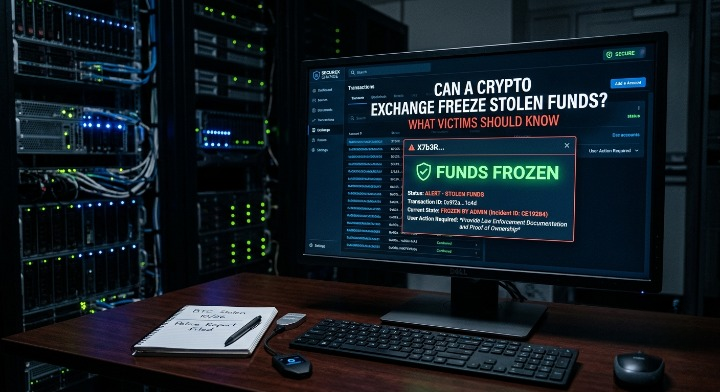
A crypto exchange can be blocked, marked, or frozen by the exchange if they have something to do with the theft. However, this is not automatic; it depends on whether the stolen money made it to the exchange in question, if the exchange is able to locate the appropriate account, and on other factors such as the policies of the exchange and the law.
Can a Crypto Exchange Freeze Stolen Funds?
The quick answer is: occasionally, depending on the conditions, but not automatically – and not simply at the request of the victim.
First of all, the centralized exchange has control of the assets and accounts on its own platform. In case stolen cryptocurrency gets onto the exchange account, the exchange may technically and legally be able to place restrictions on this account while conducting an investigation. But some conditions should be fulfilled in advance:
- The exchange must have received the stolen assets. The exchange has no control over assets that are kept in the wallet of the victim, as well as the assets being transacted through other platforms.
- The exchange needs time to act. Once the assets were withdrawn, converted or transferred to some other location before the exchange could be informed about this, nothing is left on the exchange platform to be restricted.
- There should be enough information about the transaction that was carried out – for example, the transaction hash or wallet address of the victim. It allows the exchange to find the necessary account.
- Exchanges use different protocols for investigation of suspicious activity.
- Legal conditions are different in every country.
The first is avoiding confusion between four different aspects of crypto fraud that tend to get mixed up during discussions of the subject:
- Trace – following the path of the money on the blockchain.
- Identify the destination – figuring out where the funds seemed to go (e.g., to a specific exchange account).
- Freeze – freezing the funds by the platform/authority.
- Recovery – the overall process of returning the stolen money to its rightful owner.
Just successfully accomplishing one of these steps does not mean that the next one is guaranteed.
When Can a Crypto Exchange Freeze Cryptocurrency?
Exchanges generally act on internal risk and compliance triggers rather than open-ended victim requests alone. Conditions that might force an exchange to freeze an account or transaction could be:
- Detection of unusual activities through their internal fraud monitoring systems
- Investigations into fraud or scams relating to the account
- Requests from law enforcement
- A court order or any other type of legal process
- Any requirement for regulatory or licensing purposes that the exchange has to fulfil
- AML/KYC compliance processes
- The account that is already blacklisted for other reasons and receives the funds in question
All exchanges have their own policies for determining how to respond to such conditions, but the policies are determined by the laws of the jurisdiction where the exchange operates. A victim’s report is often what starts this process, but it is rarely sufficient on its own — most exchanges also expect supporting documentation and may only act through official law-enforcement or legal channels for anything beyond an initial internal flag.
What Happens If Stolen Crypto Reaches an Exchange?
When cryptocurrency is stolen and eventually moves toward a centralized platform, a general sequence often unfolds:
- There is an outflow of cryptocurrency from the victim’s wallet due to an unintended transaction carried out by the victim.
- This transaction becomes part of the public blockchain record, which can be used for analysis.
- This analysis could give you one or more wallet addresses that the cryptocurrency went through.
- One of these addresses could be connected to a centralized exchange’s deposit mechanism.
- Then you can give relevant details of this transaction to the exchange itself or to the law-enforcement authorities.
- The exchange will conduct an analysis of the transaction according to its procedure, and analyze the user account and transactions connected with it.
- The exchange may then take further action depending on its policy and the law.
This is where cryptocurrency asset tracing becomes relevant — tracing analyzes blockchain activity and can point toward a destination, but the exchange’s internal review and any resulting restriction is a separate, later step that the exchange controls.
Can You Ask a Crypto Exchange to Freeze Stolen Funds?
Indeed, a victim can approach an exchange regarding any suspicion of theft or fraud. Nonetheless, most exchanges have some requirements that must be met before they can proceed to help, since they have their own investigation process and procedures for reporting rather than freezing the funds just like that.
Where available, the following should be provided:
- Transaction Hash (TXID)
- Address from which money was sent
- Address where the transaction is being received
- Type and amount of cryptocurrency being used
- Date and time of the transaction
- Deposit address on the exchange, if applicable
- Screenshots of activity
- Payment details/bank statements related to the fraud
- Correspondence regarding the incident, including any emails, chats, messages, etc.
- A police or law enforcement report that has been filed in relation to the incident
- Any case numbers or reference numbers that have been assigned to the situation
Important: Do not share your seed phrase, private key, password, authentication code, or wallet recovery phrase with anyone who tells you that they are able to freeze or recover your lost funds – real exchanges, investigators, and law enforcement agencies will never require you to disclose any of this information.
What Information Does a Crypto Exchange Need to Investigate Stolen Funds?
Transaction Details: Transaction hash, wallet address/es associated with the transaction, the chain/blockchain in use, type of asset/token being transferred, the amount, and the time and date of the transfer.
Account Details: Exchange account details if known, deposit address, withdrawal details if known, and user/account identifier if known.
Fraud evidence: emails, messages, website URLs, social-media profiles used in the scheme, screenshots, payment receipts, and details of any investment platform involved.
Accurate, well-organized information matters because exchanges typically review a high volume of reports and generally prioritize cases with clear, verifiable evidence that lets their compliance teams act efficiently.
Why Is the Transaction Hash Important?
Direct answer: A transaction hash (TXID) is a unique identifier for a specific blockchain transaction. This makes it possible to trace and verify that particular transaction on the blockchain, which often becomes the first step in a chain of tracing or investigation.
The transaction hash may prove that there was a transfer made, the amount transferred, as well as the wallet addresses from both sides of that transaction. Yet, just the transaction hash cannot give information about the person or company behind the wallet address in question. This information can be traced with additional effort.
Can an Exchange Freeze Bitcoin, USDT, or Other Cryptocurrency?
Direct answer: It depends primarily on where the asset currently sits, not on the type of cryptocurrency itself. Bitcoin, USDT, and other tokens can potentially be restricted if they are held within an exchange’s controlled environment, but an exchange generally has no ability to control assets sitting in a wallet it does not operate.
This distinction matters:
- Funds held at a centralized exchange — the exchange controls the underlying infrastructure and may be able to restrict the account.
- Funds held in a self-custody wallet — no third party controls these funds; only the wallet holder can move them.
- Funds in transit between wallets — these are not “frozen” mid-transfer; the relevant question is where they end up.
USDT has an added wrinkle in that some stablecoin issuers have taken action on specific addresses at their own discretion in certain circumstances, which is a separate mechanism from an exchange freezing an account — but this is issuer-specific and not guaranteed in any particular case.
What If the Stolen Crypto Is Still in a Private Wallet?
If stolen funds remain in a private, self-custody wallet rather than moving to an identifiable exchange, there is generally no third party positioned to restrict or freeze them. Blockchain analysis can still monitor the wallet and track future movement, but tracing activity is not the same as controlling assets.
Investigators may continue to watch the wallet for subsequent transfers, since stolen funds are often eventually moved toward an exchange, mixer, or other service in an attempt to cash out. When and if that happens, new options may become available — but there is no way to guarantee this outcome or a timeline for it.
What Should Victims Do Immediately After Cryptocurrency Is Stolen?
- Ensure that all transaction details are stored, such as transaction hashes and wallet addresses
- Take screenshots of wallets, transactions, and any suspect platforms
- Make sure to keep emails and any form of communication from the scammer
- Keep website and social media links associated with the scam
- Save banking statements or transaction records related to the transaction
- Reach out directly to the relevant exchange if you have details of the destination platform
- File a report to relevant law-enforcement or regulatory agencies – see how to report a crypto scam for more guidance
- Consider using a professional cryptocurrency tracing or investigation service if necessary
- Maintain a chronological written log of events
Can Cryptocurrency Tracing Help Locate Stolen Funds?
Direct answer: Tracing can be useful since it will involve looking into how the stolen money was moved through the blockchain and determining where the money seems to have been directed, but tracing does not mean that the funds will be frozen or retrieved.
Blockchain analytics could help in:
- The tracking of how the funds were moved through the blockchain through several transactions and wallets
- Identifying where the funds seemed to be directed
- Detecting patterns that suggest fraud or money laundering schemes
- Checking whether the assets seem to have been moved to a specific exchange or service provider
- Creating leads for investigation for law enforcement agencies or litigation
- Preparing the blockchain data to be used for reporting or litigation purposes
This is exactly what the job of a cryptocurrency asset tracing assignment entails, and it is usually carried out in conjunction with a full crypto investigation assignment that looks into off-blockchain evidence. If there were any fraudulent activities involved, then fraud investigation services will also come in handy.
What Is the Difference Between Tracing, Freezing, and Recovering Crypto?
- Tracing: Identifying how the flow of cryptocurrency occurred between different addresses on the blockchain
- Freezing/Restriction: The restricting or limiting of access to certain assets by a platform or regulatory body that is able to take such actions.
- Recovery: The larger process of trying to recover any funds that have been taken from their rightful owners, regardless of whether it is ultimately successful or not.
Successful tracing is often a necessary step toward recovery, but it does not by itself result in frozen or returned funds.
What If the Exchange Does Not Respond?
- Save all communications from the exchange with timestamps
- Take note of the case number assigned to your report
- Report via the appropriate channel of the exchange rather than personal communication
- It may be a good idea to file a report with the authorities as well
- Keep the blockchain evidence safe for any future reference
- In case of large amounts of money lost or complicated schemes, you should consider professional help
Do not try to hack accounts and communicate in a threatening way with employees of the exchange because it may spoil your report.
Can a Crypto Exchange Recover Stolen Cryptocurrency?
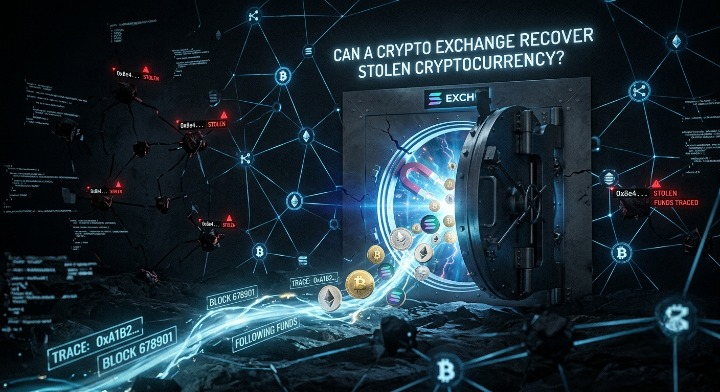
Direct answer: An exchange may, in some circumstances, be able to restrict or return assets connected to a theft, but it cannot guarantee recovery simply because a victim files a report.
Relevant factors include where the funds are currently located, whether they reached an identifiable exchange account, whether that account and its holder can be identified, whether the funds have already been moved or converted, the applicable law in relevant jurisdictions, the exchange’s own policies, and whether law enforcement or a court has issued a formal request or order.
If a suspicious platform or company was involved in the original scheme, it may also be worth checking whether it appears on official cryptocurrency regulatory warnings lists or using resources to verify a crypto company before any further transactions occur.
Conclusion
Identifying where stolen cryptocurrency has gone can be a genuinely important investigative step — but tracing, freezing, and recovery remain three separate processes, each with its own requirements and limitations. A transaction reaching a known exchange creates a possibility for intervention; it does not create a guarantee. FintechLegals offers cryptocurrency asset tracing, crypto investigations, and fraud investigation services to help victims organize evidence and pursue the appropriate next steps, though no investigation or legal process can promise that stolen funds will ultimately be frozen or returned.
FAQ
1. Can a crypto exchange block the funds which were stolen?
Yes, if the stolen funds have already been transferred to the exchange, the exchange will be able to determine the right account and, according to its policy and law, make the right decision.
2. Can the exchange block the stolen Bitcoin?
It can block the Bitcoin transferred to the exchange, but the exchange cannot do anything with the Bitcoin which is in a personal wallet. It is important where the funds are kept rather than what kind of assets they are.
3. Does the exchange have the ability to block the stolen USDT?
Yes, if the stolen USDT was transferred to the exchange account. Also, there are stablecoin issuers who are able to do something independently concerning some addresses; however, it is another issue.
4. How can I report stolen crypto to an exchange?
Report the theft using a formal fraud or security reporting process provided by the exchange and provide the transaction hash, wallet addresses and any other evidence that might be useful.
5. What information should I provide to report the theft of my crypto?
I should give the transaction hash, senders/receivers addresses, asset name and amount, timestamps, screenshots, payment receipts and all communications related to the fraud.
6. Can I use a transaction hash to track stolen crypto?
Yes. The transaction hash allows me to trace that particular transaction and find out more about it on the blockchain, which is usually the first step to see where else the funds were moved to.
7. Can cryptocurrency be frozen from a private wallet?
No, because there is no exchange or service in charge of a personal wallet; thus, no one will have the power to freeze my funds.
8. What happens when stolen crypto ends up on an exchange?
The exchange might investigate the receiving address in accordance with its compliance policies once it becomes aware of the details of the transactions, and take action accordingly.
9. Is crypto tracing able to track down the stolen cryptocurrency?
Tracing will be useful in determining the journey of the cryptocurrency and where it may end up. It does not necessarily freeze or recover the stolen money.
10. Will the freezing of stolen cryptocurrency lead to recovery of the stolen money?
Not necessarily. The freezing of the cryptocurrency only stops it from being transferred again, but recovery is still not guaranteed.
For more updates, follow us on LinkedIn.
Leave a Reply