


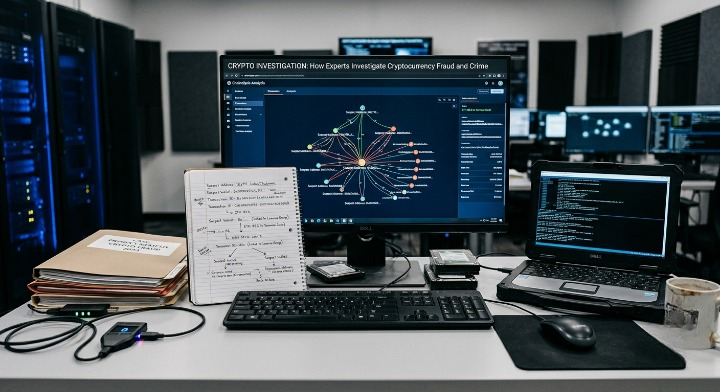
Crypto investigation is basically a systematic method through which fraud, theft and any other form of misconduct involving cryptocurrency are investigated. During such an investigation, blockchain analysis, digital forensic analysis, and ordinary investigative techniques help establish what has happened and where the money has been moved to. The majority of the popular blockchain platforms have public ledgers, which means that it is possible to track transactions from one address to another. No names are mentioned in the blockchain. It is necessary to link a wallet to a person using additional information.
What Is a Crypto Investigation?
Crypto investigation refers to a study into any suspicious use of cryptocurrencies through the analysis of data found on blockchain technology and supported by other evidence like texts and account logs. Tracing transactions is not the same as identifying a suspect: the blockchain shows addresses and transfers, while naming the person behind them requires further evidence.
The FBI’s Internet Crime Complaint Center notes that because transactions are permanently recorded on public blockchains, law enforcement can follow money in ways not possible in other financial systems. It also warns that transfers to overseas exchanges can create significant challenges.
How Does a Crypto Investigation Work?
Every case differs, but a professional cryptocurrency investigation generally follows five stages.
1. Collecting Transaction and Wallet Evidence
Investigators start with the details of the loss: wallet addresses, transaction hashes, amounts, timestamps, and the blockchain network used. They add exchange receipts, chat logs, website domains, and phone numbers. The IC3 asks victims for the same kinds of details.
Victims often confuse the two key identifiers. A transaction hash identifies one transfer. A wallet address identifies an account that sends or receives funds. Bitcoin and Ethereum transaction hashes are 64 characters, and Ethereum addresses are 42 characters, including the “0x” prefix. Keep original files, not only screenshots.
2. Tracing Cryptocurrency Transactions
Tracing begins at the victim’s outgoing transfer and follows the funds to the receiving address, then onward. Offenders often split funds across many addresses, consolidate them again, swap tokens, or bridge to another blockchain to obscure the path. Each hop is documented so the route can be checked by someone else. For a closer look at this stage, see our overview of crypto asset tracing.
3. Analyzing Blockchain Activity
Analysts look for patterns that reveal structure. Wallet clustering groups addresses that are likely controlled by the same party, for example because they were spent together in a single Bitcoin transaction. Other signals include rapid pass-through transfers and long chains in which small amounts are peeled off at each step.
Clustering is an inference, not proof. A sound investigation labels attribution by confidence level and corroborates it with independent evidence.
4. Identifying Exchanges and Other Services
When traced funds reach an address attributed to an exchange or payment service, that is often the most useful lead. Exchanges hold customer identity records, but those are not public. Obtaining them generally requires a lawful request, such as a law enforcement referral, subpoena, or court order. Investigators can prepare the documented trail that makes such a request specific and credible.
5. Preparing an Investigation Report
A good report sets out a transaction timeline, a fund-flow map, a list of relevant addresses with attribution confidence, supporting evidence, and findings. It separates established facts from inference and states its limitations plainly. This is the document a lawyer, compliance team, exchange, or police agency can actually use.
What Types of Cryptocurrency Crimes Can Be Investigated?
- Investment fraud: Investigators trace deposits to platform-controlled wallets and map how new deposits are moved onward
- Romance scams: The conversation history, payment history, and wallet addresses from the scam victim serve as the core for investigation.
- Fake exchanges: In addition to on-chain data, OSINT is as important, as well as the domain history.
- Wallet hackings/transfer without consent: The focus of attention is placed on the exact timing and method of asset withdrawal from the wallet, regardless of whether the private key was stolen or not.
- Phishing fraud: Any fraudulent actions or malicious websites are analyzed for the transfer.
- Money laundering: There is an attempt to detect any layering using mixers, bridges, and swaps.
- Illicit business interactions: There is a review of the transaction history and counterparties with respect to the on-chain data.
What Tools Are Used in Crypto Crime Investigations?
- Block explorers such as Etherscan or mempool.space make it possible to view the transactions.
- Services like Chainalysis Reactor, TRM Labs, and Elliptic also incorporate address attribution, cross-chain tracking, and visualization charts. Chainalysis refers to Reactor as the blockchain forensic solution that can trace the money flows across multiple blockchains.
- Transaction monitoring solutions detect suspicious activity in real-time. They are used by exchanges and compliance professionals more than by the victims.
- Open source intelligence (OSINT) includes domain registration data, social media profiles, and archived web pages.
- Transactions made on the exchanges connect the deposit addresses to user accounts via legal methods.
- Forensic digital evidence collected from mobile phones, email, and messaging applications connects on-chain activities to off-chain occurrences.
These tools support an investigation. They do not establish criminal responsibility or confirm who owns a wallet.
Who Investigates Crypto Scams?
Law enforcement agencies lead criminal investigations. Regulators, exchanges, forensic specialists, private investigators, and lawyers each play a different supporting role.
- Law enforcement can seek warrants, subpoenas, and seizures. In the US, scam victims can file a complaint with the FBI’s IC3.
- Licensing violations and market misbehavior are taken care of by financial regulators.
- The exchanges analyze transactions done through them and can freeze accounts according to their policies or court orders.
- Blockchain forensic experts study the transactions and provide evidence.
- Private cryptocurrency investigators serve the interests of individuals and companies. They do not have law enforcement’s legal authority and cannot compel anyone to disclose information. Professional cryptocurrency investigation supports other parties’ next steps rather than replacing them.
- Legal experts use their findings to send out legal notices or take further action.
How Can You Identify a Legitimate Crypto Investigator?
The following are some things that you should look out for:
- Business information: This includes the name, address, and contact details of the organization.
- Methodology: The service provider must be able to explain how they do their money tracing and attribute responsibility.
- Realistic outcome statements: They mention what can be achieved from it, and what cannot.
- Evidence-based reports: Deliverables include reports that are peer-reviewed.
- Confidentiality: They should have a process of protecting your information and keys.
Some warning signs include guaranteed return of funds, urgency to pay immediately, need for seed phrase or keys, and fees to unlock your funds. The FBI’s IC3 says recovery services should be avoided, particularly when they ask for any kind of up-front payment.
Can a Crypto Investigation Help Recover Stolen Cryptocurrency?
These terms are often confused:
- Investigation establishes what happened.
- Tracing follows the movement of funds. Cryptocurrency transaction tracing is one component of an investigation.
- Recovery is the later attempt to retrieve assets through legal action, exchange cooperation, or law enforcement.
Investigation will help trace the transaction process and provide evidence for police and court. Transactions are irreversible and therefore tracing would not freeze or reverse the transfer process. The outcome of tracing will depend on the destination of the money and the legal means available.
When Should You Hire a Professional Crypto Investigator?
Professional investigation may be recommended if:
- there is substantial loss of money
- money was passed through many addresses/chain
- you suspect financial pyramid fraud
- company suspects fraud on its part or from the counterparty
- you want the results to be put down on paper for your lawyer or insurance agency
FintechLegals provides crypto investigation services that consider the situation of your case, analyze blockchain transactions and activity of wallets, and put down the results on paper.
Frequently Asked Questions About Crypto Crime Investigation
Who investigates crypto scams?
Law enforcement organizations, like the FBI, conduct criminal investigations, and market misconduct investigations fall under financial regulators’ jurisdiction. The exchanges keep track of the transactions happening on their platform. Forensic blockchain analysts and private investigators look into the transaction history of the individuals who have been affected, either companies or people who want legal help.
Are there legitimate crypto scam investigators?
Yes; however, there are many scammers who do this kind of business too. True crypto investigators have clear business models, reveal how they work, set realistic expectations, and never make any promises of recoveries. The FBI has issued warnings regarding crypto recovery scams that charge upfront fees.
What resources are available for crypto investigations and analytics?
There are public block explorers such as Etherscan and mempool.space that enable everyone to access transaction information. There are also professional analytics tools, such as Chainalysis Reactor, TRM Labs, and Elliptic. Investigators also use open-source intelligence, exchange records, and digital forensic evidence. Victims can start with the FBI’s IC3 reporting guidance.
What tools do law enforcement use to investigate crypto crime?
Blockchain analysis tools, like Chainalysis Reactor, are often used together with a legal approach towards exchanges and devices and old-fashioned investigative techniques by law enforcement agencies. The FBI states that blockchain is a unique way of tracking crypto transactions that is impossible with any other financial system, although transfers abroad pose some difficulties.
Can cryptocurrency transactions be traced to a person?
It is easy to track transactions from one wallet address to another, but it does not mean that an address is linked to a particular person. Additional evidence should be found to establish a person’s identity. Tracing may point to a likely destination, but it does not by itself prove who controls a wallet.
How long does a crypto investigation take?
There is no set timeframe. Time taken varies depending on the number of wallets and blocks involved, whether money was sent via exchange sites, and the level of completeness of documentation provided. Legal requests to exchanges run on separate timelines controlled by third parties and courts.
What evidence is needed for a crypto investigation?
Useful evidence includes wallet addresses, transaction hashes, the blockchain network, amounts, and dates and times of each transfer. Also keep communications, website domains, phone numbers, exchange receipts, and account statements. The FBI’s IC3 asks for these details in complaints. Keep original files rather than only screenshots.
How FintechLegals Approaches a Crypto Investigation
FintechLegals investigates potential fraud cases carried out by a particular person, firm, or legal entity. The investigation process is well-organized and based on:
- Case analysis – analysis of circumstances, parties involved, and collected evidence.
- Evidence gathering – gathering evidence such as transaction hashes, addresses, account data, documents, and communications.
- Blockchain and money flow investigation – analyzing wallet actions and the money transfer process between addresses.
- Analysis of related activities – analyzing related wallets and exchanges.
Where the main question is simply where the money went, FintechLegals also offers standalone crypto asset tracing.
What FintechLegals Does Not Do
FintechLegals does not exercise law enforcement powers. It cannot compel exchanges or individuals to disclose information, and it does not guarantee that the person behind a wallet will be identified or that funds will be recovered. Findings are meant to support legal, regulatory, or further investigative steps, which depend on the applicable legal process. Spelling this out is part of how you can tell a legitimate provider from one making guarantees.
To discuss your situation and the evidence you currently hold, contact FintechLegals.
For more updates, follow us on LinkedIn.

Leave a Reply