


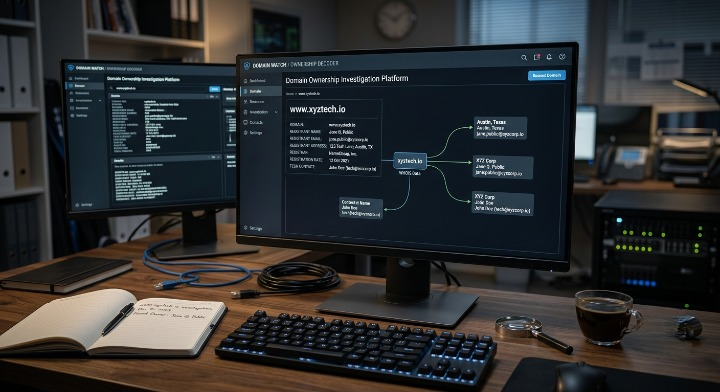
Determining the identity or organization responsible for a particular website is not usually an easy task. Registrant data could have been censored, old, or intentionally deceptive, and the name appearing in the document is not necessarily the owner of the website. A Domain Ownership Investigation refers to the compilation of various documents that can be linked to show the likely parties associated with a website. This type of investigation is usually performed for fraudulent websites, brand impersonations, online frauds, and domain conflicts.
What Is a Domain Ownership Investigation?
A domain ownership investigation involves the investigation of the domain’s registration information, history, infrastructure, and other public sources to identify the possible owner or controller of the web site. The result of the domain ownership research is clues, and not proof, as the registrant can use some private services or provide incorrect information.
Not all registrants are the operators of the web sites. For instance, it can be the web developer or even the nominee. A professional domain ownership investigation therefore reports findings with confidence levels, and results always depend on the evidence available.
Why Would Someone Need a Domain Ownership Investigation?
Investigating Fraudulent Websites
Fake investment sites and phishing pages emerge and disappear rapidly. Dates when the site registered, how the site is hosted, and how it links to other domains will demonstrate its affiliation to a larger operation, enabling the conduct of a more comprehensive fraud investigation.
Identifying Websites Impersonating Businesses
The impersonators steal the name, logo, and layout from the companies that they pretend to be. The copied websites and look-alike domains will tie the cloned sites together and identify who you should notify for a notice and takedown request.
Investigating Domain Name Disputes
Proving ownership is crucial for trademark disputes and cybersquatting complaints. According to UDRP, the claimant should prove that the domain is confusingly similar, the registrant does not have any legitimate interest, and the domain was registered and used in bad faith, as described on WIPO.
Investigating Online Defamation and Anonymous Websites
Domain-related evidence might be used to pinpoint those responsible for the online defamation. It is not an offense to be anonymous on the internet, and there are plenty of legitimate websites that employ the services of a privacy provider.
How Does a Domain Ownership Investigation Work?
Step 1 – Examining Domain Registration Records
Inquiries are made to RDAP, the Registration Data Access Protocol standardized by the IETF in RFC 9083, through various services such as ICANN Lookup. On January 28, 2025, the RDAP was established as the authoritative data source for gTLD registrations, replacing sunset WHOIS services. Registrar details, important dates, nameservers, and non-redacted contact information are recorded. Country-specific domains have their own policies.
Step 2 – Reviewing Historical Domain Information
Services of historical WHOIS and web archives can give you some information about previous owners of the domain, its content, and any changes in the way it. Such services can be unreliable and inaccurate; it is necessary to verify information.
Step 3 – Analyzing Website Infrastructure
Information about DNS, IP addresses, web hosting services, and SSL/TLS certificates can help in the analysis of the website’s infrastructure. Certificate transparency logs list all certificates that were ever issued, and it can reveal some additional hostnames. Similar use of infrastructure doesn’t mean any connections between websites, as they can be completely unrelated.
Step 4 – Examining Publicly Available Digital Evidence
Using OSINT allows you to create a bigger picture: documents of a publicly available company, contact details, social media profiles, and cached pages. It is important to find matches on names, e-mail addresses, phone numbers, and street addresses.
Step 5 – Connecting Findings and Preparing an Investigation Report
Findings are recorded along with references and dates, differentiating between verified findings and potential connections and establishing degrees of certainty. The investigative report may trigger additional investigations or even legal actions, but it will not definitely reveal the identity of the domain owner.
Can You Identify a Domain Owner When WHOIS Information Is Private?
Sometimes but not always. Concealed or shielded WHOIS information is not penetrable by means of any open research; however, there might still be some clues that can be found in the historical data, DNS or hosting information, certificate logs, and open source business information.
Registrars redact personal data under privacy laws and ICANN policy. Privacy and proxy services go further by publishing the provider’s details instead of the customer’s. For generic domains, ICANN’s Registration Data Request Service (RDRS) lets requesters ask participating registrars for nonpublic data. It is a voluntary service, so registrars are not required to take part. It excludes country-code domains and guarantees nothing: in ICANN’s two-year pilot, 26% of requests were approved, and 55% were denied.
What Tools Are Used in Domain Ownership Investigations?
Free public resources include ICANN Lookup and RDAP, DNS lookup tools, Certificate Transparency search, website archives, and public business registries. Specialized services add historical WHOIS databases, passive DNS, and OSINT platforms. No tool’s output speaks for itself; results require interpretation and independent verification.
What Evidence Can a Domain Ownership Investigation Reveal?
If available, an investigation will produce:
- Registration dates, registrar, and name servers
- The history of the domain
- Linked organizations that can be found publicly
- Content from the web pages and archives
- Technical support structures
- Other websites linked with suspicious activity
There are three levels to the information produced in an investigation: proven facts, potential links, and leads that require further verification. An investigation of a domain will not prove ownership of the website.
How Can Domain Ownership Investigations Help With Online Fraud and Legal Disputes?
The following documented findings may aid in investigations of fraud, impersonation claims, trademark issues, domain name dispute cases, takedown actions, and legal evidence collection. It will help, in combination with fraud investigations and takedown service for the right targets to be identified. It should be noted that the outcome of any investigation does not mean the presence of criminal activity.
When Should You Consider Professional Domain Ownership Investigation Services?
Professional assistance is necessary when a suspicious website tries to pose itself as an official entity, a firm faces website cloning, there is a presence of a fake website with privacy registration of domains, legal and trademark disputes, and the necessity of detailed information on the website.
The domain ownership investigation services include the examination of registration details, infrastructure, and associated websites. The information will be regarded as lead evidence; identification cannot always be assured.
Frequently Asked Questions About Domain Ownership Investigation
How do I determine who owns a domain?
Use a look-up tool, such as ICANN Lookup, which gives you the registrar, creation date, nameservers, and any un-redacted contact information. Next, consider comparing historical information, DNS, and the website itself. Your results will show the registrant of record, who does not necessarily run the website.
Can you identify a domain owner even when the WHOIS contact details are hidden?
Often, yes. Domain privacy or redaction hides the contact details, but it may still be possible to track based on historical information, connection infrastructure information, certificate information, and public corporate information. The confidential information related to the registrant usually requires a reasonable cause to do so and also needs to be approved by the registrar.
Is domain owner research legal?
Usually, domain name, DNS, and archived data research will be legal. The legality depends upon how the data has been gathered and from where the jurisdiction comes from. There should be no hacking or misleading tactics or accessing any private information by the researcher. Private information should be acquired legally. You need to check with an attorney for your particular case.
What is the difference between WHOIS lookup and domain ownership investigation?
WHOIS or RDAP lookup finds out the information about a single domain in the registry. Analysis of domain ownership goes beyond the WHOIS records to include further details about the particular domain, like history, DNS records, related domains, and other information publicly available.
What’s the duration of a domain investigation?
It depends on the domain itself, the information available about it, and the aims of the researcher. The simple process of going through publicly available documents can take a couple of days, whereas more complex situations where there is use of privacy services, numerous related domains, and official disclosure may take weeks.
Will domain ownership investigation be helpful for identifying scam websites?
A domain investigation can provide useful information for that purpose because the registration date, similar infrastructures, content clones, and other relevant domains may show connections between various scam sites and allow for reporting to the respective registrars, hosting companies, and authorities. However, an investigation of the domain will not necessarily expose a scammer himself/herself.
For more updates, follow us on LinkedIn.

Leave a Reply