


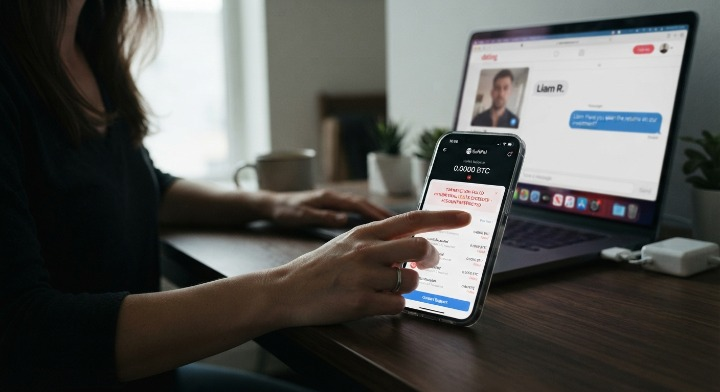
On November 13, 2026, a North Carolina consumer filed BBB Scam Tracker report #1476094 naming “SafePal.” The complainant says they met a man on a dating site who encouraged them to invest, and that a platform called SafePal later told them they had hit a withdrawal limit and needed to pay to continue. The reported loss is $6,500.
This SafePal Review summarizes one consumer-submitted report. FintechLegals hasn’t verified it. SafePal is the name of a real crypto wallet provider, and nothing in the report shows that the genuine company did anything wrong. The report doesn’t say whether the complainant used the real product or a lookalike.
The Report at a Glance
- Filed: November 13, 2026, by a North Carolina consumer
- Business name listed: SafePal
- Category: Investment scam
- Reported loss: $6,500 (self-reported, unverified)
- How contact began: a dating site
- Scammer location, email, phone, and website: unknown
What the Complainant Describes
According to the report, which hasn’t been verified:
- A man approached the complainant on a dating site, and they talked for a few weeks, including about investing.
- He said he used SafePal and had a relative who was a big stock investor, so he knew when to buy and trade.
- He offered to guide the complainant through the process.
- The complainant started with a small amount and received money back.
- He said the more they deposited, the higher the payout.
- The complainant made two more deposits and says withdrawals worked until the last attempt.
- They were told they had reached a withdrawal limit and needed to deposit $2,000 to become a “silver member” for unlimited withdrawals.
- They deposited $5,000. When they tried to withdraw, they were told their wallet was under investigation for fraud and they would have to deposit $6,000 to get their funds out.
The complainant adds that they should have stopped, but kept going because they had received money earlier. Many people in similar situations feel the same way. Early success is a documented tactic, and it doesn’t reflect poorly on the person.
Reading the Numbers Carefully
The complainant reports a loss of $6,500. The report also mentions a $2,000 “silver member” requirement, a $5,000 deposit, and a $6,000 demand. These can’t simply be added up. The report doesn’t say whether the $5,000 was a separate payment or part of the earlier deposits, whether any money came back, or how the $6,500 was calculated. The $6,000 was a demand, and the report doesn’t say it was paid.
About the Name “SafePal”
SafePal is the name of a well-known crypto wallet provider. The report lists it as the business, but gives no website, app name, or other detail showing which product the complainant used. Fake platforms and apps often copy the name or look of a real brand, and BBB’s notice says that legitimate business names are often used by scam artists.
That means two things are possible, and the report doesn’t say which one happened: the complainant may have used a lookalike platform that borrowed the name, or may have used a real wallet to send funds to a fraudulent platform. We make no claim about which.
Why “Withdrawal Limits” and “Membership Tiers” Are a Red Flag
A self-custody (non-custodial) wallet generally just holds your keys. It doesn’t normally hold your money on a server, set withdrawal limits, or require you to buy a membership to move your own funds. A platform that does these things is acting more like an exchange or an investment site, or it may not be the genuine product. [ADD: confirm against the provider’s official documentation how its wallet products work, and link it.]
Whatever the platform is, these are common warning signs:
- A “limit” that can only be lifted by paying more
- A “silver member” or other tier you have to buy to withdraw
- A claim that your account is “under investigation for fraud,” with a payment required to clear it
- Each payment leading to a new demand
Legitimate platforms may have verification steps or fees, but they disclose them up front and don’t make you pay a new, large sum each time you try to withdraw.
What We Checked
- The genuine provider’s official website and any statement about impersonation
- Whether the report gives any website or app name, and if so, the domain’s age and registrar
- Whether the app appears in an official app store, and under which publisher name
- Regulator warning lists and other public complaints, with links
- Any wallet addresses in the report, and what a block explorer shows
If nothing turns up, say so plainly.
Is This a Confirmed Scam?
No. A BBB Scam Tracker entry is an unverified consumer report, not a legal finding, and the business named can dispute it. The pattern the complainant describes, which starts with a dating-site contact, moves to investing, allows early withdrawals, and then demands payments, matches warning signs that consumer-protection agencies describe for investment and romance fraud. Treat it as a reason for caution, not as proof about any particular company.
Warning Signs of a Dating-Site Investment Scam
These are general signs, not findings about any named person or business:
- Someone you met online soon steers the conversation to investing
- A claim that a relative or “insider” knows when to trade
- Offers to “guide” you, especially through a platform they pick
- Small early gains and easy early withdrawals
- Higher payouts promised for bigger deposits
- Withdrawal limits, membership tiers, or “fraud investigation” payments
- Pressure to deposit more to recover what you’ve already put in
How to Check a Wallet or Investment Platform
- Get the app or site from the provider’s own website, not from a link someone sent you. Check the publisher name in the app store.
- Compare the web address with the provider’s official one, letter by letter.
- Be wary of any “wallet” that asks you to deposit money into an account on its site to access features.
- Search the platform’s name with “scam” or “withdrawal.”
- Check registration with FINRA BrokerCheck, the SEC’s adviser search, the NFA’s BASIC database, or your state securities regulator if it claims to offer investments.
- Test a small withdrawal first, and remember that early success isn’t proof.
- Never share your seed phrase or private keys, even with someone helping you.
- Be cautious of anyone you’ve only met online who gives investment advice, however friendly.
If You’ve Been Asked to Pay to Unlock Your Funds
- Stop paying. Each payment tends to lead to another demand.
- Save evidence: chats, usernames, wallet addresses, transaction IDs, receipts, and screenshots of the platform.
- Contact your bank, payment provider, or exchange as soon as possible.
- Report it to the FBI’s IC3 (ic3.gov), the FTC (reportfraud.ftc.gov), the dating site, and BBB Scam Tracker.
- If you connected a wallet or shared a seed phrase, move any remaining assets to a new wallet on a clean device, and don’t reuse the old phrase.
- Beware of recovery offers. People who contact you promising to retrieve your money for a fee are a common follow-up scam.
- Talk to someone you trust. These schemes thrive on secrecy, and it’s common to feel embarrassed. It happens to careful, intelligent people.
How FintechLegals Can Help
We offer crypto investigation, crypto assets tracing, fraud investigations, domain ownership investigation, and notice and takedown services. Blockchain analysis can document where funds went, though not every transaction can be linked to an identifiable person. No service can guarantee recovery or any legal outcome. Contact us.
Related Reading
Nebula Phantom, Passive Income Master, Keetaai.org, Celebrity Impersonation, Happy Dating Club
FAQ
Is SafePal involved?
The report names SafePal, but it doesn’t say whether the genuine wallet provider or a lookalike was used. SafePal is a real brand, and nothing in the report shows the genuine company did anything wrong.
Is this a confirmed scam?
No. The report is one consumer’s allegation, not a legal or regulatory finding.
Do real wallets have withdrawal limits or membership tiers?
Self-custody wallets generally don’t hold your funds or set limits, so a “wallet” that does may not be the genuine product. Confirm with the provider’s official channels.
What should I do if I’m told to pay to withdraw?
Stop paying, save all evidence, contact your bank or exchange, report it, and be wary of recovery offers.
Disclaimer: This article summarizes a consumer-submitted BBB Scam Tracker report. FintechLegals has not independently verified the allegations, and nothing here asserts that any person or company, including SafePal, committed fraud. Source: BBB Scam Tracker #1476094.
For more updates, follow us on LinkedIn.

Leave a Reply