


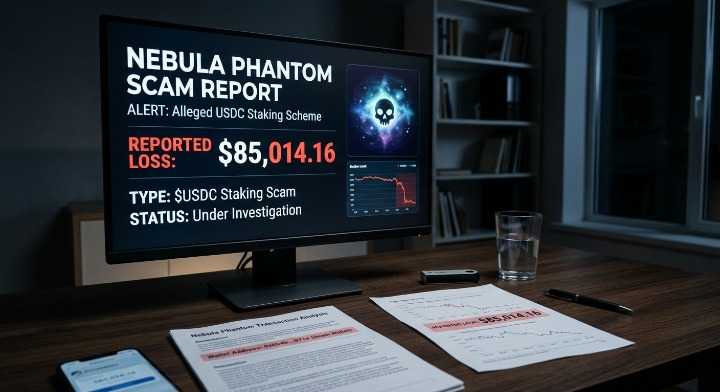
A consumer in Florissant, Missouri, has reported losing $85,014.16 after being directed to a cryptocurrency staking platform called Nebula Phantom, which used the website phantomstaking.app. According to a Better Business Bureau (BBB) Scam Tracker report filed October 30, 2026, the platform was presented as connected to the legitimate Phantom wallet. The claims below are the complainant’s allegations and have not been independently verified.
What Is the Nebula Phantom Investment Scam Report About?
The report (BBB Scam Tracker ID 1464327) is a consumer account of an alleged cryptocurrency investment scam. The complainant says the opportunity came from a man they knew through a business mentorship, whose advice they had come to trust. He allegedly described a high-yield savings or staking service tied to Phantom, a well-known crypto wallet provider.
The BBB entry lists “Agency Labs” in its business name field. That field alone does not establish who operated the platform, and this article draws no such conclusion.
How Did the Reported Nebula Phantom Staking Scheme Work?
According to the complainant, funds moved through three stages: a bank-to-exchange transfer, a transfer into a genuine wallet, and a final transfer to the staking platform. Only the last step involved Nebula Phantom.
The reported sequence:
- June 17, 2026: The complainant moved $85,000 of personal savings into Robinhood and bought USDC, a dollar-pegged stablecoin.
- After purchase: They installed the official Phantom app and sent the USDC to their own Phantom wallet.
- August 4, 2026: Following the mentor’s instructions, they sent cryptocurrency from that wallet to Nebula Phantom via phantomstaking.app, which reportedly advertised roughly 6.2% annual returns.
The distinction matters. The complainant says the wallet and exchange were legitimate. Nothing in the report suggests Phantom or Robinhood took part in any scheme. The complainant says they did not realize the staking destination might be a separate, unaffiliated platform. Using a real wallet to send funds to an outside address does not mean the wallet provider operates or endorses that destination.
Why Did the Investor Suspect a Cryptocurrency Staking Scam?
The complainant became suspicious after a failed withdrawal and a vanishing website. In October 2026, they tried to withdraw funds and were asked to verify a bank account through microdeposits. Those deposits never arrived.
Soon after, phantomstaking.app became inaccessible. Phantom support reportedly could not confirm the platform was legitimate, and the mentor stopped answering messages. The complainant says they have since reported the matter to the FBI’s Internet Crime Complaint Center (IC3), notified their financial institutions and preserved communications, transaction histories and blockchain evidence.
How Much Money Was Reportedly Lost in the Nebula Phantom Case?
The BBB report lists a loss of $85,014.16, against $85,000 in originally committed savings. The complainant says they are still tracing transactions to determine the exact amount sent to the suspected platform and how much remains unrecovered. The report does not say any funds have been recovered, and this article makes no such claim.
What Are the Warning Signs of Fake Cryptocurrency Staking Platforms?
Common red flags include borrowed credibility, unusually attractive returns and obstacles to withdrawing funds. These are general indicators seen in crypto investment fraud, not findings about any specific platform named here.
- Claimed affiliation with established wallets. A “Phantom” name on a website does not make it Phantom’s product.
- High, unverified yields. Returns that look easy and guaranteed deserve scrutiny.
- Transfers to unfamiliar addresses. Sending assets outside your own wallet is irreversible.
- Introductions through trusted relationships. Fraud often exploits personal or professional trust.
- Surprise withdrawal requirements. New verification steps, fees or deposits at cash-out time are a concern.
- Disappearing websites and silent contacts. Sudden inaccessibility and unanswered messages often follow reported losses.
How Can Investors Verify a Cryptocurrency Staking Platform?
Verify independently before sending funds. Find a provider’s official website through its verified channels rather than a link someone sent you, and confirm any claimed partnership directly with the wallet provider.
- Never assume a third-party service is affiliated with your wallet.
- Read staking terms, lock-up periods and withdrawal conditions in advance.
- Check business identities and regulatory registrations where applicable.
- Review destination wallet addresses and transaction details before confirming.
- Be skeptical of unusually attractive returns.
- Never share recovery phrases or private keys with anyone.
What Should Victims Do After a Cryptocurrency Investment Scam?
Act quickly and document everything. Early records improve any later investigation.
- Save transaction hashes, wallet addresses and screenshots.
- Keep all messages, emails and call records.
- Contact exchanges and banks involved.
- Report to the FBI IC3 for US-related incidents.
- Beware of “recovery services” that guarantee results or demand upfront fees, which are themselves a common scam.
How Can FintechLegals Help With Cryptocurrency Fraud Investigations?
FintechLegals provides services covering financial fraud investigations, cryptocurrency investigations, crypto asset tracing, due diligence, claims and disputes, and digital forensic analysis. These can help examine suspicious transfers and map transaction trails, though outcomes depend on the facts and no recovery can be guaranteed.
Relevant services include Crypto Investigation, Crypto Assets Tracing, Forensics and Data Analysis, Fraud Investigations and Due Diligence Services. Blockchain analysis can document how funds moved between addresses, which may support reports to authorities or financial institutions.
Victims of suspected crypto fraud can contact FintechLegals to learn more about their investigation options.
Source: BBB Scam Tracker Report #1464327, https://www.bbb.org/scamtracker/lookupscam/1464327 (reported October 30, 2026). Allegations are the complainant’s and not independently verified.
For more updates, follow us on LinkedIn.

Leave a Reply