



When conducting cryptocurrency investigations, the following data is usually obtained: Transaction IDs, wallets address (both sender and receiver), accounts on the exchange site, as well as any other data like screenshots, emails, chats, webpages, payment slips, and so on. Although the volume of evidence needed may differ depending on the circumstances, the more complete the evidence package, the easier it is for investigators to understand the process.
What Evidence Is Needed for a Cryptocurrency Investigation?
There is no single checklist that applies to every case. A stolen-wallet incident, a fake investment platform, and a romance-scam-related transfer each generate different types of evidence. That said, most cryptocurrency investigations rely on two broad categories of information: on-chain data (transaction hashes, wallet addresses, blockchain records) and off-chain documentation (exchange records, communications, website information, and fiat payment records).
Investigators generally start with whatever evidence is available and build outward from there. A single transaction hash or wallet address can be enough to begin a preliminary review, even if a complete evidentiary picture takes longer to assemble. Understanding what to preserve—and what to avoid doing—can materially affect the quality of an investigation.
1. Cryptocurrency Transaction Details
Transaction-related details serve as the initial source of data when investigating any cryptocurrency. These are:
- Hash/Transaction ID or TXID, which is an individual transaction’s unique number
- Sender(s)’ wallet address/es
- Receiver(s)’ wallet address/es
- Blockchain/network where the transaction took place (e.g., Bitcoin, Ethereum, Tron, BNB Chain)
- The approximate date and time of the transaction
- Type and quantity of cryptocurrency
- Screenshots or transaction confirmations from a wallet or exchange site
Transaction IDs are particularly helpful because they enable investigators to pinpoint the transaction on the blockchain and start tracing the movement of the funds after the initial transaction. The absence of a TXID makes it harder to trace cryptocurrency transactions, although it still can be done using only approximate timestamps and quantity.
2. Wallet Addresses and Blockchain Information
Wallet addresses enable investigators to track the transfer of digital assets from point to point on a blockchain network. Since the majority of public blockchains are open ledgers, it may be relatively easy to see that funds were transferred from Wallet A to Wallet B, to Wallet C, and so forth.
Yet, the wallet address itself may not identify the party behind the wallet. It is important to distinguish between three inter-related, yet different notions:
- Identification of a wallet – recognition that the specific wallet exists and has transactions
- Transaction tracing – tracking of movements of funds from one wallet to another
- Attribution of a wallet to a certain person or entity – linking the wallet to the actual identity
The first two are usually possible via blockchain analysis. The latter needs other evidence – for example, records from exchanges, obtained by legitimate means, off-chain intelligence, or voluntarily disclosed information by a platform. There is no such thing as certainty that any investigator will ever attribute a certain wallet to a specific person or entity.
3. Crypto Exchange and Account Records
As the funds flow through the exchange, there might be some information retained by the exchange itself, which will not be seen on the blockchain. The pieces of information that could be helpful to investigate are:
- Account registration data
- Data on deposits and withdrawals
- Transaction history associated with the account
- Internal ID number or user ID of the account
- Confirmation of payments or withdrawals
- Timestamp related to the activity of the account
- Email or any other message from the exchange
This type of information will help us link the wallet address to the real person, although it can be accessed only via legal procedures depending on the jurisdiction. It is one of the reasons why the cryptocurrency investigation usually encompasses more than just the blockchain analysis.
4. Communications With the Suspected Scammer or Counterparty
Discussions in relation to a transaction may be useful to show intent, instructions, and representations made to a victim. If legally obtained, it would be wise to preserve:
- E-mails
- Messages sent via WhatsApp, Telegram, or Signal
- Texts
- Convo on social media or direct messages
- Usernames/handles
- Phone numbers
- Profiles links
- Recordings of voice messages, if legally obtained
- Instructions given by the counterparty in relation to making payments
This information will be useful in proving the context of the transaction, such as whether payments were made following certain representations or instructions. It is best to preserve the entire conversation rather than just the one message at a time.
5. Websites, Domains, and Online Platform Information
There are numerous scams with cryptocurrencies that originate from or are promoted via websites, apps, or social media platforms. The evidence includes, but is not limited to, the following:
- Website and/or sub-page URLs
- Domain name
- Screenshot of the platform or listing
- Name of the platform/company
- URL of the account/profile
- Promotional content for the platform
- Social media accounts connected with the platform
- Contacts offered by the website
- Information about the investment platform/product
All of the above can be useful in connecting the cryptocurrency exchange transaction with an overall online enterprise, which may assist in investigate a suspicious crypto company and finding out the actual identity behind the offer. It is also necessary in situations where there are anonymous or unregistered websites to cinvestigate an anonymous website or domain.
6. Bank, Card, or Fiat Payment Records
Most cryptocurrency cases, in most instances, would require further investigation not only through the blockchain but through the initial fiat transaction involved in the cryptocurrency transaction or transfer. These include:
- Bank records showing transfer of funds out
- Verification of wire transfer
- Records of credit or debit card transaction
- Payment processor documentation (such as third-party payment applications)
- Purchase confirmation/invoice
- Receipt
- Recipient/beneficiary account information
The information will help establish the relationship between a fiat transaction and the cryptocurrency transaction, for example, that there is a bank transaction before any questionable cryptocurrency transactions.
7. Screenshots and Digital Documents
Screenshots may include details such as account balances, messages, confirmations, or information from a web page at a specific time point. However, screenshots have some drawbacks too. The investigator needs to evaluate the relevance and the context of the screenshot and not rely on it as the only piece of evidence since screenshots can always be manipulated.
It is recommended that whenever possible, one should save the original file, recording or the export from the platform, rather than the screenshot. Do not manipulate, cut out, or alter the content in any way, which will reduce its evidentiary value.
8. Identity and Background Information
Information regarding the suspected person, organization, social media, or the entity may also be useful, and some examples of information may include:
- Person’s name (real or assumed)
- Company name
- Email ID
- Contact number
- Social media handles
- Platform where the incident took place
- Jurisdiction (assumed or real)
- Any wallet or payment information
- Information regarding company registration (if any)
- User names
However, it must be noted that providing such information alone does not make anyone liable for any fraudulent activities. Such information simply provides more avenues for fraud investigation.
9. What Should You Do With Crypto Evidence?
Preserving evidence properly can make a meaningful difference in how effectively it can later be reviewed. General guidance includes:
- Preserve original records rather than only summaries or notes
- Save transaction hashes exactly as they appear
- Record wallet addresses accurately, character by character
- Keep all communications, including full message threads
- Preserve URLs and, where possible, archived copies of web pages
- Keep relevant emails, including headers where feasible
- Document dates, amounts, and the sequence of events
- Avoid deleting messages, even ones that feel irrelevant
- Avoid altering, cropping, or editing screenshots
- Maintain a chronological written record of what occurred
Importantly, never share seed phrases, private keys, passwords, or authentication/two-factor codes with an investigator, lawyer, website, or anyone claiming they can recover your funds. No legitimate investigator or recovery service needs this information, and sharing it can result in further loss of funds.
How Investigators Analyze Cryptocurrency Evidence
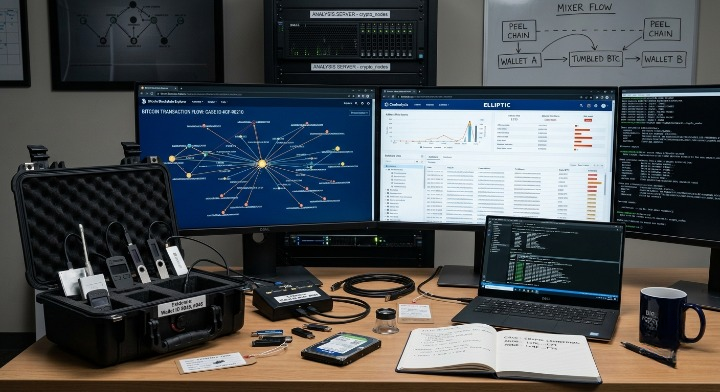
At a high level, a cryptocurrency investigation generally follows a process similar to this:
- Assess the existing evidence from the client/victim
- Identify the transaction hashes and wallet addresses pertaining to the case
- Assess the blockchain transactions
- Trace the movement of the digital currency between the wallets and, where feasible, the exchanges
- Identify other evidentiary sources for investigation, such as the pertinent exchanges and services
- Compare the evidence collected from the on-chain analysis by way of blockchain transactions with the off-chain evidences
- Develop investigative leads from the evidence gathered
- Develop findings which may be presented in the form of an investigative report
It is not guaranteed that each investigation process will result in identifying the individual associated with the wallet.
Can Cryptocurrency Evidence Identify a Wallet Owner?
Usually not on its own. Transactions made using blockchain technology are usually transparent, but even in such cases, the only thing that can be observed is the movement of digital currencies from one address to another. Unless there is some other information available, such as KYC data obtained by legal means from exchanges or other sources, a single wallet address cannot provide any identity details of the holder of such an address.
Can Deleted Crypto Scam Messages Be Recovered for an Investigation?
Occasionally, yes, but not always. In most cases, the possibility of retrieving deleted messages will depend on the messaging platform used and the other technical issues, like backups and cloud accounts. It is important to note that it is not possible to retrieve deleted messages in all cases.
What If I Don’t Have All the Evidence?
It is also very likely that victims or companies will not initially have complete proof at hand when reaching out. However, offering what evidence is available in a valid form remains helpful, which includes such examples as:
- One transaction hash
- One wallet address
- Exchange receipt
- Transaction or chat screenshot
- Relevant email
- Website or platform link
- Bank/card payment confirmation
In most cases, the investigator will be able to see what information was offered and determine what other evidence would be helpful. For those who are not sure of the first steps to take, information on how to report a cryptocurrency scam will also be useful.
Frequently Asked Questions
What evidence is needed for a cryptocurrency investigation?
Typically, transaction hashes, wallet addresses, exchange records, and supporting documentation such as communications, screenshots, and website details. The specific evidence needed varies by case and jurisdiction, but more complete records generally support a more effective review.
Can a crypto transaction be traced with a transaction hash?
A transaction hash allows investigators to locate a specific transaction on a public blockchain and observe where funds moved afterward. It doesn’t guarantee identification of who controls the receiving wallet, but it’s a useful starting point for tracing.
Can a wallet address identify the person who owns it?
Not by itself. A wallet address shows blockchain activity but rarely reveals a real-world identity without additional evidence, such as exchange records or other off-chain information obtained through lawful means.
What information is needed to trace stolen cryptocurrency?
Helpful information includes the relevant transaction hash, sending and receiving wallet addresses, the blockchain used, approximate date and amount, and any exchange or platform involved in the transfer.
Can crypto exchange records help an investigation?
Yes, where legally available. Exchanges may hold account information, deposit/withdrawal history, and identity verification records that aren’t visible on the public blockchain, subject to applicable legal process.
Can deleted crypto scam messages be recovered?
It depends on the platform, device, and backup settings involved. Some deleted messages may be recoverable through backups or platform logs, but recovery is never guaranteed.
What should I do after losing cryptocurrency to a scam?
Preserve all available evidence, avoid contacting parties claiming they can recover funds in exchange for upfront payment, never share private keys or seed phrases, and consider reporting the incident to relevant authorities and seeking an investigative review.
Can screenshots be used as evidence in a crypto investigation?
Yes, but their reliability depends on context. Investigators typically evaluate screenshots alongside other evidence rather than treating them as independently conclusive, since screenshots can be altered or lack full context.
How long should cryptocurrency evidence be preserved?
Evidence should generally be preserved indefinitely until an investigation or legal matter is resolved, since retention requirements and statutes of limitations vary by jurisdiction and case type.
What happens after a cryptocurrency investigation?
Findings are typically compiled into a report summarizing the evidence reviewed, transaction flows identified, and any investigative leads developed. Depending on the case, findings may support legal action, regulatory reporting, or further inquiry.
Conclusion
The quality and completeness of the evidence that is collected may substantially influence how effective the cryptocurrency investigation will be in assessing transactions, finding leads and supporting the following procedure of law enforcement or report filing. Transaction hashes, wallet addresses, exchanges, communication records and financial documentation are all helpful in such a case, and even incomplete evidence may give valuable grounds for the investigators.
Due to the fact that the laws, rules of evidence collection and disclosure obligations may differ depending on the jurisdiction, it is recommended that those who have faced cryptocurrency fraud or losses should receive consultation which is suitable to their particular situation. FintechLegals is willing to help in cryptocurrency investigation, tracing, due diligence and fraud investigation issues, but cannot guarantee recovery of money or finding responsible parties.
For more updates, follow us on LinkedIn.
Leave a Reply