



Introduction: Deleted Does Not Always Mean Gone
Deleted messages surface constantly in fraud investigations, cybercrime cases, corporate disputes, and financial-crime inquiries. A party may claim a conversation never happened, or a critical exchange may vanish just before litigation begins. This raises a question investigators, lawyers, and compliance teams ask often: can deleted messages be recovered for an investigation?
The honest answer is: sometimes, but not always. The possibility of recovery is dependent upon the device, the software used, the method of data storage, availability of backup and elapsed time. It is here that the usefulness of cyber intelligence technology comes into play, not to facilitate recovery, but to identify systematically whatever evidence still exists.
Can Deleted Messages Be Recovered for an Investigation?
While deletion hides the message from sight, the original data may not be immediately removed in all cases, depending on the medium. This could be due to:
- Storage media on the device, where the deleted item could still exist until new data writes over the space
- Databases within the application, where the record could still exist even after being deleted from the user interface
- Local caches, temporary files, or notification logs
- Backup copies of the device or application in the cloud, prior to deletion
- Linked accounts across several devices
- Server-side data kept by the hosting company, depending on their retention policy
- Metadata associated with the message or attachment and timestamps
- Operating system or application logs
This is not assured. Modern apps increasingly use disappearing-message features, end-to-end encryption, and prompt server-side deletion, all of which can make recovery difficult or impossible. Recovery possibilities genuinely vary from case to case, and any investigation should start by determining what data sources actually exist before assuming a message can be restored.
How Cyber Intelligence Tools Support Message Investigations
Cyber intelligence tools generally don’t “recover” deleted content on their own. Their strength lies in collecting, organizing, and correlating digital information from multiple sources — connecting accounts, devices, IP addresses, or domains where lawfully accessible, and building timelines out of scattered data points.
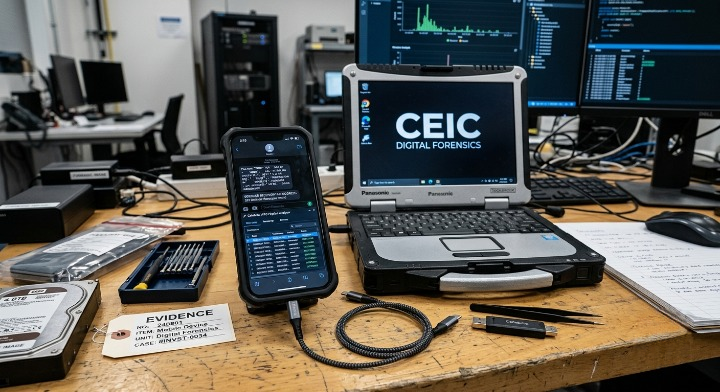
This is distinct from digital forensics, which focuses on technically extracting and preserving evidence from a specific device or system in a legally defensible way. Digital forensics and cyber intelligence go hand in hand, since forensics allows for the uncovering of any artifacts from the device or account, while intelligence will help to determine any patterns or relations within the gathered data.
What Happens When a Message Is Deleted?
Though the deletion of a message causes its visible removal, this does not necessarily result in the erasure of all the traces it leaves behind. It is not uncommon for data to be stored in databases, cached files, and backups, long after being removed from the viewable interface.
However, several factors work against recovery: encryption, secure-deletion mechanisms, storage overwriting, and provider retention limits. As storage fills and new data is written, previously deleted content is increasingly likely to be permanently unrecoverable.
Evidence Beyond the Message Itself
Investigations don’t always hinge on recovering the exact deleted text. Related evidence can often establish that a communication occurred, including:
- Timestamps and account-activity logs
- Login records and device information
- IP-related records
- File and attachment metadata
- Email records and transaction data
- Backups and application logs
- Other, related communications
Correlating these artifacts can reconstruct a credible timeline even when the original message itself cannot be restored.
Why Evidence Preservation Matters
Digital evidence is fragile. Casually accessing a device or account can alter or destroy artifacts before they’re properly documented. CISA notes that digital forensics involves analyzing evidence collected from cybersecurity incidents, and its incident-response guidance stresses establishing proper means to collect forensic evidence early. Controlled procedures, documentation, and chain-of-custody practices matter if evidence may later be used in legal proceedings.
Legal and Privacy Considerations
Access to private correspondence, cloud-based storage, or provider databases may involve various forms of legal action, including consent, privacy legislation, or other proceedings, depending upon the country. This article is only general information, not legal advice. Companies involved in any kind of lawsuit should contact competent legal and forensic specialists.
When Professional Cyber Intelligence and Digital Forensics Help
Professional assistance may be required in situations when there is a suspicion of financial fraud, cybersecurity, internal threat, cryptocurrencies, data breach, hacked accounts, or litigation associated with digital communication channels. The work of FintechLegals is aimed at helping investigators and legal specialists properly assess the possible benefits of the available digital evidence.
FAQ
Is it possible to recover deleted messages for investigation?
This is not always possible. This depends on many factors, including the type of device, app, existence of backups, and time passed after deletion. There is no 100% guarantee, which means investigators have to examine potential data sources individually.
How does cyber intelligence software assist in investigations?
It collects, structures and correlates digital data from different accounts, devices and indicators, enabling investigators to detect patterns that cannot be noticed based on just one data source.
Is it possible to recover messages from a deleted account?
Again, this is not always possible. It depends on the service provider’s policy regarding the storage of information, on backups, on synchronization of devices, etc. Some data could be available in the server or in backups, while other data could be irretrievably lost.
What other evidence can be used to prove the fact of communication?
Timestamps, login and device information, metadata, backups, and other related communications can provide proof that communication took place despite the lack of the message itself.
How should digital evidence be preserved?
With the use of proper forensic techniques, without changing devices or accounts and by documenting all actions.
For more updates, follow us on LinkedIn.
Leave a Reply