



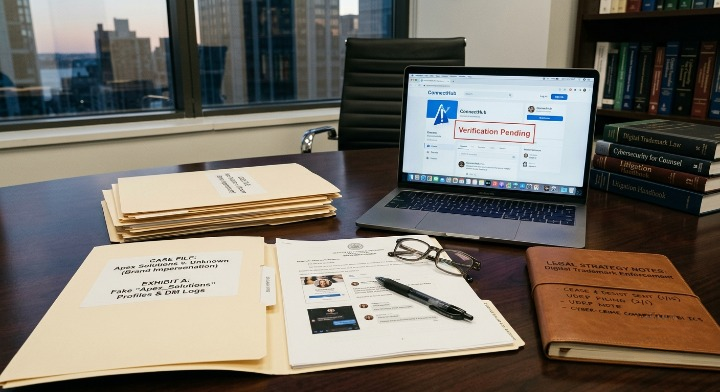
Brand impersonation on social media happens when someone sets up an account that pretends to be your business or your staff. Businesses can usually respond by documenting the account, reporting it through the platform’s process, warning customers, and, where the facts support it, pursuing legal or investigative steps. None of these routes guarantees removal or identification. It all depends on the evidence, rules of the platform, and the law in question.
Typically, phishing pages replicate the name, logo, profile picture, information about the website, or the identities of the actual employees of the business. This is especially true for fintech startups, cryptocurrency exchanges, and financial platforms because customers entrust their money and identity to such brands.
What Is Brand Impersonation on Social Media?
Brand impersonation on social media is a term used to describe the process of establishing a social media profile which mimics an actual representative of a corporate entity, using, for example, the name or logo of a business organization.
However, not all such cases where someone uses your name are illegal. These are different cases:
| Situation | What it means | Automatically unlawful? |
| Brand impersonation | Account pretends to be the company | Depends on facts and jurisdiction |
| Fake business profile | Invented business page copying yours | Often violates platform rules |
| Executive/employee impersonation | Fake profile of a founder or staff member | Often violates platform rules; may support other claims |
| Trademark infringement | Unauthorized use of a protected mark likely to confuse consumers | A legal claim with specific requirements |
| Phishing account | Account built to harvest credentials or funds | May involve fraud |
| Parody or fan account | Clearly labeled commentary or tribute | Often permitted |
| Criticism or commentary | Honest opinion or review | Generally not impersonation |
How Do Fake Social Media Accounts Impersonate Businesses?
An imposter creates all those aspects which make the account seem genuine. There are certain common ways to do it. Those include:
Replicating logos/profile pictures.
- Creating usernames similar to the usernames used by the actual accounts (just one letter changed, an added underscore, or a swapped letter).
- Posing as customer care.
- Being a CEO, founder, or an employee.
- Selling fraudulent investments.
- Sending phishing emails to customers.
- Providing links for clone sites.
- Organizing fraudulent giveaways/cryptocurrency campaigns.
- Creating fake Telegram/WhatsApp groups.
- Making false statements about the products/services of the company.
Hypothetical example: a fake “support” account replies to a customer’s public complaint about a delayed withdrawal and moves the conversation to private messages. It then sends a link to a cloned login page. The customer never contacts the real company until the money has moved.
What Should a Business Do When Someone Impersonates Its Brand?
Document first, then report. Record everything that is important, save the proof, check that the account does not belong to you, report it via the platform, and alert your customers officially. In case of any fraud or website scam, contacting an attorney or an investigator would be helpful.
- Locate the impersonator account. Record the precise link of the profile, its name, the platform, and its activities.
- Save the evidence. The evidence includes screenshots, messages, profiles, advertisements, and the timestamp.
- Check for impersonation. Compare the account with your genuine official profiles.
- Report the account. Use the platform’s impersonation or intellectual property process.
- Notify affected customers. Where appropriate, post a factual warning on verified channels.
- Review legal options. Consider trademark, fraud, privacy, or other applicable grounds.
- Investigate associated websites. If the profile points to a suspicious site, preserve the URL and consider a domain ownership investigation.
- Seek professional help where needed. See the last section below.
How Can You Report a Fake Business Account on Social Media?
Each platform has its own process, and impersonation and trademark claims often go through different forms. Use the impersonation route for fake identities and the intellectual property route when your registered mark or copyrighted material is being used. Menus change, so confirm the current steps before filing.
- Instagram. Impostor accounts can be reported in the app, including accounts pretending to be a business or organization, and there is a form for people without an Instagram account. Instagram also hosts a dedicated impersonation report form. The impersonation report path covers pretending to be someone or something, not other kinds of misrepresentation, and reports are anonymous except for intellectual property reports. Trademark and copyright claims use separate IP forms.
- Facebook. Use the Report option on the Page or profile (look for options such as pretending to be someone, or fake account). Meta also offers an impostor-account form that can be used without a Facebook account, with an option for someone who created an account for a business or organization. Use Meta’s IP reporting channels for trademark claims.
- X (formerly Twitter). Accounts posing as a person, group, or organization in a confusing or deceptive way may be suspended, and an authorized representative can file a report without an X account. Businesses reporting misuse of trademarks or brands should file under X’s trademark policy.
- LinkedIn. From the profile, open More, choose Report/Block, and select the option that the person is impersonating someone or that the account is not a real person.
- TikTok. Report from the profile in the app, or use TikTok’s Help Center impersonation form. Trademark and copyright complaints have their own forms.
- Telegram. Use the in-app Report function on the account, channel, or group. Telegram’s FAQ lists additional abuse contacts, and its reporting options are more limited than those of larger platforms.
- WhatsApp. Report the contact or group from the chat details screen, and use Settings > Help > Contact Us for scam reports. Because messages are end-to-end encrypted, WhatsApp’s review generally depends on the reported profile details and what the report sends to it.
What Legal Action Can You Take Against Brand Impersonation?
Which remedies exist depends on the facts, the evidence, and the jurisdiction. The principles below are U.S.-based; other countries use different rules and terminology.
- Trademark infringement. In the U.S., the Lanham Act allows claims where use of a mark is likely to cause confusion about source. For registered marks, 15 U.S.C. § 1114(1) covers use of a reproduction, copy, or colorable imitation that is likely to confuse or deceive, and owners of unregistered marks may also have claims. Registration helps, but it does not guarantee a platform will remove an account.
- Passing off / unfair competition. This applies when a third party falsely presents its activity as connected to your business. In the U.S., it arises under federal and state unfair-competition law; “passing off” is a distinct tort in the UK and some Commonwealth countries.
- Fraud and identity-related offences. If the account is used to deceive customers or obtain money or sensitive data, state and federal fraud and identity laws may apply. These are usually pursued through law enforcement rather than by the business.
- Copyright infringement. If logos, pictures, or text are copied, then a copyright takedown notice might be appropriate. In the U.S., that is the DMCA process under 17 U.S.C. § 512.
- Defamation. This concerns false statements of fact that harm reputation, not identity misuse. See the defamation section below.
- Civil proceedings. The company can pursue its legal remedy through the courts if it has a case, including an injunction to prevent the behavior or even monetary damages.
These are distinct legal matters and should not be considered synonymous. There is no violation of the law simply because of a fraudulent account.
Can You Get a Fake Social Media Account Removed?
Often yes, but not always. Platforms can remove accounts that breach their impersonation, fraud, or intellectual property policies. Whether a particular account comes down depends on the platform’s rules, the quality of your evidence, and the applicable law. A platform policy is a contract-style rule, not a statute.
What usually helps:
- Following the platform’s own reporting procedure.
- Clear supporting evidence.
- Trademark documentation, where you are making an IP claim.
- Proof that you own the genuine official accounts.
- A formal notice where appropriate, such as a notice and takedown request.
- Escalation if the first report is rejected or ignored, usually by resubmitting with clearer evidence or using a different reporting category.
Can You Identify Who Created a Fake Social Media Account?
Sometimes partially, and often not definitively. Identification usually depends on pulling together several indicators rather than any single one. Useful sources include:
- Publicly available profile information.
- Associated websites and domains.
- Public contact details.
- Links between multiple accounts.
- Other relevant digital evidence.
- Platform-held records, available only through lawful disclosure processes.
An IP address, username, or similar technical indicator does not by itself prove who a person is. Access to a platform’s private records generally requires a legal process such as a court order, and platforms may resist or be legally restricted in what they can release.
What If a Fake Account Is Using Your Brand to Promote Crypto Scams?
Treat it as potential fraud as well as impersonation. Fake profiles may be used to:
- Promote fraudulent cryptocurrency investments.
- Pretend to represent a legitimate exchange.
- Offer fake customer support.
- Ask for wallet transfers.
- Distribute phishing links.
- Promote fraudulent token sales.
- Direct users to cloned investment sites.
Where transactions are involved, blockchain tracing may help document how funds moved, because many blockchains are public ledgers. It does not by itself identify the person behind a wallet, and funds that pass through mixers or multiple chains can be harder to follow. A cryptocurrency investigation can organize that on-chain evidence for lawyers, exchanges, or law enforcement.
Can a Business Take Legal Action Against an Anonymous Impersonator?
Anonymity does not necessarily prevent legal action, but finding the responsible person can be hard and is never assured. The usual building blocks are:
- Evidence preservation.
- Legal notices to platforms and hosts.
- Platform reporting.
- Court-authorised disclosure where a court compels a provider or platform to disclose some particular records
- Civil procedures
- Fraud investigations that can possibly link accounts, domains, and payment routes
- The extent to which this can go depends on jurisdiction, the kind of records available in the platform and whether the operator has any software to hide his identity.
What Is the Difference Between Brand Impersonation and Online Defamation?
Brand impersonation is an account falsely presenting itself as your company or someone affiliated with it. Online defamation is content containing allegedly false factual statements that may unlawfully harm a person’s or business’s reputation.
A fake account can involve impersonation without defamation, for example when it posts nothing false about you but poses as your support team. The reverse also happens: a real account can publish defamatory claims without impersonating anyone. Negative reviews or harsh opinions are not automatically defamatory, and the legal tests vary by jurisdiction. If false statements are being published about your business, see FintechLegals’ online defamation services.
How Can Businesses Prevent Social Media Brand Impersonation?
No measure eliminates the risk, but these steps make impersonation easier to spot and harder to exploit:
- Maintain clearly identified official accounts.
- Link your official profiles from your website.
- Monitor your brand name and common username variations.
- Protect business accounts with multifactor authentication.
- Set up an internal process for reporting impersonation.
- Train staff to recognize fake executive accounts.
- Warn customers that you will never ask for wallet transfers, seed phrases, or private keys in direct messages.
- Keep records of repeat incidents.
Frequently Asked Questions
1. How can I respond to a fake business account being made in my business’s name?
Make sure that you have the profile URL, username, and any other proof you can find and then contact the IP process on that platform, along with informing your clients through your legitimate channels. Should there be a question of money and/or credentials, report it to the necessary authorities as well.
2. Is impersonating a business on social media an illegal activity?
This question has no straightforward answer and will depend on the circumstances as well as the business in question. Generally, impersonation is illegal and also against the policies of that platform, particularly in cases where there is deception involved or where money or credentials can be obtained.
3. How can I have a fake Instagram or Facebook account deleted?
Possibly, but not in all cases. Both these social media platforms have a process for reporting impersonations. Then, there is an IP report if there are any issues with trademarks or copyrights involved. The outcome may, however, depend on several factors.
4. Can I file a lawsuit against an impersonation of my business?
Maybe. Involvement of trademark infringement, unfair competition, fraud, defamation, etc., would depend upon the situation. Lawsuits need evidence, and in an anonymous case, revealing the identity may involve legal intervention. It would be better to seek legal advice from a lawyer in this field.
5. How do I report a fake social media account?
One needs to report the account using the reporting feature on that particular platform: either the Report button on the profile itself or the platform’s impersonation or IP form. Attach screen captures, the URL of the fake profile and any proof that you have the real accounts.
6. What evidence do I need to prove brand impersonation?
The URL of the fake profile and its username, screen captures with dates, your real website and profiles and any documentation relating to trademarks or registration of the brand. Complaints from customers, fake messages, other websites and transactions make the case even stronger.
7. Can a fake social media profile be taken down in the absence of trademark registration?
Absolutely, in most instances. The websites will usually consider impersonation cases on grounds of identity abuse without requiring the trademark to be registered. The trademark registration could help in filing an IP case; however, the lack of registration does not necessarily mean that removal will not occur.
Next Steps
If there is a fake account replicating your business, then we at FintechLegals could assist you further. You can explore its notice and takedown services to get started. Where false statements or suspected fraud are also involved, its online defamation and fraud investigation teams can look at those parts of the case too.
For more updates, follow us on LinkedIn.

Leave a Reply