


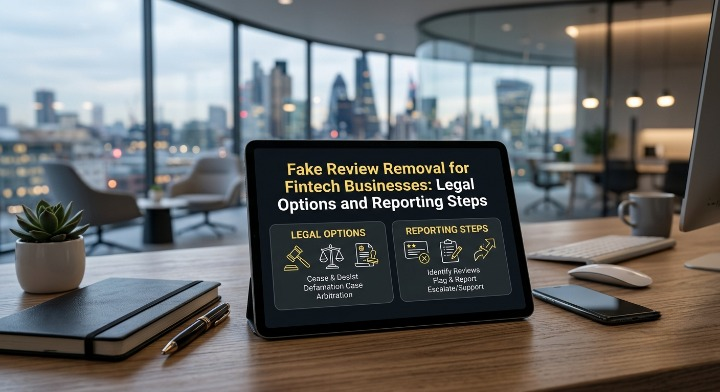
Is there any way to delete the fake reviews about a fintech or cryptocurrency company? Yes, but only in some cases. There are chances of deleting the review when it goes against the rules of the platform or when it is illegal under the law.
What Counts as a Fake Review for a Fintech or Crypto Business?
A false review is a review that does not represent the real experience of a consumer. For instance, the definition of a false review according to Trustpilot is “reviews which do not represent a real experience.” Common examples in financial services:
- A reviewer who was never a customer, or a competitor posing as one
- Fabricated transaction stories, such as a withdrawal that never happened
- Impersonation of real customers or employees
- Clusters of reviews from newly created or linked accounts
- Demonstrably false factual allegations
- Threats, harassment, or exposure of private information
A negative review is not fake simply because it is unflattering. A statement such as “support was slow and unhelpful” is opinion about a real experience. “This exchange froze my funds and stole them” is a factual claim that can be checked and, if false, may be defamatory. That distinction drives every decision below.
How Can Fake Reviews Affect Fintech and Cryptocurrency Businesses?
False reviews can erode trust where trust matters most. The possible consequences will be:
- Decreased trust of potential customers and their reluctance to work with you
- Worry for investors, banks, or payment services
- Extra work on handling fake complaints
- Confusion when imposters represent your team and send clients to scam sites
Different companies have different impact levels; the mere existence of a bad review will not lower your search results. Do not speculate but assess the real damage.
How Can You Identify a Fake or Suspicious Online Review?
Warning signs deserve attention but don’t prove anything on their own. Look into it before pointing fingers.
- The transaction described doesn’t correspond with any records you have on hand.
- There are multiple reviews that all contain the same wording.
- Multiple reviews suddenly crop up.
- The reviewer says he/she speaks for someone else.
- Facts like dates, amounts or features are wrong.
- The account is linked to impersonation.
- Threats or demands for payment are present in the review.
Genuine customers sometimes use a different name or email than the one on file, so check records carefully first.
How Do You Report Fake Reviews on Google?
You report a policy-violating review through your Business Profile, but Google removes only reviews that violate its policies. A disagreement with the content is not enough. The general process:
- Read Google’s reviews policy and identify which rule the review breaks, such as fake engagement or impersonation.
- Save screenshots, the review link, and the reviewer’s profile details.
- Report the review from Google Maps, Search, or the Reviews Management Tool.
- Track the status. “Report reviewed – no policy violation” means Google found no breach.
- Use the appeal option if eligible. Google’s documentation describes a one-time appeal of up to 10 reviews through the Reviews Management Tool.
Be specific about the violated policy, since “this is unfair” is not a policy basis. Google’s process can also differ by region, so check the current help page.
Can Fake Reviews Be Removed From Trustpilot and Other Review Platforms?
Yes, if they breach platform rules. Trustpilot says it removes fake reviews, and businesses can flag reviews through their business account or by contacting its Content Integrity team. Its guidelines say a review is not removed just because a business finds it unfair or critical. They also say flagging should be fair and consistent, and that misuse of the flagging tool is not tolerated.
Across platforms, expect to:
- Read the platform’s own content policy first
- Choose the accurate reporting reason
- Supply evidence, such as records showing no matching customer
- Allow for moderation review, which may include a request to the reviewer to edit
- Use any appeal or escalation route offered
Procedures differ, and no platform guarantees removal. Check each platform’s current documentation before relying on a process.
Can a Business Identify an Anonymous Fake Reviewer?
Sometimes, but not always, and anonymity alone proves nothing. Legal methods may include:
- Checking out the individual’s public profile details, review history, and post history.
- Checking the information with your own records.
- Asking the online site or service for the information, which generally involves a legal process.
- Seeking court-ordered discovery if the law allows.
Do not resort to hacking, stalking, or deception. They can be unlawful and can undermine a later claim. An IP address does not by itself identify a person, and platforms may not hold or release identifying data.
What Evidence Should You Collect Before Requesting Fake Review Removal?
Gather and preserve:
- Review URL and platform name
- Reviewer username and public profile
- Date and time of publication
- Full-page screenshots of the original review
- Transaction or customer records showing no matching account (minimized and securely handled)
- Evidence of impersonation
- Related emails, tickets, or messages
- Documents showing why a statement is factually wrong
- Records of previous platform reports and responses
- Relevant corporate or licensing documents
Keep originals unaltered and restrict access. Never publish customer data to rebut a review, since that can create privacy and regulatory exposure of its own.
What Is the Difference Between Fake Review Removal and Online Defamation Services?
Fake Review Removal consists of reporting reviews that have violated the rules on the platform or taking legal action if the content is eligible for removal. The Online Defamation Service entails analyzing whether the statement is potentially defamatory and weighing whether platform-based action or legal action should be taken. They are not the same. A fake review that lacks any false factual assertion might be a matter of the platform rules, while a realistic review that has a false statement may pose legal challenges.
According to FintechLegals, their Online Defamation Services entail investigating the possible source of the potentially defamatory content, documenting its publication and analyzing potential remedies. The Notice and Takedown Services entail sending formal notice to the right party, which may be the platform, host, or registrar. Neither can guarantee removal.
What Should a Crypto Business Do If Competitors Post Fake Reviews?
- Protecting the reviews and all related evidence.
- Reviewing the evidence against platform rules.
- Looking into the possibility of coordination without assuming guilt.
- Recording relevant business documentation.
- Reporting through appropriate platform channels.
- Consulting a lawyer when evidence points toward an illegal act.
- Monitoring and acting professionally as required.propriate.
One should not make public accusations towards a competitor unless he has evidence for that. In case the reviews point out a cloned website, then conducting a domain ownership investigation can help. In case the campaign includes scams or extortion, then fraud investigations may prove useful.
How Can Fintech and Crypto Businesses Protect Their Online Reputation?
- Frequently monitor review platforms
- Maintain accurate business listings
- Respond to complaints in a calm and factual manner
- Solicit constructive criticism, without offering incentives which contravene the terms of the platform or any applicable laws
- Record any suspect activities
- Develop an internal chain of command among support, compliance, and legal
- Train the support staff to detect impersonation and extortion attempts
- Seek legal counsel regarding potentially defamatory postings
Do not pay for reviews, compel customers to remove truthful reviews, or threaten frivolous legal action. Such behavior may contravene the terms of the platform and/or FTC guidelines.
Frequently Asked Questions
1. Is it possible for a fintech company to remove a fake review from Google?
Yes, but only if the review is contrary to the policies of Google. This can be achieved by reporting through the Google My Business account of the business, providing evidence, and making an appeal if necessary. Google will not delete a review simply because the business asked it to do so. The results may vary depending on the situation.
2. How can a cryptocurrency exchange report a fake review found online?
Visit the proper platform where the fake review was posted and select the appropriate violation. Provide evidence, including transaction records, to show that there was no customer. In cases where the business is accused of impersonation, send a notice.
3. Do fake negative reviews amount to defamation?
Not necessarily. While fake reviews may be considered violations of platform policies, these may not be considered defamation. Defamation involves the publishing of false information and damaging the reputation of an individual.
4. Can a company sue fake review sites?
Yes, perhaps, in case of proper grounds and evidence. The actions could include notifications or lawsuits. Nevertheless, improper grounds have many possible negative aspects, including the threat of SLAPP suits in some US jurisdictions; thus, consult an attorney first.
5. Is it possible to unmask anonymous fake reviews?
No, not necessarily. One could investigate public profile information and activity patterns, and in some cases even force disclosure by the website via judicial decision under relevant legislation. Anonymity does not ensure that no evidence exists or that the facts are not known.
6. What is the time required to remove fake reviews?
There is no exact time limit. Platform complaints would probably take several days or more, and the procedure of notification or lawsuit would certainly take more time. Evidence and grounds for the policy implementation would surely ease the process, but no assurances about the time or outcome are provided.
7. What should be my evidence for filing a false review report?
Provide the link to the review, the website it was published on, the profile of the reviewer, the date of posting, and any corresponding screenshots. Offer any proof that there was no such customer, that it was an impersonation, correspondence regarding this issue, as well as proof of its inaccuracy.
8. Can a lawyer help me get rid of these defamatory online reviews?
The lawyer will assess whether or not the review is actionable, collect the necessary evidence, prepare all notifications, as well as advise what to do legally. The lawyer cannot make each platform act and ensure the removal of these reviews.
Conclusion
Honest criticism is part of operating in financial services, and the goal is to separate legitimate complaints from fabricated or unlawful content, not to silence customers. Document first, use the right platform channel, and bring in legal support when the content makes false factual claims or involves impersonation or extortion. If your business faces potentially defamatory or fraudulent reviews, explore FintechLegals’ Online Defamation Services and Notice and Takedown Services to understand your options. Outcomes are never guaranteed.
For more updates, follow us on LinkedIn.

Leave a Reply