



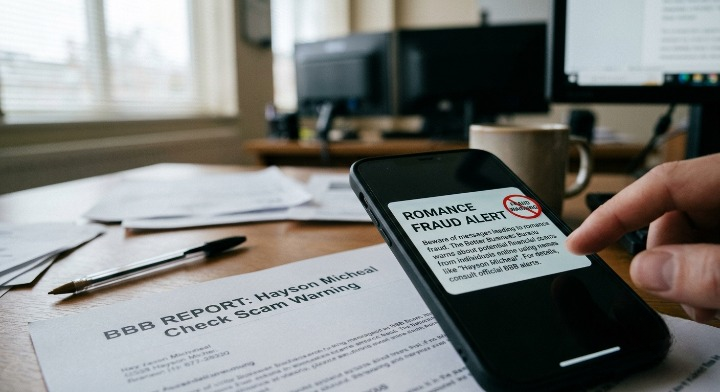
A BBB Scam Tracker report filed on November 1, 2026 describes an emailed $900 Wells Fargo check from someone using the name Hayson Micheal and the email address haysonmicheal399@gmail.com. The complainant deposited it and noticed similarities to an earlier BBB report. The check has not been confirmed as fraudulent.
Who Is Hayson Micheal According to the BBB Complaint?
“Hayson Micheal” is the name the individual used when contacting the complainant, who is in Mc Farland, California. The report also lists the email address above and the phone number (432) 205-2261. The BBB categorized the report as a romance scam. No business name or website is listed, and the person’s real identity has not been independently established.
What Happened in the $900 Wells Fargo Check Incident?
From the report, the individual sent pictures of a $900 Wells Fargo check that was dated October 31, 2026, and was written to the complainant. In addition, the report shows that this check had listed David R. Wold and Tracy L. Wold as account holders and not the individual in question. Furthermore, the complainant had received this check and was waiting for it to clear before filing the report.
In the report, the complainant did not mention any requests for money or anything that was bought using the credit card.
Is the Hayson Micheal Check a Confirmed Fake Check?
No. The BBB report does not confirm that the check was counterfeit, returned, or fraudulent. The complainant was still waiting for it to clear and filed the report because of similarities to an earlier complaint.
A check image, a deposit receipt, or an initial credit to an account does not necessarily mean the funds have been finally collected. Banks often make funds available before the issuing bank has completed verification. Before spending or transferring anything, ask your bank directly whether the check has fully cleared.
What Is the Connection to BBB Scam Report #1100983?
The complainant uncovered a previous BBB report, #1100983, from November 10, 2025, regarding an individual with the name “Micheal Hayson.” According to the complainant, this report involved receiving an email check and then a money transfer.
The complainant did not have the ability to determine if both reports relate to the same individual, nor do we. Any connection between the two is yet to be verified. It is important to note similarities in the two names, but it does not prove anything.
How Do Fake Check Scams Work?
A fake-check scam generally relies on a check that looks real but is later returned unpaid. This is general educational information, not a sequence confirmed in this complaint. A typical scheme runs as follows:
- Someone sends an image or physical copy of a check.
- The recipient is encouraged to deposit it.
- The bank may show the funds as available before the check is finally verified.
- The sender can demand a refund, a fee, or even buy something from you.
- When the check bounces back, it will be the responsibility of the receiver to pay off any funds that were either transferred or spent.
What Should You Do If Someone Emails You a Check?
- Do not deposit or transfer money according to the email check image.
- Contact the bank through its official means of contact and not those provided by the sender.
- Inquire about the verification process of the check as well as when funds will be deposited.
- Do not make any payments to the sender.
- Keep all your evidence handy like emails, images of checks, phone numbers, and messages.
How Can You Report a Suspected Fake Check or Online Fraud Incident?
Start with your bank so it can review the deposit. Then report to the Federal Trade Commission at ReportFraud.ftc.gov, to the BBB Scam Tracker, and, if money was lost, to local law enforcement or the FBI’s Internet Crime Complaint Center (IC3). Provide accurate dates, names, email addresses, and amounts, and keep copies of everything. Complete records make reports more useful.
How Can FintechLegals Help With Fraud Investigations?
Checking fraud online typically creates a pattern of emails, photos, and transactions that would not be easy to sort out on your own. FintechLegals has services related to fraud investigations, digital forensics and data analysis, cyber threat intelligence, and claims and disputes support. Such services may assist in documenting what has happened and discussing the situation with the bank. There are no guarantees of success. To speak about your case, contact FintechLegals
FAQ
Is the Hayson Micheal check confirmed fraudulent?
No. The BBB report does not state that the check bounced or was counterfeit.
What is a fake-check scam?
A scheme in which a victim deposits a check that is later returned unpaid, often after being asked to send money or buy something.
Can a deposited check still be returned unpaid?
Yes. Funds may appear available before the check is finally verified, so confirm with your bank.
What should someone do after receiving an emailed check?
Don’t spend or send money, verify with your bank, and keep all communications.
Where can suspected fake-check fraud be reported?
Your bank, the FTC, BBB Scam Tracker, the FBI’s IC3, and local law enforcement.
Source: BBB Scam Tracker report #1465903. This article discusses a consumer-submitted report. Its allegations have not been independently verified by FintechLegals.
For more updates, follow us on LinkedIn.

Leave a Reply