


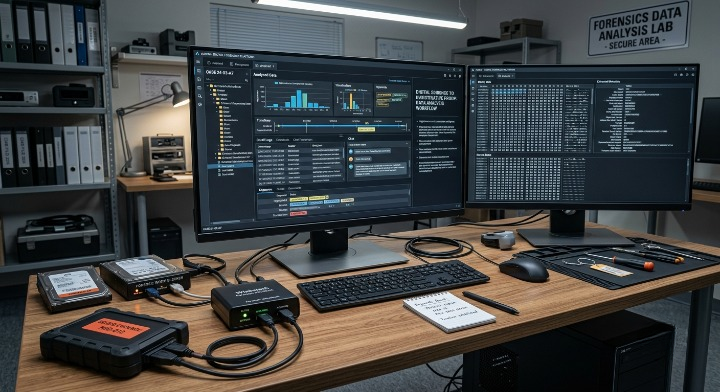
Financial fraud, cryptocurrency cases, and digital asset investigations do not usually rest upon one particular piece of paper or transaction. Rather, the truth is spread out among many different sources, including spreadsheets, wallets, emails, and timestamps – all of which only make sense when analyzed together. This is where the main purpose of forensic data analysis lies.
If you are a lawyer, compliance specialist, or just a person dealing with fraud or cryptocurrency issues, it’s crucial to understand the process.
What is forensics data analysis?
Forensics data analysis involves gathering, analyzing, and making sense of digital and financial information to find out important information regarding an investigation or any legal matter. This entails a technical analysis as well as documentation of the information gathered such that the results are admissible in a court of law.
Forensic analysis of data differs from casual data analysis in that it is done bearing in mind the fact that the data might later on be put under test or even become part of evidence.
How does forensic data analysis work?
Forensic data analysis starts with the systematic collection of relevant data, the preservation of such data in its original condition, followed by its analysis using specific procedures.
The general steps in this process include:
- The identification of possible sources of the data, such as bank documents, exchange transactions, or any other means of communication
- The preservation of the data in an unaltered form
- The arrangement of large amounts of data in a way that makes them reviewable
- The analysis of the data for patterns, omissions or anomalies
- Documenting the process to enable future verification.
The data that investigators deal with tends to be large in quantity and cannot be reviewed manually in detail, which is why the analytical process becomes just as important as the data itself.
What data can be examined during a forensic investigation?
Forensic research can be based on financial transactions, transactions with cryptocurrency, wallet history, bank statements, email/messaging history, metadata, and system logs, among other pieces of evidence. It depends on the issue that one is trying to investigate.
For instance,
- Analysis of financial transactions for unusual payment history;
- Checking the history of cryptocurrency transactions and relationships between wallets;
- Comparing timestamps from several accounts;
- Cross-checking communication history with financial transactions;
- Spotting inconsistencies between reported statistics and reality.
It is usually the analysis of all these pieces of evidence as a whole that brings a pattern out, while looking at one piece at a time does not bring much.
Why does chain of custody and documentation matter?
As the forensic results can be used for court cases, arbitration and regulatory purposes later, preserving and documenting them becomes crucial as opposed to being an option. An evident chain of custody proves that the data was collected in a proper manner without any changes that affect its credibility.
It is also necessary to point out that the forensic analysis reveals the patterns and anomalies but doesn’t prove intent, fraud or misconduct on its own. The findings should be interpreted together with other evidence.
How is AI used in forensic data analysis?
AI helps in forensic data analysis by providing support to investigators in processing large amounts of data more efficiently, uncovering patterns that would otherwise be difficult to discern manually and in organizing the data for subsequent human review. AI should primarily be seen as an investigative aid rather than a substitute for human judgment.
Some examples of such applications are:
- Large dataset processing and identification of the records that need to be investigated
- Identification of anomalies in financial/transactional data
- Classification and organization of digital evidence
- Comparison of different records for identifying overlaps and inconsistencies
- Mapping of the relationships among various accounts, entities or transactions
- Timeline generation based on multiple data points
- Identification of records that require the most investigation
Can forensic data analysis help investigate cryptocurrency transactions?
Yes. It is possible to analyze data from forensic cryptocurrency transactions, wallets and blockchain in order to detect some peculiarities that would require further investigation. Since the blockchain is mostly open yet fragmented, the tools of analysis are used to put all the pieces together.
For instance, a single cryptocurrency transaction would seem to be an isolated act at first. But once analyzed in correlation with other transactions and their timestamps, the whole picture of money flow could be seen. The AI-driven analysis can reveal such correlations or peculiarities to give an investigator a clue for their further work.
It should be stressed that the analysis of blockchain or financial data by itself is not enough to prove any ownership, intentions, fraud or liability issues.
Why is forensic data analysis important in financial investigations?
Forensic data analysis is important because financial misconduct rarely leaves a single obvious trace. It typically shows up as small inconsistencies spread across multiple records, and structured analysis is what allows investigators to connect those details into a coherent picture that can support legal or regulatory action.
What is the difference between data analysis and forensic data analysis?
Ordinary data analysis focuses on identifying trends or insights for business or operational purposes. Forensic data analysis is conducted with evidentiary standards in mind, meaning the process must preserve data integrity, maintain documentation, and produce findings that can be defended if challenged in a legal setting.
Forensic Data Analysis in Practice
This is where forensic data analysis intersects with the type of work handled by FintechLegals, including cryptocurrency investigations, crypto asset tracing, fraud investigations, digital-asset disputes, and due diligence matters. Forensic data analysis often complements blockchain analysis and transaction tracing by helping organize and contextualize digital evidence gathered during an investigation, supporting the broader legal or investigative process rather than replacing it.
Conclusion
Forensic data analysis gives investigators a structured way to make sense of complex digital information — turning scattered transaction records, timestamps, and communications into organized evidence that can inform legal, regulatory, or investigative proceedings. As AI-assisted tools continue to support this work, the underlying principle remains the same: findings must be accurate, well-documented, and interpreted within their proper context.
For individuals or organizations navigating crypto investigations, asset tracing, or fraud-related disputes, understanding how forensic data analysis works is a useful starting point before engaging investigative or legal support.
Frequently Asked Questions
What is the goal of forensic data analysis?
The goal is to identify, preserve, and interpret digital or financial data in a way that produces accurate, well-documented findings suitable for investigative or legal use.
Is forensic data analysis only used in criminal cases?
No. It is also used in civil disputes, regulatory investigations, due diligence, and asset-tracing matters, including those involving cryptocurrency.
Can AI replace human investigators in forensic analysis?
No. AI can assist with processing and organizing large datasets, but interpretation, context, and professional judgment remain essential parts of any investigation.
Does forensic data analysis prove fraud automatically?
No. It identifies patterns and anomalies that may warrant further investigation, but conclusions about fraud or liability depend on the full body of evidence.
How is cryptocurrency data analyzed forensically?
By examining transaction histories, wallet relationships, and timestamps, often alongside other financial or communication records, to identify patterns relevant to an investigation.
Why does documentation matter in forensic analysis?
Proper documentation and chain of custody help ensure that findings are credible and can withstand scrutiny in legal or regulatory settings.
How does FintechLegals use forensic data analysis?
Forensic data analysis can support the type of work FintechLegals is involved in, including crypto investigations, asset tracing, and fraud-related disputes, by helping organize and interpret digital evidence as part of a broader investigative process.
For more updates, follow us on LinkedIn.
Leave a Reply