


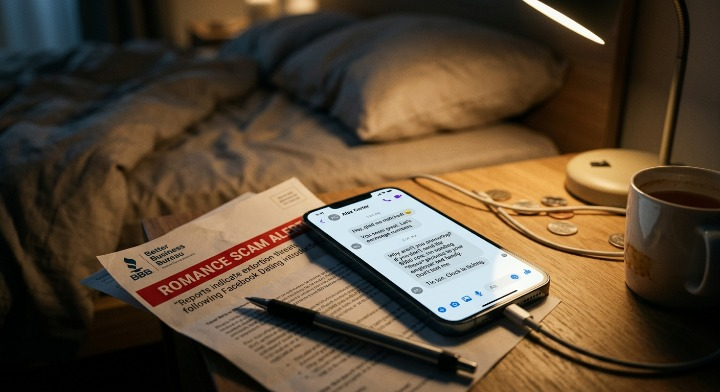
A romance scam may not start with love and end with the demand for cash. The complaint filed to the BBB Scam Tracker on October 30, 2026 illustrates another example of the romance scam – a case in which the interaction through the dating site resulted in blackmail and payment demands. The case is a useful reminder that online romance scam tactics now include pressure and intimidation, not only false promises of love.
This article summarizes the complainant’s allegations. None of the claims below has been independently verified, and no individual has been found responsible for wrongdoing.
What Happened in This Reported Romance Scam?
According to the BBB Scam Tracker entry, the complainant matched with someone on Facebook Dating. The person then allegedly tried to extort money, warning that inappropriate pictures of the complainant would be released if payment was not made. The report is categorized as a romance scam, lists a business name of “Tammy,” and gives the complainant’s location as Fort Wainwright, Alaska.
The report does not state a financial loss, and it does not say whether any payment was sent. It also lists the scammer’s location as unknown. We have intentionally left out the contact details published in the report, since they have not been verified and may belong to an unrelated party.
How Did the Reported Romance Scam Work?
The complainant included a transcript of messages. According to the above transcript, the accused reportedly:
- Said he had allowed the complainant to solve their problems “easily” and that this was the last chance being given.
- Told the complainant to transfer money to a certain payment app account and to send a screenshot of the transaction.
- Set a time limit, saying that the “time” had begun.
- Threatened that military headquarters and “the authority” will be notified of the complainant in case of non-payment.
The report does not mention cryptocurrency, bank wire transfers or a fake investment opportunity. The requested method appears to be a peer-to-peer payment app. Even so, the case fits the broader category of online dating scams, where a quick connection is used to create leverage over a target.
How Do Online Romance Scammers Gain People’s Trust?
The BBB report does not describe a long period of relationship-building, so we cannot say how trust was established here. In general, the FTC and FBI describe romance fraud as relying on fast emotional closeness, flattery, and pressure to move the conversation off the original platform. In extortion variants, often called sextortion, the scammer may encourage private photos or conversations and then use them as leverage.
Targets can include anyone, but service members and their families may be singled out because threats involving a command or reputation can feel especially serious. Fear is the tool in these cases.
What Are the Warning Signs of a Romance Scam?
Romance scam warning signs seen in this report and in official guidance include:
- Sudden threats. A match who shifts from friendly to menacing is a red flag.
- Payment demands with deadlines. Countdowns are designed to stop you from thinking clearly.
- Requests for proof of payment. Asking for a screenshot is a common step in pressure schemes.
- Threats to contact employers or authorities. Legitimate agencies do not collect payment through personal payment apps.
- Reluctance to video chat or meet. Scammers often avoid verification.
- Early requests for money, gift cards or cryptocurrency. These methods are hard to reverse.
What Should Victims Do After a Romance Scam?
Romance scam victims should act calmly and methodically. The FBI generally advises people facing sextortion not to pay, because payment rarely ends the demands.
- Stop communicating with the sender and avoid responding to the deadline.
- Preserve evidence, including messages, usernames, payment details and screenshots, before blocking or reporting the account.
- Contact your bank or payment provider immediately if money has already been sent, and ask about disputing or recalling the transaction.
- Secure your accounts by changing passwords and reviewing privacy settings.
- Report the profile to the dating platform.
- Seek support. Extortion can be distressing, and talking to someone you trust helps. Military members may also consider speaking with their command, legal assistance office or security officer, depending on their situation.
Adults worried about intimate images being shared can look into StopNCII.org, which helps create digital fingerprints of images so participating platforms can block them. If the person pictured was under 18, NCMEC’s Take It Down service is designed for that situation.
How Can People Report Romance Fraud?
If you want to report a romance scam, these are the main official routes in the United States:
- FBI Internet Crime Complaint Center (IC3): ic3.gov
- Federal Trade Commission: ReportFraud.ftc.gov
- BBB Scam Tracker: bbb.org/scamtracker
- Local law enforcement, particularly if you feel threatened
Reports help investigators spot patterns and help warn other people.
How Can Financial Investigation Services Help Scam Victims?
In cases where the funds have already passed through the banking system, payment platforms, or cryptocurrencies, having a record of transactions is important. Professional investigators can structure all transactions, analyze activity in bank accounts and develop a chronological order that could be used by the victims in contacting financial organizations or the police.
How FintechLegals Helps Address Financial Fraud and Crypto-Related Investigations
FintechLegals is a financial investigation and legal support service provider. Its services include cryptocurrency investigations, crypto asset tracing, financial fraud investigations, digital forensics and data analysis, due diligence, and support in reviewing suspicious online platforms and transactions.
This matters for romance fraud cases that involve cryptocurrency transfers, a cryptocurrency romance scam or a relationship investment scam, where victims are steered toward a fake trading platform. Blockchain transaction analysis can help examine how funds moved between wallets, depending on the available evidence and circumstances. FintechLegals does not guarantee fund recovery or any particular investigation or legal outcome.
Readers who suspect cryptocurrency-related financial fraud can visit FintechLegals to learn more about its investigation services.
Conclusion
The reported Facebook Dating case shows that financial fraud can arrive through intimidation as well as affection. Slow down when an online relationship becomes urgent, verify identities through video calls and independent searches, and never send money under threat. If something feels wrong, stop, document, and report.
Source: BBB Scam Tracker report, Scam ID 1464873, reported October 30, 2026: https://www.bbb.org/scamtracker/lookupscam/1464873
For more updates, follow us on LinkedIn.

Leave a Reply