



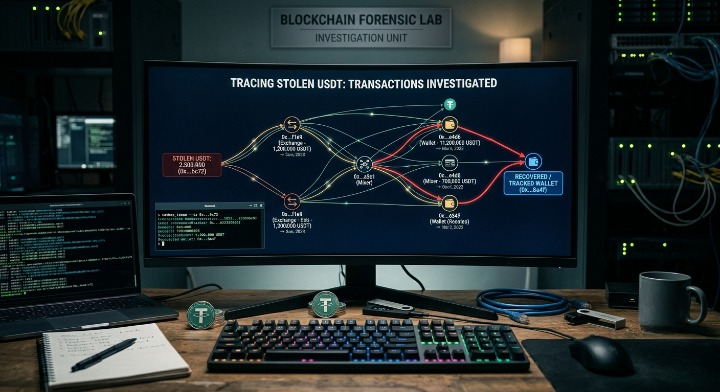
In many cases, yes. USDT transactions are recorded on public blockchains, so investigators can often follow the movement of funds from one wallet address to another. Tracing shows where funds went. It does not guarantee that they can be recovered, and it does not always reveal who controls a wallet.
USDT (Tether) exists on several blockchain networks, including Ethereum, Tron, and Solana, so the network involved shapes how an investigation proceeds. Anyone searching “can you trace stolen USDT” should understand the difference between USDT transaction tracing (analysing where funds moved) and recovery (obtaining assets back through legal, regulatory, or exchange processes).
How Does USDT Transaction Tracing Work?
USDT tracing means reading public blockchain records to reconstruct the path of a transfer. USDT is a token issued by Tether and transferred on blockchain networks. Each transfer is recorded with:
- Wallet addresses: the sending and receiving addresses.
- Transaction hash: a unique ID for that transfer.
- Amount, date, and time.
Tools called blockchain explorers display this data publicly. Starting from the victim’s transaction, an investigator checks what the receiving address did next, then follows each later transfer. This is the basis of stolen USDT tracing, and of cryptocurrency tracing more broadly.
Which Blockchain Was Used for the USDT Transaction?
Identifying the network is the first step, because USDT is not tied to one blockchain. It is available on Ethereum, Tron, Solana, and other networks, and each has its own explorer, address format, and transaction records. An address that works on one network may not exist on another.
Preserve the transaction hash and network name from the start. Without them, investigators must reconstruct this information from wallet history or platform records, which takes longer and is less reliable.
What Information Do You Need to Trace Stolen USDT?
The most useful items are the transaction hash, the wallet addresses, and the network. A practical checklist:
- Your USDT wallet address and the receiving wallet address
- Transaction hash(es) and blockchain network
- Amount transferred, with date and time
- Exchange names and account details, if any
- Screenshots of transactions and the platform
- Scam website or platform URL
- Emails, chat messages, and social media accounts
- Bank or payment records linked to the purchase of USDT
Original records matter because screenshots alone can be incomplete or disputed. Hashes and addresses can be independently checked on the blockchain.
Can You Follow USDT Through Multiple Wallets?
Yes, often. Blockchain history is permanent, so moving funds through several addresses does not erase the earlier transfers. A simplified example:
Victim wallet → Wallet A → Wallet B → Exchange
This is only an illustration. Real paths can involve many more addresses, splitting and merging of funds, and different networks. Investigators examine each hop and document it as a timeline, which makes the movement understandable for reports and legal use.
Can You Identify the Person Behind a USDT Wallet?
Not from blockchain data alone. A wallet address is a string of characters, not a name. Tracing can identify and cluster addresses and show their activity, but that is different from identifying the real-world person who controls them.
Identification may become possible if funds reach a regulated service, such as an exchange, that holds customer information. Even then, that information is generally released only through the service’s legal processes, not to private individuals on request. Whether any identification is achievable depends on the case.
What Happens If Stolen USDT Reaches a Crypto Exchange?
An exchange deposit can be an important investigative point, because exchanges keep transaction records and, typically, account information. Investigators look at the deposit address, the transaction records, and whether the address appears to belong to a known exchange.
Reporting the transaction to the exchange promptly, with hashes and supporting evidence, can be useful. However, exchange policies, legal requirements, and jurisdiction all affect what is possible. An exchange is not obliged to freeze or return funds simply because you report a loss.
What If Stolen USDT Moves Between Different Blockchain Networks?
Cross-chain movement makes an investigation more complex but not necessarily impossible. Funds may be moved through bridges, swapped into other assets, or split across many addresses. Investigators may need to examine activity on more than one blockchain and keep a careful timeline linking each step. Complexity increases time and cost, and can reduce certainty in the findings.
Can USDT Be Frozen?
Sometimes, but it depends. The answer varies by blockchain, the type of USDT involved, the circumstances, and the entities involved. It helps to separate four things:
- Blockchain tracing: observing movement; it does not freeze anything.
- Token-level controls: Tether has publicly stated it can restrict certain addresses in some circumstances. Check Tether’s current official statements for details.
- Exchange actions: at the exchange’s discretion and subject to its policies.
- Legal or regulatory intervention: dependent on jurisdiction and process.
USDT transactions cannot simply be reversed after a scam.
What Should You Do After Losing USDT to a Scam?
- Stop sending additional money, including “fees” to release funds.
- Preserve the transaction hash.
- Record all wallet addresses.
- Identify the blockchain network.
- Save screenshots and communications.
- Secure remaining accounts and assets.
- Contact any relevant exchange promptly.
- Report the incident to the appropriate authorities in your jurisdiction.
- Consider professional crypto tracing or investigation assistance.
Warning: never share seed phrases, private keys, or passwords with anyone claiming they can investigate or recover your funds. Legitimate investigators do not need them.
USDT Tracing vs. USDT Recovery
USDT tracing means analysing blockchain transactions to understand where funds moved. USDT recovery refers to efforts to obtain assets back through legal, regulatory, exchange, or other processes. Successful tracing can support recovery efforts by providing organised evidence, but it does not guarantee any outcome.
How Long Does a USDT Tracing Investigation Take?
There is no universal timeframe. Duration depends on the number of transactions and wallets, the networks involved, whether funds reached an exchange, any cross-chain movement, the quality of available evidence, and overall complexity. Be cautious of anyone who promises a fixed timeline.
When Should You Consider a Professional USDT Investigation?
Professional help is most useful when the case is complex or the stakes are high. Consider it if you have:
- A significant financial loss
- Funds moved through multiple wallets
- Cross-chain transactions
- Funds that reached an exchange
- A fake investment platform case
- A need for organised, presentable evidence
- Possible civil or criminal proceedings
FintechLegals provides Crypto Assets Tracing and Crypto Investigation services. These can help analyse USDT movements, organise blockchain evidence, and support further investigative or legal action. They do not guarantee recovery. See also [how crypto funds are followed across exchanges and wallets – link to be inserted] and [legal evidence needed for cryptocurrency investigations – link to be inserted].
Frequently Asked Questions
1. Can stolen USDT be traced?
Often, yes. USDT transfers are recorded on public blockchains, so investigators can usually follow movement between wallet addresses. Tracing shows where funds went but does not guarantee recovery or identification of the person behind a wallet.
2. Can USDT transactions be traced?
Yes. Each transaction has a hash, sender, receiver, and amount recorded on its blockchain. Because USDT runs on multiple networks, such as Ethereum and Tron, the correct network must be identified first.
3. Can a USDT wallet be traced to a person?
Not by blockchain data alone. Addresses are not tied to names. Identification may sometimes be possible if funds reach a regulated exchange holding customer records, but that usually requires legal processes and depends on jurisdiction.
4. Can stolen USDT be recovered?
Sometimes, but it is never guaranteed. Recovery depends on where the funds went, the entities involved, applicable law, and cooperation from exchanges or authorities. Be wary of anyone who promises guaranteed recovery, especially for an upfront fee.
5. Can USDT sent to another wallet be traced?
Yes, in most cases. Investigators can follow the funds through subsequent addresses, because earlier transactions remain on the blockchain. Complex paths, splitting, or cross-chain movement can make this slower and harder.
6. Can an exchange freeze stolen USDT?
Possibly, but not automatically. Exchanges act under their own policies and legal obligations, which vary by jurisdiction. Reporting quickly with transaction hashes and evidence helps, but a freeze or return of funds is never assured.
7. What information is needed to trace USDT?
At minimum: the transaction hash, wallet addresses, blockchain network, amount, and date. Screenshots, scam platform URLs, exchange details, messages, and payment records also help investigators build an accurate and well-documented timeline.
8. How long does a USDT tracing investigation take?
It varies. The number of wallets and transactions, networks involved, exchange involvement, cross-chain movement, and evidence quality all affect duration. Simple cases may be quicker than complex ones, but no reliable fixed timeframe exists.
Need Help Analysing Stolen USDT Transactions?
If you have lost USDT and need help analysing transaction activity or organising your evidence, FintechLegals’ Crypto Assets Tracing and Crypto Investigation services can help you understand what the blockchain record shows. Outcomes depend on the circumstances, and recovery cannot be guaranteed.
For more updates, follow us on LinkedIn.
Leave a Reply