



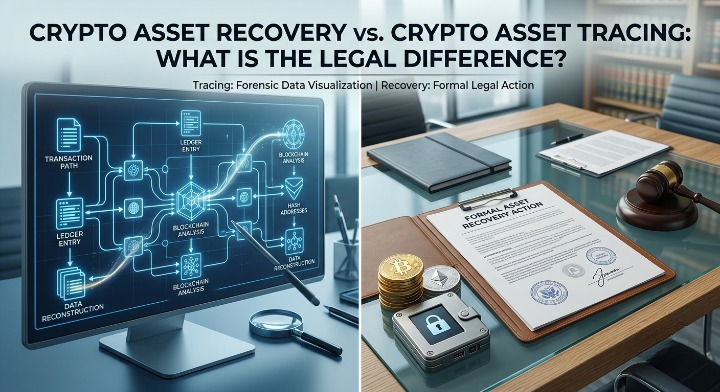
Since cryptocurrency transactions are done on public blockchains, most people think that once funds are stolen or misappropriated, they could easily be traced and retrieved. Tracing cryptocurrencies and the recovery of such cryptocurrencies are two different things. There’s an important distinction between crypto asset recovery and crypto asset tracing that victims and even companies need to consider.
In short: tracing asks, “Where did the crypto go, and who may control it?” Recovery asks, “What legal or investigative steps can be taken to attempt to recover it?” The two are connected, but they serve different purposes.
What Is Crypto Asset Tracing?
Crypto asset tracing is the process of analysing blockchain data to follow the movement of digital assets. Investigators examine wallet addresses, transaction histories, token movements, and the relationships between addresses. Cryptocurrency tracing can help to:
- identify transaction paths;
- follow funds through multiple wallets;
- identify links to exchanges or other service providers;
- build an evidence trail;
- support fraud investigations, disputes, or legal proceedings.
A wallet address does not, on its own, reveal the real-world identity of its owner. Professional tracing is best treated as one part of a broader legal investigation, and it is the focus of FintechLegals’ Crypto Assets Tracing service.
What Is Crypto Asset Recovery?
Crypto asset recovery is a separate stage. Once tracing is done, there are various ways by which asset recovery can be done, including determining who the responsible party is, securing the evidence, communicating with the platform or intermediary, making claims, and getting any appropriate legal orders issued in the jurisdiction concerned.
Tracing can establish evidence, but asset recovery requires some more legal work. Tracing does not necessarily lead to asset recovery.
Crypto Asset Tracing vs. Crypto Asset Recovery: Key Differences
| Crypto Asset Tracing | Crypto Asset Recovery | |
| Primary purpose | Establish how assets moved | Seek the return of, or compensation for, assets |
| Main question answered | Where did the funds go? | What can be done to recover them? |
| Typical evidence | Transaction hashes, wallet addresses, on-chain histories | Tracing findings plus off-chain evidence, records, and correspondence |
| Role of blockchain analysis | Central | Supporting |
| Legal involvement | Often investigative or evidential | Often procedural (claims, orders, enforcement) |
| Expected outcome | Evidence and a transaction timeline | Depends on jurisdiction, parties, and circumstances |
How Does Blockchain Evidence Support a Legal Case?
Transaction hashes, wallet addresses, timestamps, token transfers and so on make up blockchain evidence that may act as a basis for crypto asset investigation, providing an undeniable record of events taking place on the blockchain.
However, information from the blockchain is not always enough for the investigation and, in most cases, has to be supplemented by off-chain evidence – exchange history, communication and payment documents. This is where FintechLegals’ blockchain and cryptocurrency investigation capabilities become relevant.
When Do You Need Crypto Asset Tracing?
Tracing may prove helpful in cases where:
- there is a fraud or investment scam relating to cryptocurrencies;
- unauthorized transactions;
- there is a misappropriation of digital assets; and
- there are disputes arising from crypto transactions.
When Can Crypto Asset Recovery Become Relevant?
If recovery actions become relevant, then this would happen once a sufficient amount of information has been collected regarding the movement of assets and possible parties that could have control over them. The right approach to choose depends on jurisdiction, evidence quality, identification of relevant parties, location of assets, and presence of intermediaries (exchanges).
In certain cases, FintechLegals’ services could include Crypto Assets Tracing, Crypto Investigation, Claims and Disputes, Fraud Investigations, and Due Diligence Services.
Why Professional Legal and Investigative Support Matters
Crypto investigations often need both technical blockchain analysis and legal knowledge. Blockchain data shows the movement of assets; legal analysis helps determine how that information can be used to identify parties, establish evidence, assess potential claims, and decide on next steps. FintechLegals works at the intersection of cryptocurrency investigations, digital assets, blockchain evidence, and legal matters.
FAQ
Is crypto asset tracing the same as crypto asset recovery?
No. Tracing relates to the tracking and investigation of movements of assets. Recovery pertains to actions that might potentially lead to getting assets back.
Can stolen cryptocurrency be traced?
Blockchain transactions are usually traceable. Still, the fact that cryptocurrency has been tracked cannot identify the real-world owner of the wallet, and it will not ensure its recovery.
Does tracing cryptocurrency guarantee recovery?
No, tracing can provide valuable evidence, but whether recovery is possible depends on the situation, available evidence, jurisdiction, identified parties, etc.
What evidence is useful in a crypto asset investigation?
Valuable evidence may include transaction hashes, wallet addresses, exchange data if available, communication, payment history, accounts, contracts, screenshots, etc.
When should I seek professional help with a crypto asset dispute?
Early help will ensure the preservation of evidence, transaction timeline, investigation of the asset’s movement, and possible legal ways out of the situation.
Conclusion
Crypto asset tracing and crypto asset recovery are similar but separate legal procedures. The former identifies what happened to the money while the latter determines what can be done legally from there on, in accordance with the law. Should you have a case concerning crypto fraud, crypto assets in dispute, or any complicated blockchain transaction, you can avail of the legal services provided by FintechLegals.
For more updates, follow us on LinkedIn.
Leave a Reply