



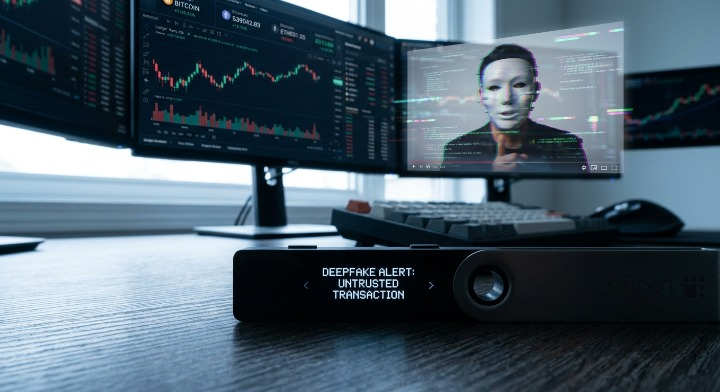
Scammers can make fake or manipulated videos and audio of celebrities or other known persons, such as financial experts, corporate leaders, or people whom we know, in order to deceive others by impersonating these individuals and marketing fraudulent schemes involving cryptocurrencies, trading, giveaways, and money demands.
How Can Deepfakes Be Used in Cryptocurrency Scams?
Deepfakes are typically used as a trust-building layer wrapped around an otherwise ordinary financial scam. A fabricated video or voice recording makes a fraudulent pitch look credible, while the underlying mechanics of the fraud — a fake exchange, a cloned website, a wallet address controlled by the scammer — remain the same as in traditional crypto fraud.
Common uses include:
- Fake celebrity endorsements promoting a token, exchange, or giveaway
- Fake investment experts offering trading advice or “guaranteed” returns
- Fake executives or company representatives appearing to represent a real firm
- Fake interviews edited to suggest an endorsement was given
- Fake livestreams using looped or manipulated real footage
- Fake video testimonials from supposed satisfied investors
- Voice impersonation used in calls, voicemails, or voice messages
- Fake customer-support representatives guiding victims toward fraudulent sites
In each case, the deepfake’s job is to lower a victim’s guard. The financial harm still depends on the victim visiting a fraudulent platform, sending funds, or sharing account access.
What Is a Deepfake Crypto Scam?
A deepfake crypto scam is a fraud scheme in which AI-generated or digitally altered media is used to impersonate a real or invented person in order to promote a fraudulent cryptocurrency opportunity. The general pattern looks like this:
Deepfake → impersonation → trust → fraudulent crypto offer → victim payment
It’s worth being precise here: deepfake technology itself is not inherently fraudulent. It has legitimate uses in film, education, and accessibility. The fraud lies entirely in how the technology is deployed — to deceive a specific person into believing they are interacting with someone they are not.
How Do Deepfakes Make Crypto Scams More Convincing?

The deepfake takes advantage of the viewer’s existing trust in the face and voice of a familiar personality. A video with a realistic look and voice will trigger the very same credibility that the real person possesses but is, in fact, fake.
Scammers do this by:
- Using recognizable faces and realistic voices
- Fake credentials (titles, certifications, logos)
- Social proof in the form of fake testimonials
- Creating an artificial sense of urgency (today-only offers)
- News-style presentations
- Interview-like presentation
As the influence of the visual and audio components of the video is so strong, the content is trusted as a whole and not questioned. For this reason, verification of claims through official sources becomes more important than ever.
What Types of Cryptocurrency Scams Use Deepfakes?
Investment platform scams
These deepfakes can direct visitors to sites that look like investment or trading platforms but are actually scams.
Cryptocurrency scams involving celebrities
The footage generated by artificial intelligence can make it seem like a celebrity endorses cryptocurrency-related products which they don’t have anything to do with.
Impersonation of executives
Scammers impersonate a company’s CEOs, founders, or financial advisors to legitimize their requests.
Crypto giveaway scams
Another popular type of scam in deepfake videos is the double-your-crypto scheme where users need to pay money upfront.
Voice impersonation
AI voice clips may be used for making phone calls or sending voice messages pretending to be a reliable acquaintance.
How Can You Identify a Deepfake Cryptocurrency Scam?
Red flags usually surround the offer more than they relate to the quality of the videos themselves:
- Unsolicited and/or guaranteed investment offers
- Unusual and high returns
- Requests for cryptocurrency before any payment is made back to you
- Time pressure to invest
- Unverifiable celebrity endorsement
- Suspicious-looking website URLs
- Unverifiable testimonials
- Inconsistency of the information about the company on different platforms
- Requests to move communications to instant messengers
- Unverifiable wallet address
It is important to remember that visual defects are not always a characteristic of such projects. Many deepfakes today are polished enough that relying solely on spotting artifacts is unreliable. Verifying the underlying offer independently is a more consistent safeguard than trying to “detect” the fake.
What Evidence Should Victims Preserve?
If you suspect you’ve encountered — or been affected by — a deepfake crypto scam, evidence preservation is critical for any later investigation. Save, where possible:
- Original video and audio files (not just screen recordings)
- Screenshots of posts, profiles, and conversations
- URLs and website details
- Usernames and account handles
- Emails and messages
- Voice recordings, where lawfully obtained
- Wallet addresses and transaction hashes/TXIDs
- Payment or bank records
- Information about the real person or company being impersonated
Do not delete or alter anything that could be relevant, even if it feels upsetting to keep. And critically: never share private keys, seed phrases, passwords, or authentication codes with anyone claiming they can investigate or recover stolen cryptocurrency — legitimate investigators do not need this information.
Can Blockchain Analysis Help Investigate a Deepfake Crypto Scam?

Blockchain analysis can assist in investigating the economic aspects of the deepfake fraud through the review of wallet addresses, transaction hashes, flow of money, destination wallets, and signs that might indicate the presence of an exchange off-ramp. In general, this becomes one of the main elements of cryptocurrency asset tracing.
However, blockchain analysis is unlikely to provide information on who made the particular video or deepfake, as blockchain evidence reveals only where the money flows and not what happens behind the camera. Thus, it usually has to be used together with website analysis, communications, etc.
How Can a Deepfake Crypto Scam Be Investigated?
In general terms, this kind of fraud examination would include:
- Protecting evidence
- Confirming the identity of the individual or firm that claims to be the victim
- Investigating the website and its online presence
- Analyzing communications
- Determining the cryptocurrency transactions that have been linked to the fraud
- Mapping wallet transactions
- Comparing on-chain evidence and off-chain evidence
- Documenting findings
As this is usually done for fraud investigations, it often combines crypto investigation techniques with fraud investigation techniques because of the nature of deepfakes being located at the crossroads between media analysis and financial tracing. Every investigation does not necessarily lead to discovering the culprit.
Can a Deepfake Video Be Used as Evidence in a Crypto Investigation?
A deepfake video can itself become relevant evidence, but its usefulness depends on several factors: the source of the file, indicators of authenticity, available metadata, the context in which it was shared, access to original (not re-compressed) files, its distribution history, and related communications or payment evidence.
The legal treatment and admissibility of this kind of digital evidence varies by jurisdiction and by the specific facts of a case, so no universal rule applies. Anyone pursuing a legal remedy should discuss evidentiary questions with qualified counsel familiar with their jurisdiction.
What Should You Do If You Lost Crypto to a Deepfake Scam?
If you believe you’ve sent cryptocurrency because of a deepfake scam:
- Stop sending any additional funds immediately
- Preserve all evidence described above
- Record wallet addresses and transaction hashes
- Save all related communications
- Write down a timeline of events while details are fresh
- Report the fraud to relevant authorities and platforms — see how to report a crypto scam
- Contact the exchange if stolen funds appear to have reached one
- Consider engaging professional cryptocurrency asset tracing support
Before committing more funds to any platform, it’s also worth learning how to verify a crypto company or using crypto due diligence resources to independently check its legitimacy.
Recovery of stolen cryptocurrency cannot be guaranteed in any case.
Conclusion
Deepfakes make cryptocurrency scams more convincing by fabricating false identities, endorsements, and investment presentations that borrow the credibility of real people. The underlying fraud — a fake platform, wallet, or payment request — remains familiar, but the impersonation layer makes it harder to spot. Independently verifying investment claims, rather than trusting video or audio alone, remains one of the strongest defences. If fraud does occur, preserving both digital and blockchain evidence promptly gives any later investigation the best chance of success.
FintechLegals assists clients with cryptocurrency investigations, asset tracing, and fraud-investigation matters connected to these cases, without promising recovery or guaranteed identification of those responsible.
For more updates, follow us on LinkedIn.
Leave a Reply