



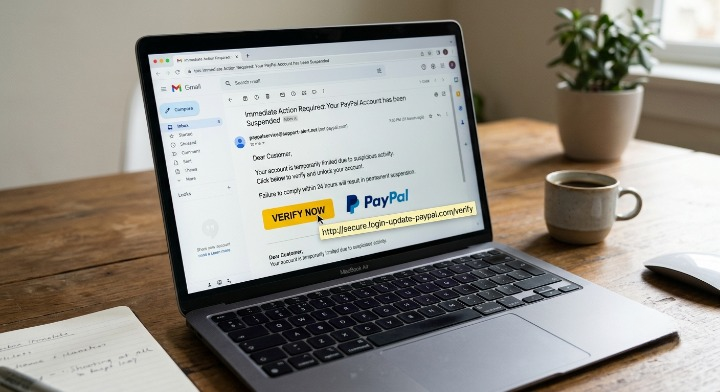
A PayPal email is likely a scam if it asks you to click a link, open an attachment or call a phone number. Don’t use any of them. Instead, open your browser, type paypal.com yourself and log in. If your account shows no matching payment, invoice or alert, the message is almost certainly one of the many scams from PayPal impersonators.
Anyone searching “scams paypal email” is usually holding a message that looks slightly off. PayPal is a trusted name, so criminals borrow it. Knowing how these messages work protects your money and every other account that shares your password.
Can You Get Scammed While Using PayPal?
Yes, in two main ways. Most often, criminals impersonate PayPal to get a password, a payment or remote access to your device. Third parties run these PayPal phishing scams. PayPal is the brand being copied, not the culprit.
Less often, criminals take over accounts using passwords stolen elsewhere. PayPal notified 34,942 users about a credential-stuffing attack in which hackers used login details from other data leaks, and it said its own systems were not breached.
How Do Scams From PayPal Impersonators Work?
Fake suspension warnings. The email says your account is about to be suspended and asks for your password on a phishing page.
Fake payment confirmations. It claims you bought something you didn’t and gives a number to “cancel” the order.
Phishing links. They can lead to lookalike domains such as secure-paypal.com.
Fake customer support. Caller ID can be faked, so a call showing “PayPal” proves nothing.
Invoice and money request scams. Fake invoices can be sent through PayPal itself, with a scammer’s phone number in the seller’s note.
Refund and overpayment scams. You’re told you were paid too much and asked to send back the difference. In PayPal’s own illustration, a $500 payment arrives for a $300 camera, but the fraudster has paid nothing.
Real Examples of PayPal Email Scams
The FTC’s Binance alert (2023)
The FTC warned that a fake PayPal message said BNC Billing had canceled a payment to Binance and supplied a phone number to reach “PayPal.” Clicking or calling, the FTC said, lets scammers steal financial or personal information. Warning signs: a transaction you never made, a crypto exchange you don’t use, and a number to call. Source: https://www.news4jax.com/money/2023/05/11/ftc-those-urgent-emails-from-metamask-and-paypal-are-phishing-scams/
A PayPal Scam Email That Almost Worked
This one is convincing because the email is real. Trend Micro reported in February 2023 on a set of PayPal-based invoice scams, drawing on Reddit posts, that aimed to get people to dial the number in the message. Eftsure’s write-up says Reddit users reported invoices from “Parisi Studios” in 2023 and 2024, ranging from $699.99 to almost $1,300, and that the phone number on them differed from PayPal’s official fraud hotline.
Because the invoice comes through PayPal’s platform, there are no fake links or spoofed domains. PayPal says the alarmist note is meant to get you to call so that you reveal personal or financial details. Warning signs: an invoice for something you never ordered, and a “dispute” number inside the seller note. Source: https://www.reddit.com/r/Scams/comments/10sry3s/paypal_scam_looked_very_legit/
Overpayment aimed at sellers (FTC, 2014)
The FTC’s blog on online sellers describes a “buyer” who says they sent payment plus extra funds and asks the seller to ship quickly. Warning signs: payment proven only by an email, an amount that is too high, and pressure to hurry. Check your PayPal activity before sending anything.
How to Identify a Fake PayPal Email
- Greeting and sender: PayPal says it addresses you by name, never “Dear user.” Sender addresses can be forged, so a familiar name proves nothing.
- Links: hover over them to see the real destination.
- Attachments: PayPal says genuine emails never contain attachments or software.
- Urgency: alarmist deadlines are meant to make you ignore warning signs.
- Unusual requests: PayPal says it never asks you to email a tracking number.
- Verification: genuine urgent messages also appear in your PayPal notifications.
What Should You Do If You Receive a Suspicious PayPal Email?
Don’t click, reply or call. Log in to PayPal directly and check your activity. Forward the whole email to phishing@paypal.com without changing the subject line. Then report it: in the US at ReportFraud.ftc.gov, in the UK to report@phishing.gov.uk. Delete it afterwards.
What If You Have Already Clicked a Suspicious Link?
Change your PayPal, email and other online passwords immediately. Start with email, because it can reset everything else. Turn on two-factor authentication. Contact PayPal through the Contact Us link on its website, not the message. Call your bank or card issuer if you entered card details, and watch statements closely for weeks and months. If you gave someone remote access, disconnect and have the device checked.
Can You Get Your Money Back After Being Scammed on PayPal?
Sometimes, but not always. Purchase Protection covers eligible purchases that never arrive or are significantly not as described. For an item not received, the dispute must be opened within 180 days of payment. The payment must also have been made with PayPal rather than as Friends & Family, and an unescalated dispute can close after 20 days.
Phishing is different. If you handed over a password or paid someone posing as PayPal support, report unauthorized activity to PayPal straight away, but recovery isn’t guaranteed. If a card funded the payment, a chargeback with the card issuer may be possible within 120 days once PayPal denies a claim. Deadlines are short, so act quickly.
How Can You Protect Yourself From PayPal Email Scams?
Use a unique password and two-factor authentication. Go to PayPal directly instead of using email links. Never ship goods or refund an “overpayment” until the money shows in your activity. Treat phone numbers in emails and invoices as untrusted.
FAQs
How can I tell if an email from PayPal is genuine?
Look for your real name, links to paypal.com, no attachments and no urgent demands. If unsure, log in separately.
Does PayPal send emails about account restrictions?
It can email about account activity, but a real issue should also show when you log in. Never use the email’s link or number.
What should I do with a fake PayPal payment email?
Don’t call or click. Check your activity, forward it to phishing@paypal.com and delete it.
Can someone steal money through a PayPal phishing email?
Yes. Stolen account details can be used to spend from your account, and scam calls can lead to stolen card details.
Where can I report a PayPal email scam?
Forward it to phishing@paypal.com. In the US, also report to the FTC and IC3. In the UK, use report@phishing.gov.uk.
If scams from PayPal has cost you money or exposed personal data, FintechLegals’ investigation services can help you document what happened. This article is general information, not legal or financial advice.
For more updates, follow us on LinkedIn.

Leave a Reply