


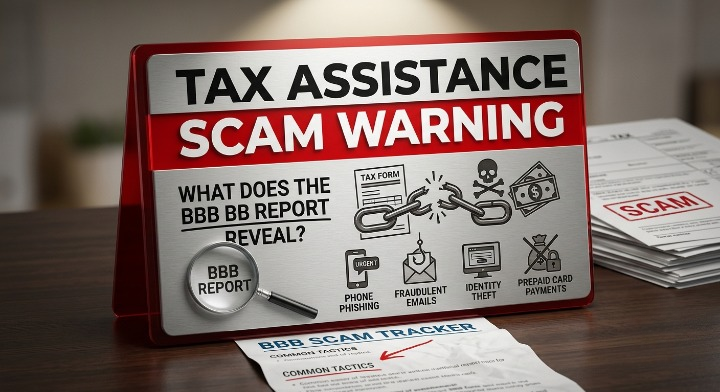
On November 6, 2026, a consumer in Americus, Georgia, submitted BBB Scam Tracker report #1470514 about a voicemail from a caller identifying herself as Amanda Moore of a “tax assistance team.” The message reportedly suggested a tax balance might be reduced and gave 844-515-1255. The report lists 1 (469) 313-9137.
This article summarizes Tax Assistance Scam Warning.
The Report at a Glance
- Filed: November 6, 2026, by a Georgia consumer
- What was received: a voicemail from a caller giving the name “Amanda Moore” and referring to a “tax assistance team”
- Callback number in the voicemail: 844-515-1255 (ownership unverified)
- Email, website, location: listed as unknown
- Reported loss: none
What Is the Amanda Moore Tax Assistance Call?
It is a voicemail described in a consumer report. The caller identified herself as Amanda Moore from a “tax assistance team.” Her identity and organisation have not been independently verified.
According to the BBB report, the message said that having a tax balance does not necessarily mean paying the full amount as it stands. It reportedly claimed there may be ways to reduce what is owed, depending on the recipient’s circumstances, and invited listeners to call 844-515-1255 to discuss options.
The report does not identify the organisation’s legal name, and it lists the email address, website, and location as unknown. The report also does not say whether the offer was genuine.
What Phone Numbers Are Associated With the Tax Assistance Report?
Two numbers appear: 844-515-1255, given in the voicemail as the callback number, and 1 (469) 313-9137, listed in the BBB’s scammer information. The report does not establish how they are related.
The report does not confirm who controls either number, nor does it show they belong to the same person or organisation. Neither number should be treated as confirmed fraudulent based on this report alone. The report also does not say that the consumer called back.
Is the Tax Assistance Call a Confirmed Phishing Scam?
No. Although the report qualifies as one of the phishing scam cases, the consumer report cannot be considered a legal finding. There is no proof whatsoever of any collection of the person’s private or financial data through the call.
Most times, the term phishing is used to refer to the activity of trying to obtain sensitive data through impersonation. Although there is no evidence of illegal behavior on the part of the caller, a phone call concerning tax debt is a matter of concern. The caller may know nothing about your actual tax situation, and a callback number gives a stranger a way to start collecting information.
How Do Tax Relief and Tax Assistance Scams Usually Work?
Most tax relief scams depend on surprise contact and speedy debt settlement to establish legitimacy before trying to get personal or financial details. These are general warning signs, not actions confirmed in this report.
- Unsolicited calls or voicemails promising tax debt reduction.
- Provides fast settlement for existing balances.
- Asks for personal details without confirming the business first.
- Prepayment or payments made via alternative means such as gift cards and cryptocurrency.
- The need to pay immediately.
- Access to tax authorities.
How Can You Verify a Tax Relief Company or Tax Assistance Caller?
Verify independently. Do not rely on contact details supplied by the caller. Look up the organisation yourself and confirm any tax balance directly with the relevant tax authority.
- Ask for the organisation’s full legal name and business address.
- Check its credentials and contact information through independent sources.
- For questions about taxes due to the US government, contact the IRS at IRS.gov.
- Read service agreements and disclosures in writing before agreeing to anything.
- Do not give out Social Security numbers, bank accounts, or tax account information over the phone.
What Should You Do If You Shared Information With a Suspicious Tax Caller?
Act quickly to ensure your safety, contact the appropriate authorities, and document the occurrence. Early action can possibly save you from additional losses.
- Contact your bank or credit card company if your financial data is compromised.
- Change your password if your financial information is compromised.
- Monitor all of your accounts for any suspicious activity.
- File a report of any scams or thefts with the appropriate federal government agency, such as the FTC (ReportFraud.ftc.gov and IdentityTheft.gov) or the IRS.
- Save your voicemail, call logs, emails, and other documentation.
How Can FintechLegals Help With Phishing and Digital Fraud Investigations?
FintechLegals provides investigative and evidence-oriented services which could be used to examine any suspicious communication or instances of fraud. It is not a tax preparation service and does not guarantee tax relief, refunds or recovery.
Relevant services include fraud investigations, cyber threat intelligence, forensics and data analysis, and claims and disputes. Reviewing digital evidence such as call records, voicemails, and message trails can help show how a suspicious contact unfolded. To discuss a situation, contact FintechLegals.
Related Reading
- Eliopi Review: What Does the BBB Complaint Reveal?
- Wallstreet Broker Review: What Does the BBB Complaint Reveal?
Frequently Asked Questions
Who is Amanda Moore from the tax assistance call?
She is the name used by the caller in the voicemail described in the BBB report. Her identity, and any link to a real organisation, has not been verified, and she should not be described as a confirmed scammer.
What phone numbers are listed in the BBB report?
The voicemail gives 844-515-1255 as the callback number. The report’s scammer information lists 1 (469) 313-9137. The report does not confirm that they share an owner.
How can you identify a tax relief phishing call?
Look for unsolicited contact, promises of reduced tax debt, pressure to act quickly, requests for sensitive information or upfront payment, and claims of guaranteed results.
Can unsolicited callers legally promise tax debt reduction?
Rules vary, and legitimate tax professionals exist, but no one can guarantee a particular outcome. Check the IRS’s guidance on tax relief options and consider consulting a qualified tax professional or attorney.
What should you do after sharing personal information with a suspicious caller?
Contact your bank, secure your accounts, monitor for suspicious activity, report to the appropriate authorities, and keep all evidence.
For more updates, follow us on LinkedIn.

Leave a Reply