



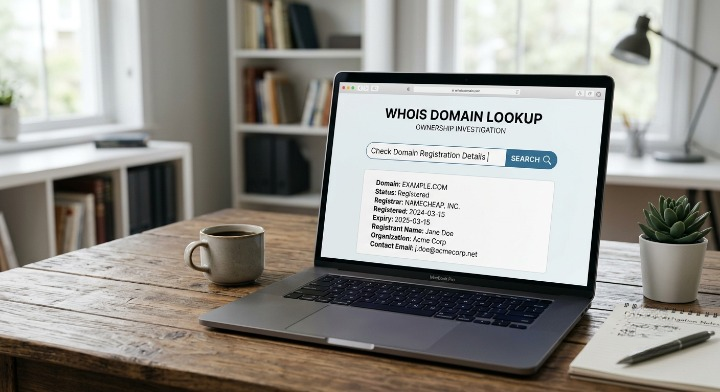
If you’ve landed on a suspicious website, received a questionable investment pitch, or need to verify who’s really behind an online business, your first instinct is probably to search: “where can I check domain registration details quickly?” The good news is that basic domain information is often just a lookup away. The less convenient truth is that this information rarely tells the whole story — especially when the domain in question is deliberately hiding its owner.
This guide walks through what a quick domain lookup can reveal, what cyber intelligence tools add to the picture, and when it’s time to move from a five-minute search to a structured Domain Ownership Investigation.
What Domain Registration Details Can You Check Quickly?
A standard WHOIS lookup or RDAP lookup (the newer, more structured replacement for WHOIS) can typically show:
- The domain name and its exact spelling variations
- Registration date and expiration date
- The registrar the domain was purchased through
- Nameservers and basic DNS-related information
- Current domain status (active, expired, locked, pending transfer)
- Public registrant information, where the registrant hasn’t opted for privacy protection
For anyone assessing a suspicious website, this is a reasonable starting point. A domain registered two weeks ago and set to expire in a year is a different risk profile than one that’s been active for a decade. Mismatched nameservers, foreign hosting for a supposedly local business, or a registrar known for minimal verification can all be early warning signs worth noting.
Which Cyber Intelligence Tools Can Help?
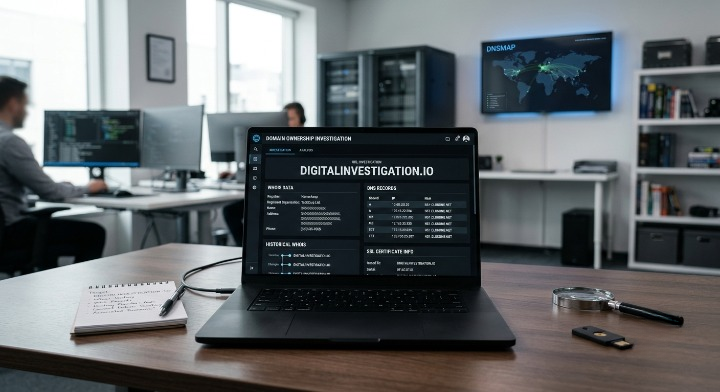
Beyond a basic WHOIS lookup, there are many types of domain intelligence tools which offer more insight into a domain:
- DNS intelligence – provides insight into the structure and relationships of a domain’s network architecture
- Domain history – demonstrates the history of registration changes made to the domain
- Certificate transparency logs – capture all SSL/TLS certificates associated with a domain, revealing related subdomains
- IP/hosting intelligence – exposes the web server infrastructure and hosting used by a site
- Passive DNS – records all historical DNS resolves
- Website technology detection – determines the technologies used in the creation of a website
- Threat intelligence databases – highlight previous malicious associations with a domain
Used together, these categories can help establish connections between digital assets — for example, linking an anonymous website to a cluster of related domains sharing the same hosting or infrastructure fingerprint.
Why a Quick Domain Lookup May Not Be Enough
Here is the problem: many new domains come with privacy protection or proxy services as standard. Hence, what you get from a search might be the name of a privacy service and not a real individual or corporation. Furthermore, publicly available information can be incomplete, inaccurate, or even purposely obscured, and there could be many transfers of ownership without any trace.
This is where the real question shifts from “how can I investigate who owns a domain?” to “how do I correlate scattered pieces of evidence into something reliable?” A single database rarely has the full answer — meaningful conclusions usually come from cross-referencing multiple sources.
What Is Domain Ownership Investigation?
Domain Ownership Analysis refers to the systematic study of digital evidence to uncover possible owners or operators of a certain domain. It usually includes looking into the following:
- Historical data about the domain and its registration
- DNS and hosting details
- IPs and related domains
- Website content and other technical aspects of websites
- Business records
- Digital footprint in general
Can cyber intelligence tools reveal who is behind a website? Sometimes — but not always, and rarely with total certainty. The goal of a proper investigation is to build a reliable, evidence-based picture using lawful, verifiable information, not to promise a guaranteed identity match.
When Should You Consider a Professional Investigation?
A deeper domain investigation is worth considering when:
- A website appears to impersonate a legitimate company or brand
- A business can’t determine who operates an anonymous site it’s dealing with
- A domain is connected to a suspected fraud or scam
- A site seems part of a wider network of related suspicious domains
- Domain ownership needs to be established as part of a legal dispute
- A cryptocurrency or financial platform has opaque or questionable online infrastructure
How FintechLegals Can Help With Domain Ownership Investigation
At FintechLegals, our approach to Domain Ownership Investigation combines cyber intelligence tools, open-source research, and legal context to help clients make sense of anonymous or suspicious online entities. Whether you’re dealing with a crypto platform of uncertain legitimacy, a fraud case, or a dispute that hinges on identifying who controls a website, our investigators work through publicly available evidence methodically — without overstating what any dataset can prove.
We don’t claim to unmask every anonymous domain owner; privacy protections and incomplete records are real limitations. What we can offer is a thorough, lawful investigation that pulls together the strongest available evidence.
Conclusion
A quick domain lookup is a useful first step — it can tell you when a site was registered, who hosts it, and whether basic details look legitimate. But when privacy protections, proxy registrations, or fraud are involved, that surface-level information often isn’t enough. A structured Domain Ownership Investigation, combining multiple sources of domain intelligence and digital evidence, is usually what’s needed to get closer to a reliable answer.
FintechLegals works across digital asset investigations, crypto asset tracing, fraud investigations, domain ownership investigations, due diligence, compliance and forensic data analysis, supporting clients who need digital findings that are properly verified and documented.
For more updates, follow us on LinkedIn.
Leave a Reply