




The investigative process of AI scams in cryptocurrencies generally includes analysis of blockchain, cryptocurrency tracing, and digital forensics. It could involve the analysis of wallet addresses, transaction records, communications, phishing websites, and open-source intelligence. The perpetrators may not necessarily be found, and the funds may not be recovered.
How Are AI-Powered Crypto Scams Investigated?
The fraudulent methods practiced in the cryptocurrency world have changed due to artificial intelligence. While previously people could be fooled with the use of fake emails and fake social media profiles, where they would share their personal details, artificial intelligence can now create believable text, images, voice and even video impersonations. This means that fraudulent investment schemes, customer service scams and impersonations of executives have become harder to recognize at first glance.
To investigate such scams based on artificial intelligence, it is necessary to analyze two separate lines of evidence. First of all, there is on-chain evidence, which consists of transaction history recorded on the blockchain and includes wallet addresses, transaction hashes, and transfers of money between wallets or exchanges. Second, there is off-chain (or digital) evidence, which includes web pages, messages, images, videos, and other information relevant to the scam. While analyzing each line separately does not give the complete picture, the correlation of the two gives a better understanding of what happened in the fraudulent scheme.
How Is AI Used in Cryptocurrency Scams?
The use of artificial intelligence has made it easier to create fake material convincingly. These include investment scams where an AI is programmed to send investment messages in a style similar to that of a financial advisor, deepfake videos where a public figure’s endorsement video can be created with either edited or entirely fabricated images, and voice cloning technology for conducting telephone scams.
Firms conducting themselves through fraudulent means may also use fake cryptocurrency “experts,” completely fabricated social media accounts featuring AI-created pictures, and automated chatbots that can carry out real conversations with a number of people at once. Fraudulent trading platforms and websites developed using artificial intelligence can be developed in no time and for little cost, and in some cases mimic legitimate exchanges. Phishing emails and impostor schemes can be made to look more personal by using AI.
The reason these methods are effective is straightforward: AI reduces the visual, linguistic, and behavioral cues that people traditionally rely on to spot fraud. A message with fewer grammatical errors, a face that looks and moves naturally on video, or a voice that sounds exactly like a trusted contact all lower a victim’s guard. This article does not provide operational guidance on producing this content — only an explanation of how it’s investigated.
What Evidence Is Collected in an AI Crypto Scam Investigation?
Digital evidence is often time-sensitive, so preserving it early matters. Investigators generally look to collect wallet addresses, transaction hashes (TXIDs), the type and amount of cryptocurrency involved, and the specific blockchain or network used. Alongside this, off-chain material such as emails, chat logs, social media profiles, website URLs, screenshots, video or voice recordings, payment records, bank statements, exchange account records, phone numbers, usernames, and domain registration details all help build context.
Where possible, victims should preserve original files rather than only screenshots, since original files can retain metadata that supports later analysis. See FintechLegals’ guide on the evidence needed for a cryptocurrency investigation for a more detailed breakdown.
A critical warning: never provide private keys, seed phrases, passwords, or two-factor authentication codes to anyone claiming to help investigate or recover stolen cryptocurrency. Legitimate investigators do not need this information, and requests for it are themselves a common secondary scam targeting fraud victims.
How Does Blockchain Analysis Help Investigate AI Crypto Scams?
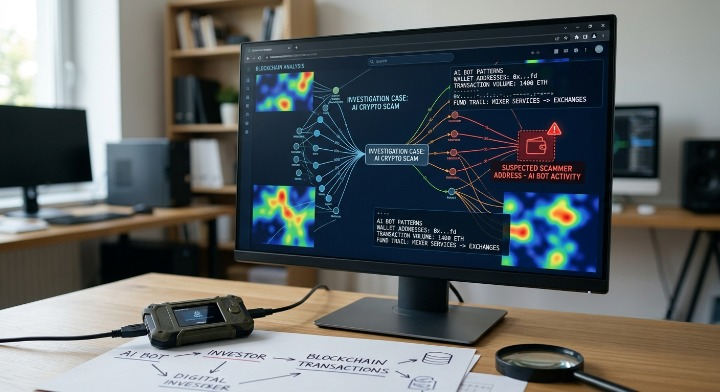
Blockchain analysis plays an important role in many investigations of cryptocurrency scams due to the openness and irrevocable nature of the underlying ledger. It often includes determination of wallet addresses involved, analysis of transaction hashes and further tracking of money flow during following transactions to see if destination wallets could be detected, whether money splitting was performed across many wallets very fast, or whether funds were used to pay for some exchange or service requiring know-your-customer measures.
Then off-chain information about timing, amounts and accounts is correlated with blockchain information. What should be understood at this stage is that blockchain analysis allows understanding how money flowed and who received it, but a wallet address does not necessarily indicate the owner’s identity. Attribution usually requires connecting blockchain data to off-chain identifiers, such as an exchange account or a linked communication trail. FintechLegals’ cryptocurrency asset tracing services focus on this kind of transaction analysis.
Can Investigators Identify an AI-Generated Fake Identity?
Sometimes, but not always, and rarely from a single piece of evidence. Social media accounts can be analyzed by investigators to find out their social media accounts, usernames, email IDs, contact numbers, registration details on various websites, and communication patterns. Reverse image analysis, account creation dates, and cross-referencing multiple platforms can also surface inconsistencies.
AI-generated identities complicate this work considerably. A synthetic profile photo has no public “original” to trace, and AI-written text lacks the stylistic fingerprints that once helped link accounts to individuals. Because of this, attribution typically depends on assembling multiple independent evidence sources rather than relying on any single indicator. An AI-generated image or profile alone cannot reliably be linked to a specific real person without corroborating evidence.
How Are Fake Crypto Websites Investigated?
AI-powered schemes include a variety of fraudulent investment websites and clone exchanges as one of their most common parts. Researchers usually consider such aspects as the domain registration data when it is possible, the website content, its history (even archived versions), contact details, payment directions, cryptocurrencies wallets addresses provided by the website, and social media profiles of the fraudster(s).
This website-level evidence is then compared against blockchain records and communications to see whether the details align — for example, whether a wallet address shown on the site matches one that received victim funds. For guidance on identifying who controls an anonymous site, see FintechLegals’ resource on how to investigate an anonymous website or domain.
How Do Investigators Connect AI Scam Communications With Blockchain Transactions?
One of the most important parts of an investigation is establishing the chain that links a fraudulent communication to an actual blockchain transaction. This is usually done in a rational order: a scam message is followed by a payment message, which refers to a wallet address, which relates to a blockchain transaction, which can be linked to a destination wallet or exchange.
A comparison between all available information is performed through timestamp, wallet address, payment amount, username, and website information. When the same payment amount appears in a chat log as well as in the blockchain data at the same timestamp, such correlation adds value to the whole narrative about the scam. This type of correlation alone cannot prove someone’s identity or criminal liability.
Can Deepfake Evidence Be Used in a Crypto Scam Investigation?
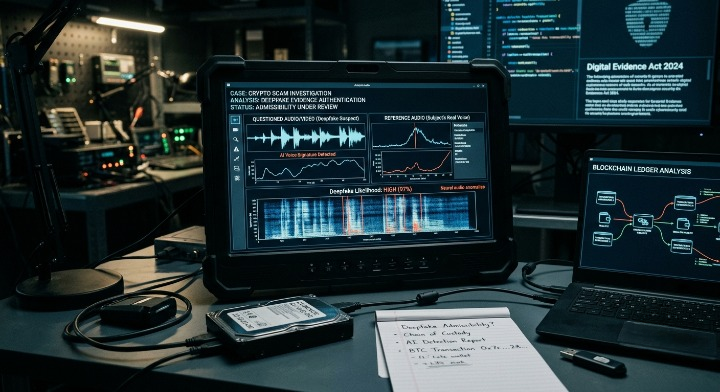
All of these videos, audio clips, images, and messages relating to the scam could potentially be part of an investigation, although there is no guarantee that they will have been genuine or that their true significance has been properly understood.
In digital forensics, there are tools available to identify any traces of tampering, although not all technology is foolproof and not all deepfakes can be identified. In addition to this, it is rare for a deepfake to be used as a standalone form of evidence in a legal case.
What Happens After an AI-Powered Crypto Scam Is Identified?
The investigative process may broadly include: collecting evidence that is available, recording details of the crime committed, determining blockchain transactions, tracking the flow of funds, analyzing websites or accounts involved, linking digital and financial evidence, identifying investigative leads, making findings, and deciding on the channel to report on or take legal action.
This process does not guarantee that funds will be recovered or that a perpetrator will be identified — outcomes depend heavily on the specifics of each case, including jurisdiction and how quickly funds moved through the crypto ecosystem. Victims are generally encouraged to review FintechLegals’ guidance on how to report a crypto scam as part of this process.
What Are the Challenges of Investigating AI-Powered Crypto Scams?
The creation of fake identities and deepfakes makes it difficult to track the identity of the perpetrator. AI content creation can be done fast and in bulk, enabling scammers to conduct multiple schemes simultaneously. Websites used and communication addresses can be abandoned shortly after the scam ends.
As far as finance is concerned, the use of multiple wallet transfers, cross-chain transfers, as well as the use of tools like mixers, makes the money trail difficult to follow. International jurisdictions add legal complexity, and communications may be deleted or otherwise become unavailable over time. AI increases the sophistication and volume of fraudulent content overall, but blockchain records — being public and permanent — continue to provide a useful, relatively stable source of transaction evidence even as other evidence becomes harder to obtain.
Frequently Asked Questions
How are AI-powered crypto scams investigated?
Investigators typically combine blockchain analysis and cryptocurrency tracing with digital evidence such as communications, website data, and OSINT research. This mixed method would help understand how the scam was executed and how money was wired through the process, but it will not necessarily identify the person behind it or recover the funds lost.
How is AI used in cryptocurrency scams?
It enables scammers to create believable messages about investing, videos and cloned voice recordings, and even false profiles on social networks.
Can blockchain tracing help investigate an AI crypto scam?
Yes. Blockchain tracing allows investigators to follow the movement of funds between wallets and identify whether they reached an exchange or other identifiable service. However, tracing funds is different from identifying the person who controls a wallet.
Can investigators identify an AI-generated scammer?
Sometimes, using a combination of social media analysis, digital footprints, communication patterns, and public records. AI-generated identities complicate this work, since synthetic images and text lack traditional identifying traces, so attribution isn’t always achievable.
Can deepfake videos be used as evidence in a crypto investigation?
Deepfake material can form part of an investigation, but its authenticity often needs assessment through original files, metadata, and forensic review. Not every deepfake can be conclusively verified as synthetic, so it’s generally treated alongside other supporting evidence.
How are fake crypto investment websites investigated?
Investigators will look into domain registration information, website information, payment directions, wallet addresses provided and links on social media sites. The above information will be correlated with the blockchain and communication data to determine any similarities and contradictions.
What evidence should I save after an AI crypto scam?
Keep wallet addresses, transaction hashes, original communication, screen captures, video messages, voice messages and any payment or exchange proof. You should never give your private keys, seed phrase or authentication code to anyone.
Can AI crypto scam investigations recover stolen cryptocurrency?
Not always. Investigations can trace how funds moved and identify investigative leads, but tracing, identifying leads, and actually recovering funds are distinct outcomes, and recovery depends on many factors outside an investigator’s control.
Conclusion
Investigating AI-powered crypto scams generally requires combining blockchain evidence with digital, financial, communications, and open-source information. AI-generated content — from deepfakes to synthetic identities — can complicate attribution, but blockchain records continue to offer valuable, relatively permanent evidence about how funds moved. FintechLegals supports victims and organizations through crypto investigation, cryptocurrency asset tracing, and broader fraud investigations work, helping build a clear evidentiary picture without promising specific outcomes.
For more updates, follow us on LinkedIn.
Leave a Reply