


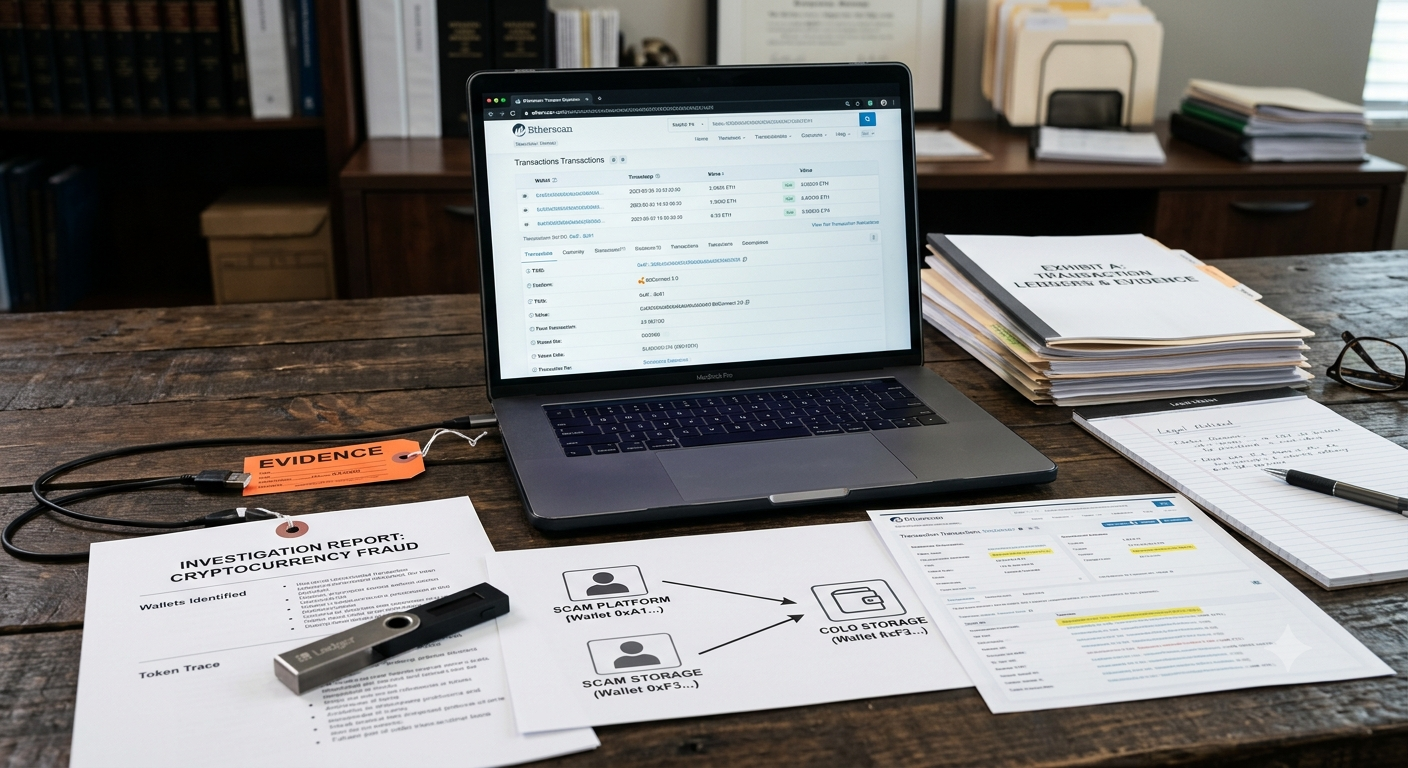
Cryptocurrency scams take many forms: fake investment platforms, phishing, fraudulent wallets, impersonation, Ponzi schemes, romance scams, and unauthorized transfers. A screenshot or a victim’s statement is rarely enough to support a cryptocurrency scam investigation. Investigators usually need to connect blockchain transactions with websites, accounts, communications, devices, and financial records to build a coherent, reviewable picture.
What Counts as Legal Evidence in a Cryptocurrency Scam Investigation?
Useful digital evidence helps establish what happened, when, who was involved, how funds were transferred, where the cryptocurrency moved, what communications took place, and what loss occurred.
It helps to separate two categories. Blockchain evidence is on-chain data such as transactions and wallet activity. Off-chain evidence is everything else: messages, websites, bank records, and exchange documents. Neither category is usually sufficient alone. The rules of admissibility and evidentiary requirements depend on the jurisdiction and type of legal proceedings.
1. Blockchain Transaction Evidence
The foundation of evidence related to cryptocurrency fraud involves:
- Transaction IDs (hashes)
- Wallet addresses involved in transactions
- The blockchain network
- Timestamp, token type and amount
- Exchange deposits and withdrawals
- Cross-chain transactions or bridge
Blockchain explorers and forensic software tools enable you to trace and understand how assets were transferred and thus allow for tracing cryptocurrency transactions despite multiple wallet usage.
2. Communications and Digital Records
Save emails, WhatsApp or Telegram conversations, social media discussions, SMS, user ID and account ID, payment instructions, and investment offers. Call logs can also be important depending on the law.
Original documents or messages and their metadata are more significant compared to edited or cut-off screenshots, since they help establish authenticity and provenance.
3. Website, Domain and Online Identity Evidence
These may include fraudulent websites, website registration, website history, social media, fraudulent company information, fraudulently impersonated accounts, and online advertising. Information pertaining to the IP address can be considered if such information is legally available.
This is where domain ownership investigation and cyber intelligence tools come in. Registration records, archived pages, and infrastructure links can show whether several scam sites share a common operator. Such links are indicators to be corroborated, not proof of identity.
4. Financial and Exchange Records
Bank statements, card/payment transaction history, exchange statements, receipts of cryptocurrency purchases, and records of deposits and withdrawals link the payment made by the victim to the on-chain evidence. The record of the origin of the funds can also be used to prove the loss.
5. Cyber Intelligence and Blockchain Forensics
Blockchain forensics uses analytical techniques on data stored in public ledgers. Together with cyber intelligence software, legal inquiries will be able to:
- Analyze network connections of wallets
- Find transactions patterns
- Trace money flows through different wallets and blockchain networks
- Analyze address correlations
- Examine suspicious entities
- Combine blockchain data with publicly available data
- Find exchange or provider of services connection points where legal inquiry of records could be performed
All these techniques use publicly available data and legal processes. No illegal intrusion, access or bypass is involved.
6. Preserving Evidence for Legal Use
The victim must keep the original files, refrain from deleting any messages, refrain from altering screenshots, refrain from resetting the device unnecessarily, and stop communicating with scammers. The victim should save transaction IDs, wallet addresses, emails, payment details, and usernames.
Warning: never share seed phrases, private keys, passwords, or authentication codes with investigators or recovery services. A legitimate investigation does not need them.
Reports can be filed with authorities such as the FBI’s Internet Crime Complaint Center (IC3) or the FTC, or with the equivalent agency in your country.
How FintechLegals Can Help
FintechLegals is a fintech and digital-assets legal and compliance firm, not a law-enforcement agency. It supports cryptocurrency and blockchain matters through services including Crypto Assets Tracing, Crypto Investigation, Fraud Investigations, Due Diligence Services, and Cryptocurrency Compliance, as well as claims and disputes.
It can also involve organizing and analyzing data that could potentially be used for taking legal action, reporting to law enforcement authorities, for disputes or recovering funds. Blockchain transactions can usually be tracked, although tracking doesn’t necessarily mean recovery of funds.
FAQ
What evidence is needed to investigate a cryptocurrency scam?
Typically, transaction hashes, wallet addresses, the blockchain network, communications, website and account details, and bank or exchange records. Together, these show what was paid, where it went, and who solicited it. Requirements differ by jurisdiction and proceeding.
Can blockchain transactions be used as legal evidence?
Usually, yes. Being transparent and timestamped, the blockchain can record transactions. Whether it will be accepted or not in court will depend on the jurisdiction, methods of collecting and storing data, and presentation of the same.
Can cyber intelligence tools help trace a cryptocurrency scam?
Certainly. Cyber intelligence tools use legitimate public information to identify patterns and connections between wallets and people. The output of their work serves as clues, which must still be proven as evidence.
What information should I save after a crypto scam?
Transaction ID, wallet address, original texts and e-mails, user names, links to websites, and documents regarding payments and banking. Use the original sources, rather than edited screenshots. Do not disclose seed phrase, private key, password, or authentication code to any third party.
Can a stolen cryptocurrency transaction be traced?
Typically, one can trace the transaction on-chain, as public blockchains track all transactions. It may be more difficult with the use of mixers, privacy services, or cross-chain transactions. Finding out the identity of the wallet owner usually requires additional proof.
Can cryptocurrency investigation evidence help with legal recovery?
This type of evidence can be used for legal claims, law enforcement reports, or requests to exchanges. Nonetheless, there is no guarantee of success.
For more updates, follow us on LinkedIn.
Leave a Reply