


Cryptocurrency transactions are often referred to as being transparent. However, while this may be true in one way, it does not necessarily mean that the identity of the individuals involved in these transactions can be revealed easily. Wallets use alphanumeric addresses, which cannot reveal identities.
This is the reason why crypto asset tracing has become a significant aspect in finance cases, fraud investigations, and legal issues. The transaction history, links between wallets, exchange activities, and money transfers between different addresses are used by investigators in their efforts to follow the path of money.
Understanding the Blockchain Transaction Trail
Every transaction performed on a blockchain leaves a trace, which is usually composed of:
- Sender’s address
- Receiver’s address
- Transaction ID (unique code of the transaction)
- Timestamp
- Amount to be transferred
Moreover, transactions are interconnected. The money received at one address may be forwarded further, resulting in another chain of transactions.
Seeing a Transaction vs. Identifying a Person
Public blockchain data shows what happened, not who did it. An address is pseudonymous: it has no name attached. Linking an address to a real person or organization usually demands more than what the blockchain provides.
Following Funds Between Crypto Wallets
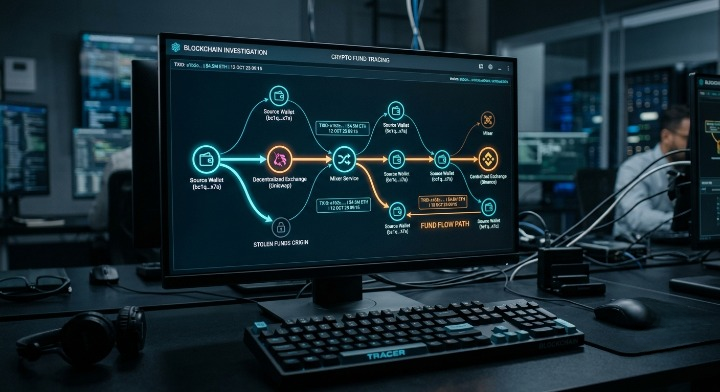
Fundamentally, tracking cryptocurrency involves tracking the funds from one wallet to another. Analysts look into factors such as time, amount, and frequency of transactions and the addresses connected to the same party. This activity is referred to as clustering.
Money usually goes through several wallets before arriving at its destination. This is something that could have happened simply due to practical reasons or otherwise, but it does become a little difficult to trace sometimes. It is something that should be carefully analyzed rather than assumed.
Tracing Crypto Funds Across Exchanges
Sometimes exchanges could be key to any investigation. This is because many individuals change crypto into regular money or transfer it from one platform to another using exchanges. In this regard, deposits and withdrawals on exchanges would indicate important moments in transaction chains.
If investigators find out that there is a wallet which seems to be associated with an exchange, it could be quite a clue. However, it is worth noting that it would not mean that one can know the owner of the exchange account. This is because most exchanges keep all customers’ data, and it is possible to access it only legally.
How Investigators Analyze Complex Transaction Paths
Transaction flow reconstruction normally involves a number of techniques, including:
- Address clustering to bring together relevant addresses
- Transaction mapping to show how funds were transferred
- Wallet relationship analysis to reveal links between addresses
- Transaction timeline reconstruction to order the transactions
The use of such techniques turns raw blockchain data into a systematic picture which can be analyzed, challenged, and validated. Such an analysis of transactions on the blockchain is grounded in methodology and logic.
Why Cross-Chain and Multiple-Wallet Transactions Can Be Difficult
Tracing becomes more demanding when activity spans many wallets, several blockchain networks, cross-chain bridges, decentralized services, or multiple exchanges. Each environment records data differently, and a transfer between networks may not appear as a single continuous record.
However, in such cases, tracing cryptocurrency transactions requires specific analytical software and skills. Moreover, one should take into consideration the limitations of the results that can be obtained because the correlation of addresses does not necessarily mean identical ownership.
From Blockchain Data to Legal Evidence
Blockchain data is just one aspect of an investigation. For the findings to be useful for dispute resolution or in legal matters, the findings should be:
- Preserved, which means that the transaction information is accurately captured
- Documented, and the process too
- Sustained, which means that there is reasoning behind the association with the address
- Traceable, which means that there is an evidential chain
Determining the real identity of an address would require more evidence or requests for the same from the respective parties.
How FintechLegals Supports Crypto Asset Tracing
FintechLegals is a specialized investigation and legal services platform that focuses on topics such as cryptocurrency compliance, crypto investigations, due diligence, claims and disputes, fraud investigations, online defamation and domain name investigations. The crypto asset tracing services offered by FintechLegals are aimed at cases that require systematic analysis of cryptocurrency movements.
Such tracing may facilitate investigation of transaction histories, tracking of movement of money from wallet to wallet and exchange to exchange, as well as gathering of blockchain-related information for further investigation. As in all investigations, results will depend on the circumstances and the law, and there are no guarantees.
Frequently Asked Questions About Crypto Asset Tracing
What is crypto asset tracing?
It is the process of tracking the movement of cryptocurrencies from one blockchain address to another. Agencies will analyze the information available in public records in order to identify the origin, destination, and link between different addresses.
Can cryptocurrency transactions be traced across wallets?
Yes, it is possible. Most blockchains record every transaction that happens on the platform. This means that it will be possible to trace the money from one wallet to another. However, this can get tricky if there is a long chain of transactions or multiple wallets involved.
Can investigators trace crypto funds through an exchange?
It is possible to track when funds are transferred to a wallet connected to an exchange, which is an important lead. It is impossible to observe what goes on in the exchange and will require a proper legal process to obtain client information.
Can a blockchain address be linked to a real person?
Not from blockchain data alone. Addresses are pseudonymous. Linking one to a real person generally requires supporting evidence, such as lawfully obtained exchange records or other documentation, and the strength of any link depends on that evidence.
Why is professional crypto tracing useful in an investigation?
The information stored on a blockchain can be extensive and difficult to understand. Professional crypto investigation uses a systematic approach, records results in an orderly fashion, and assists with ensuring information can be used by legal or financial departments.
For more updates, follow us on LinkedIn.
Leave a Reply