


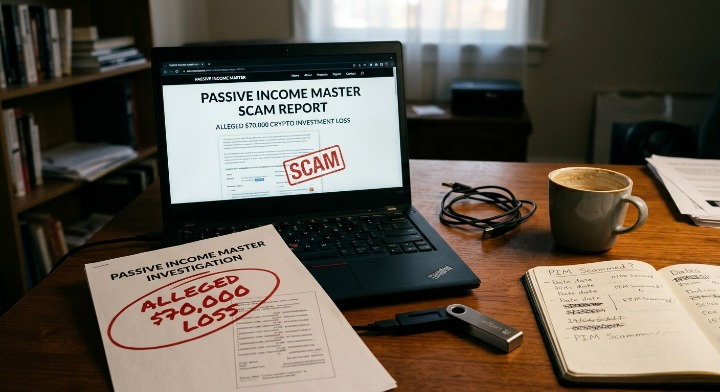
A report filed with the Better Business Bureau (BBB) Scam Tracker describes a cryptocurrency investment arrangement tied to a day-trading membership, a platform called Alt Saving, and a later demand for $50,000 to obtain a “license.” The complainant reports a total loss of $70,000. This article summarizes those allegations, explains the red flags they illustrate, and outlines how to check an investment offer before sending money.
These are consumer allegations. They have not been independently verified, and nobody named has been found to have committed fraud.
What Is the Passive Income Master Investment Scam Report About?
The report, filed October 28, 2026 (Scam ID 1462825), lists “Jared Wesley” in the business-name field and “Passive Income Master” as the website. The complainant says the person presented himself as a day trader and encouraged them to buy a membership.
BBB categorizes the report as an investment scam. Scam Tracker entries are based on victim accounts and are not findings by BBB or any regulator.
How Did the Reported Cryptocurrency Investment Scheme Work?
According to the complainant, the sequence began with a membership offer. The complainant was then told to buy roughly $10,000 in cryptocurrency and move the funds to Alt Saving, which the report describes as a savings-type platform.
The complainant says the account then appeared to show potential earnings above $200,000. The report does not say these earnings were ever received or withdrawn, and this article does not treat them as real profits. It also gives no details about how Alt Saving operates, so none are assumed here.
Why Was an Additional $50,000 Payment Requested?
The complainant alleges that Alt Saving said a license was needed once the balance passed $200,000. The complainant says Jared Wesley then told them the license would cover any earnings amount, and that it cost $50,000.
Unexpected charges for licenses, taxes, “unlocking” fees or withdrawal permissions are a widely reported warning sign in online investment fraud. They tend to appear after a victim has already sent money and is hoping to retrieve a large balance. Each payment makes the next request feel easier to justify.
What Happened to the Promised Trading License?
The complainant says the license never arrived. What they received, they report, was a training certificate.
The report does not say whether the certificate came from any recognized body. This article therefore makes no claim that it is fake or invalid. The complainant’s point is that a training certificate is not the license they were told they were paying for.
How Much Money Was Reportedly Lost?
The complainant reports a total loss of $70,000. This is consistent with the roughly $10,000 crypto purchase plus the $50,000 license payment, and the report leaves the remainder unexplained, so any other costs, such as the membership fee, are unconfirmed.
Cryptocurrency transfers are usually hard to reverse, so checking a platform and a payment request before sending funds matters far more than trying to fix the problem afterward.
What Are the Warning Signs of Cryptocurrency Investment Scams?
These are general warning signs, not confirmed findings about any named party:
- Unverified day-trading experts who cannot show registrations or a track record you can check independently.
- Paid memberships that promise exceptional returns.
- Instructions to move crypto to an unfamiliar platform you did not research yourself.
- Unrealistic earnings claims, especially balances you cannot actually withdraw.
- Unexpected license or certification fees that appear after you invest.
- Pressure to make further payments to access your own funds.
- No independently verifiable credentials for the people or firms involved.
How Can Investors Protect Themselves?
Start by checking whether the person or firm is registered. In the U.S., tools such as FINRA BrokerCheck and the SEC’s Investment Adviser Public Disclosure site cover securities professionals, and the NFA’s BasicCheck covers futures and commodities firms. Registration is not a guarantee, but its absence is a reason to stop.
Then:
- Research who owns the platform. Look for verifiable company details, not just a polished website.
- Test withdrawals early with a small amount before depositing more.
- Question every new fee. A genuine regulator-issued license is obtained from the regulator, not purchased through the person selling you the investment.
- Keep all evidence: chats, receipts, wallet addresses, transaction IDs and screenshots.
- Report promptly to BBB Scam Tracker, the FTC and the FBI’s IC3.
How Can FintechLegals Help With Financial Fraud Investigations?
FintechLegals provides services related to financial fraud, cryptocurrency investigations, asset tracing, due diligence, claims and disputes, and digital forensic analysis.
Its fraud investigations and crypto investigation services can help examine suspicious transactions. Crypto assets tracing follows available blockchain records, though not every transaction can be linked to an identifiable person. Due diligence services can help assess the background and available information on a platform or provider, and forensics and data analysis supports evidence review.
No outcome or fund recovery can be guaranteed. If you’ve been affected by a similar scheme, contact FintechLegals to discuss your situation.
Primary source: BBB Scam Tracker Report #1462825. No additional sources were consulted.
For more updates, follow us on LinkedIn.

Leave a Reply