



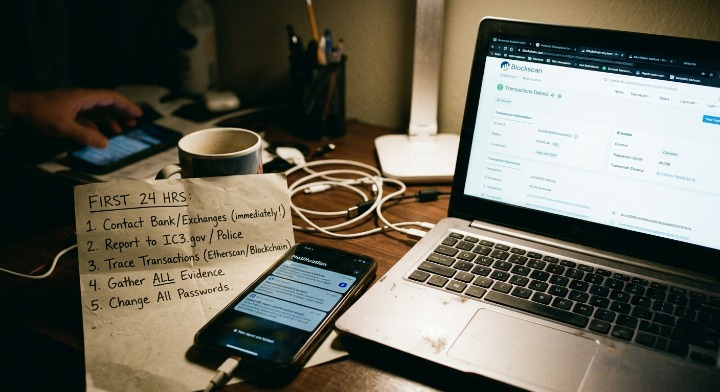
Discovering that you have been the victim of a crypto scam is disorienting. The most useful thing you can do now is slow down and work methodically. What you do in the first day often determines how much usable evidence you have later, whether you are reporting to authorities, contacting an exchange, or seeking a professional crypto scam investigation.
This guide covers what to do after being scammed on crypto, what to preserve, and how blockchain tracing works. It is general information, not legal advice, and the remedies available to you depend on your jurisdiction and circumstances.
What Should You Do Immediately After a Crypto Scam?
Your priorities are to stop further loss, secure your accounts, and preserve everything. Do not delete messages, close accounts in frustration, or move funds around in a panic. Document first, then act.
Blockchain transactions are generally irreversible, which is why speed matters. Records stay on the public ledger, but off-chain evidence (chats, profiles, websites) can disappear quickly when scammers delete accounts.
First 24-Hour Crypto Scam Checklist
- Stop sending money. Scammers often ask for “fees,” “taxes,” or “verification deposits” to release funds. Additional payments typically add to the loss.
- Limit contact with the scammer. Do not confront them or reveal what you know. If you must reply, keep it minimal, and never share seed phrases, passwords, or remote access.
- Preserve all communications. Take screenshots and export chats, emails, and call logs before anything is deleted.
- Record wallet addresses and transaction hashes. Copy them exactly, since a single wrong character makes an address useless.
- Note the asset, amount, date, time, and network. For example, “USDT on the Tron network” is materially different from “USDT on Ethereum.” Include the time zone.
- Identify the receiving wallet and transaction path. Paste the transaction hash into a public block explorer for the relevant network to see where the funds went. Take screenshots.
- Contact the relevant exchange or service, if applicable. More on this below.
- Secure your remaining accounts and wallets. Change passwords, enable two-factor authentication, revoke token approvals if you interacted with a malicious contract, and move assets to a new wallet if you suspect your keys were exposed.
- Report the incident to the appropriate authorities (see below).
- Consider professional crypto tracing or investigation help, particularly if the loss is significant or the funds have moved.
What Evidence Should You Save After a Crypto Scam?
Keep anything that links you, the scammer, and the movement of funds:
- Transaction IDs/hashes and wallet addresses (yours and theirs)
- The blockchain network used
- Screenshots of conversations, platforms, and dashboards
- Emails, chat messages, and voice or call records
- Website URLs and social media profile links
- Payment records, bank statements, and card receipts
- Exchange account details and withdrawal confirmations
- Names, usernames, and handles the scammer used
- Dates and timestamps
Preserve originals rather than editing or deleting. Cropped, annotated, or re-saved files are harder to authenticate, and deleted conversations can undermine credibility later. Make copies for working purposes and store the originals untouched.
Can Stolen Cryptocurrency Be Traced?
Often, yes, in the sense that most major blockchains are public ledgers. Every transfer is recorded, and investigators can analyze transaction paths, wallet addresses, clustering behavior, and movement into exchanges or other services.
But tracing is not recovery. Tracing shows where funds went. Recovery depends on separate factors: whether the funds are still reachable, whether a regulated service holds them, whether a court or authority acts, and whether the person behind a wallet can be identified. Tracing can produce valuable evidence, but no responsible provider can promise an outcome.
What If the Scammer Moves the Crypto to Another Wallet or Exchange?
Moving funds does not erase their history. Transfers between wallets remain recorded, and investigators can follow flows across multiple addresses, including through intermediary wallets, swaps, and bridges. Where funds reach an identifiable exchange or other service, that can be a meaningful investigative point.
That said, obfuscation techniques such as mixers, privacy tools, and chain-hopping can make analysis harder. Not every wallet owner can be identified, and tracing results should be treated as investigative findings, not conclusions about who is responsible.
Should You Contact a Crypto Exchange?
If your funds were sent from, or appear to have gone to, a centralized exchange, contacting its support or compliance team promptly is reasonable. Provide your account details, the transaction hashes, wallet addresses, dates and amounts, a short factual description of the scam, and any report number you have.
Act quickly, but set realistic expectations. An exchange cannot necessarily freeze or return funds because you submit a request. Its response depends on its policies, applicable law, and often a formal legal or law enforcement process.
Where Should You Report a Crypto Scam?
Reporting options depend on where you live and what happened. In the United States, common channels include:
- FBI Internet Crime Complaint Center (IC3):
- Federal Trade Commission (FTC):
- Securities and Exchange Commission (SEC), for investment-related fraud
- Commodity Futures Trading Commission (CFTC), for commodity or derivatives-related fraud
- State financial regulators and local law enforcement
Outside the U.S., contact your national financial regulator or police cybercrime unit. Reporting creates an official record and may assist investigations, but it does not automatically result in frozen or recovered funds.
When Should You Consider a Crypto Tracing Investigation?
Professional help is worth considering when there is:
- A significant financial loss
- Multiple wallet transfers
- Funds moving through several addresses
- Transfers involving exchanges
- Complex cross-wallet or cross-chain activity
- A need for organized, well-documented evidence for legal proceedings
FintechLegals offers Crypto Assets Tracing to map fund flows, and Crypto Investigation for broader fact-finding and evidence organization.
Internal link opportunities (use only where the existing article genuinely fits): link the exchange and wallet-movement sections to your article on following crypto funds across exchanges and wallets; link the evidence section to your article on legal evidence for cryptocurrency investigations; link “tracing is not recovery” to your tracing vs. recovery article.
What Information Is Needed for a Crypto Tracing Investigation?
Before contacting an investigator, prepare:
- A short timeline of events
- Transaction hashes and wallet addresses (yours and the recipient’s)
- Asset type, amounts, network, dates, and times
- Exchange or platform names and account details
- Screenshots and saved communications
- Scammer names, handles, websites, and profile links
- Copies of any police or regulatory report numbers
Frequently Asked Questions
Can stolen crypto be traced?
Often, yes. Most major blockchains are public, so transfers can be followed between addresses. How far tracing goes depends on the asset, the network, and whether funds pass through privacy tools or services. Tracing shows movement; it does not by itself identify the person behind a wallet.
What should I do immediately after a crypto scam?
Stop sending money, preserve all communications and transaction details, secure your accounts and wallets, and report the incident to the appropriate authorities. Avoid deleting anything. If the loss is substantial or funds have moved, consider speaking with a professional crypto tracing provider.
Can a blockchain transaction be reversed?
Generally, no. Confirmed blockchain transactions are designed to be irreversible. The practical options are usually indirect: reporting, contacting a service that may hold the funds, and pursuing legal or law enforcement processes where available. Outcomes vary widely by case and jurisdiction.
Can a crypto exchange freeze stolen funds?
Sometimes, but not automatically. Exchanges act under their own policies and legal obligations, and typically need verifiable information and, often, a formal request from law enforcement or a court. Contacting them quickly with accurate details improves the chance your report is reviewed promptly.
What information is needed to trace stolen cryptocurrency?
At minimum: transaction hashes, wallet addresses, the blockchain network, the asset and amount, and dates and times. Supporting material such as chats, screenshots, and platform details helps place the transfers in context and makes the findings more useful.
Can cryptocurrency sent to another wallet be traced?
Usually, transfers to another wallet remain visible on the public ledger, and investigators can follow them across addresses. Complexity increases with many hops, swaps, cross-chain bridges, or mixing services. Tracing may become less conclusive in those cases, though partial findings can still be valuable.
How long can a crypto tracing investigation take?
It varies. A simple, single-chain case may take days, while complex cases with many wallets, chains, or services can take weeks or longer. Timelines depend on data quality, the scope of work, and whether third-party responses are needed.
Does tracing cryptocurrency guarantee recovery?
No. Tracing produces information and evidence, not a result. Recovery depends on factors outside the tracing itself, including where funds end up, legal processes, and the cooperation of third parties. Be cautious of anyone who promises a particular outcome.
Understanding Your Options
FintechLegals provides crypto asset tracing and investigation services to help analyze cryptocurrency transactions, organize relevant evidence, and understand available investigative and legal options. We do not promise outcomes, but we can help you build a clear, documented picture of what happened to your funds. If you would like to discuss your situation, you can contact FintechLegals to speak with the team.
For more updates, follow us on LinkedIn.
Leave a Reply