



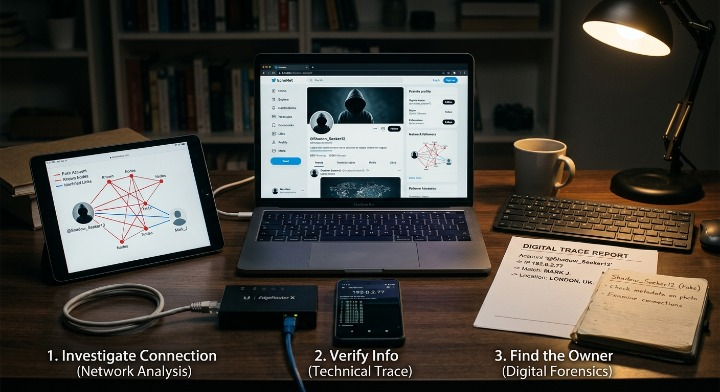
Identifying a person who operates a fake social media profile can involve looking at public data, behavior in the profile, use of similar usernames, associated websites/domains, images, among many others. In some cases, transaction history might be relevant. Identification of the real identity of a person will often involve platform-specific data or legal processes since usernames/profiles do not prove the creator of the account.
How Can You Identify the Person Behind a Fake Social Media Account?
There is no single method of unmasking all such users. It depends on the volume of information provided by the owner of the profile and the analysis of this information to determine whether it is possible to unmask the user or not.
Generally speaking, a good investigation would consist of certain elements such as:
- Available information about the profile in open sources.
- Investigation of the username and handle on different platforms.
- Analysis of images/photos.
- Information about websites/domains associated with the account.
- Behavior on different platforms.
- Digital footprints left in posts and comments or in metadata.
- Transactions information, if the case concerns money.
- Information from the platforms, if it is possible to get it legally.
- Additional evidence.
None of these clues should be considered conclusive on its own. Investigators build a case by cross-referencing multiple independent data points, since any one piece of evidence — a name, a photo, a phone number — can be fabricated, reused, or misattributed.
What Is a Fake Social Media Account?
A “fake” account is not always the same thing as a fraudulent one. It helps to distinguish between related concepts:
- Pseudonymous account – uses a name that isn’t the operator’s legal name, but isn’t necessarily deceptive.
- Anonymous account – conceals the true identity of the operator.
- Fake account – provides fake information to conceal the identity of the operator or his intentions.
- Impersonation account – imitates a real individual or entity.
- Fraudulent account – set up or used for fraudulent purposes to defraud people for personal gain.
Using a pseudonym is not, by itself, evidence of wrongdoing — many legitimate users choose not to use their real name online. The situation becomes materially more significant when an account is used for fraud, impersonation, harassment, defamation, phishing, extortion, scam activity, or intellectual property abuse.
What Information Should You Preserve Before Investigating a Fake Account?
Before any investigation begins, evidence should be preserved, since content can disappear or accounts can be altered or deleted. Useful items to record include:
- The profile URL and username
- The display/account name
- Screenshots of the profile, posts, and bio
- Posts, messages, and comments (with visible timestamps)
- Profile and cover photographs
- Any linked websites
- Publicly visible email addresses or phone numbers
- Publicly visible payment handles or details
- Cryptocurrency wallet addresses, if displayed
- Transaction IDs, where relevant to a scam or fraud claim
This should be limited to publicly accessible information. Readers should not attempt to access private accounts, private messages, or any information without proper authorization — doing so can itself create legal exposure.
Can a Fake Social Media Account Be Traced?

A fake account can sometimes be connected to its operator through a combination of digital evidence, but this depends heavily on the platform involved, the account’s privacy settings, the account’s history, whether the operator reused identifying details elsewhere, and whether legal access to platform records is available.
It is essential to distinguish between these two concepts: finding the account’s history and contacts is different from identifying its owner. Tracing may lead to the discovery of various information and hints; proof of ownership will involve additional evidence and often legal means.
How Do Investigators Use OSINT to Identify the Owners of Fake Accounts?
OSINT (open-source intelligence) means the legitimate gathering and analysis of information that is freely accessible. In the context of fake account investigations, this typically includes usernames, public profiles, personal or business websites, public posts, business registries, domain records, search engine results, publicly posted images, and public professional profiles (such as those on business networking sites).
Investigators compare these sources against one another, looking for consistent identifying details — a repeated writing style, a reused photo, a shared contact address, or a website registered to the same party. This kind of structured digital investigation is far more reliable than looking at a single data point in isolation.
None of this involves bypassing privacy settings or accessing non-public data. Where a matter involves suspected fraud, impersonation, or defamation, a professional digital investigation service can help structure this research properly and preserve findings so they hold up if legal action follows.
Can a Username Reveal Who Is Behind a Fake Account?
In some cases, the username used can also serve as a hint, particularly where the same or similar username appears on several websites. Through this, you will be able to find out more about such people.
However, this similarity in usernames does not automatically mean that these are all accounts belonging to the same person. There might be coincidence, copying or impersonation. Any lead generated this way needs to be corroborated with additional, independent evidence before it carries real weight.
Can Reverse Image Searches Help Identify a Fake Profile?
Reverse image searches will help find out if the profile photo has been taken elsewhere, if it belongs to someone else or has appeared on some other website, or has been used to create a fake identity through stolen images. These are often used for romance fraud or impersonations.
However, it is not enough just to establish the image match because the image match alone will not tell who the actual user behind the profile is.
Can a Fake Account Be Linked to a Website or Domain?
The fake accounts involved in scams and impersonation cases are often part of an existing online footprint in terms of a fraudulent website, a company name, or a contact point that can be found somewhere else. Investigators can analyze publicly available links between the social media account and related domains or business listings.
Investigations into the domain can disclose more information about who registered it or who is hosting the domain and which businesses are related to it. Conducting a structured domain ownership investigation can be useful in linking the fake account to the website.
Can Investigators Find the IP Address Behind a Social Media Account?
In general, no — it is impossible for an investigator to get access to another individual’s private IP address using the information from his/her social media profile. IP addresses and other technical account information are usually owned by the platform itself and are not visible to the public at all times.
Here lies the distinction between public information (anything that could be found in an individual’s profile or posting) and platform-owned information (technical account information that is owned by the service provider). Platform information can only be accessed through the platform itself or through proper legal means, such as a subpoena or court order. There is no legal way of obtaining an individual’s IP address without his knowledge.
Can Social Media Platforms Reveal the Identity of a Fake Account Owner?
It is possible for the platforms to have account information that consists of registration information, related email accounts, and also connection logs, but access to the account information that is not publicly available depends on various rules, laws, and legal requirements of particular jurisdictions.
Legal authorities, including lawyers and police, can apply the appropriate legal means, such as obtaining court orders or other forms of legal requests, in order to get this information. There is no automatic right to obtain another user’s private platform data.
How Can a Fake Account Be Investigated for Fraud?
Fake social media accounts are frequently connected to investment scams, cryptocurrency scams, phishing schemes, payment fraud, romance scams, impersonation of businesses or executives, and other forms of business fraud.
Investigating these cases usually means combining social media evidence with other data: payment records, website evidence, domain information, cryptocurrency wallet activity, transaction records, and relevant communications. Where digital assets are involved, crypto investigation and cryptocurrency asset tracing may help follow the flow of funds and connect financial activity back to the account in question. A broader fraud investigations approach ties the social media evidence to the financial trail.
How Can a Fake Social Media Account Be Investigated for Defamation?
It’s important to distinguish between criticism, opinion, false factual statements, impersonation, and content that may be defamatory — this article does not offer legal conclusions on any specific case, since that determination depends on jurisdiction and specific facts.
From an investigative standpoint, the focus is typically on establishing who controlled the account, what was published and when, whether content was later altered or deleted, and what evidence connects the account to a specific individual or entity. Where reputational harm is involved, an online defamation investigation can help document this evidence properly before content disappears.
What Evidence Can Help Identify a Fake Social Media Account Owner?
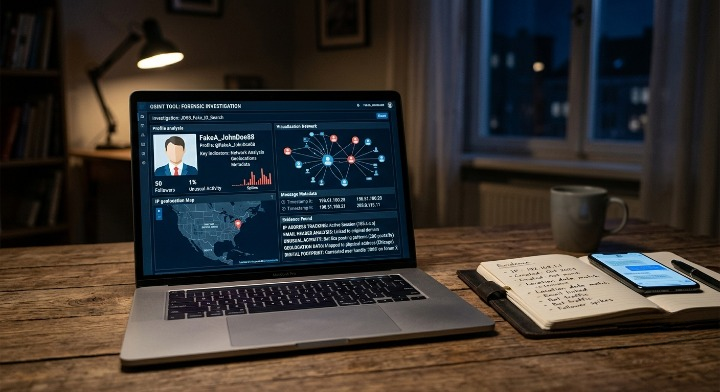
The list of evidence includes profile URL, profile picture, posts by the user, screenshots, messages, email and phone number provided by the person in question, duplication of usernames, websites linked to, information regarding the domain, public records about the business, cryptocurrency wallet address, transaction hash, and any other trace.
At the same time, evidence can be different in strength, depending on the situation and authentication of evidence. Thus, for instance, a screenshot is less powerful than data with a timestamp and source.
What Are the Limitations of Fake Social Media Account Investigations?
Limitations should be openly acknowledged by investigators. Limitations that may occur are false or stolen identities, use of proxies and other technologies for maintaining anonymity, deleted information, multiple interlinked or throwaway accounts, fake information, restrictions imposed by the website regarding the transfer of information, international jurisdiction problems, lack of cooperation from the platform, and lack of sufficient information in general.
It would be wrong to promise anything without having an overview of the available evidence.
What Should You Do If You Find a Fake Account Using Your Identity?
- Gather evidence instantly, such as screenshots and links to the pages.
- Gather the precise link to the profile as well as the username.
- Report the account through the impersonation report form on the specific social media network.
- Protect yourself by protecting your accounts too.
- Change the password of all accounts that may have been compromised.
- Gather any communication regarding the impersonation.
- Seek the advice of a lawyer in addition to legal guidance.
- Hire a professional investigator, especially if there is financial loss, harassing behaviors or continued impersonation, including notice and takedown services.
It is best not to approach the individual operating the suspicious account, as this may jeopardize both your safety and any potential future investigations.
Frequently Asked Questions
Is a fake social media account traceable?
Not always. The possibility of tracing depends on the platform used, its privacy settings, and the amount of identification left by the person operating the account. Digital fingerprints, similar usernames and associated websites are all good leads, but tracing of activity does not equate to tracing ownership.
What methods can be used to ascertain the identity of a fake social media account’s owner?
The investigation of an account’s identity usually entails OSINT research and analysis of the username or profile picture, websites or domain names, as well as behavior across different platforms. Multiple corroborated independent pieces of evidence are always necessary for identification.
Does the username used by the owner of an anonymous social media account reveal his identity?
A reused username might be a lead which will show you other websites or social media profiles that belong to the same individual. However, coincidence of the username alone does not constitute proof of ownership of both accounts.
Can reverse image searches identify a fake account owner?
Reverse image searches can show whether a profile photo was stolen or copied from elsewhere, which is common in impersonation and romance scams. This confirms the image isn’t genuine but doesn’t, by itself, identify who is actually operating the account.
Can investigators obtain the IP address of a social media account?
Generally not directly. IP addresses are platform-held technical data, not public information. The collection of this type of information typically entails either cooperation of the platform or a legal procedure involving, for instance, a court order – there is no legitimate way to gain this information without proper authorization.
Can a social media company give out the identity of the fake account holder?
While they can have information about the identity of account owners, this data will be protected by privacy regulations, platform policies, and applicable law. Information about individuals cannot be shared without the use of the right legal means.
How can I save evidence from the fake social media account?
You will need to gather the profile’s URL, the username, screenshots of the posts and direct messages, timestamps of the posts and messages, profile photos, linked websites (if any), and publicly available contact/payment information. It is important to collect it immediately, as the information can be changed or deleted.
Can a fake social media account be investigated for fraud?
Yes, this can happen. Investigation of fraud-related fake accounts involves the use of social media evidence together with the information about payments, domains, and cryptocurrencies, if applicable.
Can an impersonated social media account be investigated for defamation?
Yes, although the defamatory nature of certain content will vary according to jurisdiction and circumstances. The investigation will aim to prove the identity of the account owner, the nature of the posted content, and how it is linked to a particular individual or organization.
What actions should be taken when someone impersonates me on social media?
Evidence must be collected, reporting should take place on the social network, security of personal accounts must be strengthened, and legal assistance might be sought in case of serious cases of impersonation.
Conclusion
Identifying the person behind a fake social media account usually requires multiple pieces of corroborating evidence rather than a single online clue. OSINT research, digital footprints, domain and website information, public records, social media evidence, and — where legally available — platform-held information can all contribute to building a credible picture of who is behind an account.
No legitimate approach can promise that every anonymous account will be identified. Where impersonation, fraud, or defamation is involved, FintechLegals’ Online Defamation, Domain Ownership Investigation, Fraud Investigation, and Notice and Takedown services can help structure a lawful, evidence-based investigation appropriate to the circumstances.
For more updates, follow us on LinkedIn.
Leave a Reply