


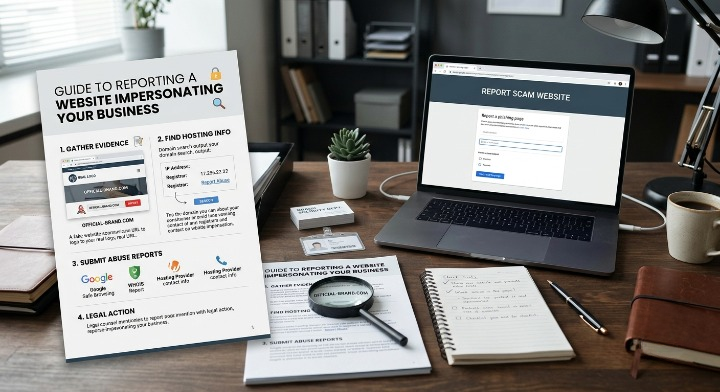
To report a site that is falsely representing your company, start by gathering evidence in the form of screenshots, links to the site, and the copied logos. After that, you need to make sure that your business information is accurate and establish the identity of the domain registrar and host. Report through the appropriate channel, since the right route depends on the type of impersonation.
What Is Website Impersonation?
Website impersonation takes place when there is a copy of any brand name, logo or identity of a business through a fake site in order to make people think that they are dealing with the real organization. Common instances of website impersonation may be a cloned site which is collecting personal details of clients; a false “customer support” page; a site with wrong claims that it belongs to the real brand; or any site using false descriptions or images of the company.
It is necessary to understand the difference between impersonation and criticism or comparison. The competitor’s comparison page, customer reviews or parody is not necessarily illegal even though it is impersonation.
How Can You Tell If a Website Is Impersonating Your Business?
Signs that you could consider monitoring include:
- Identical or confusingly similar branding and logos
- Plagiarized firm description/ “About Us”
- Claimed affiliation with your company when there isn’t one
- Deceptively similar domain name
- Faked contact information, executives, or customer support sections
- Unauthorized trademark usage
- Demands for client payment or password/login details
- Claiming to be the “official” company website
However, no single sign is sufficient on its own as proof of illegal activity.
What Should You Do First If You Find a Fake Website?
Step 1: Do not contact the operator right away. Doing so may trigger the site to vanish before you get a chance to collect evidence.
Step 2: Collect evidence. The evidence you need to collect include the complete URL, domain name, screenshot, date and time accessed, copied branding, false claims, contact details, payments instruction, and associated social media accounts. Having evidence will support the case you will file later on.
Step 3: Compare it with your website. List down how the sites are similar and different to prove that the site copied your site.
Step 4: Evaluate potential risk to customers. If the site accepts payments, passwords, and personal details, then treat it as an emergency issue.
How Do You Report a Website Impersonating Your Business?
1. Domain Registrar
Many registrar firms have an abuse reporting procedure in place. The following are things you’ll need to have: the domain name itself, proof that impersonation has occurred, company details, an explanation of the problem, and information related to any trademark or copyright. This is not a reason for a registrar to automatically suspend every domain reported.
2. Hosting Provider
The identification of the host (using technical tools) will help you make your complaints directly to the hosting company. However, hosting companies are not required to take down all sites that receive complaints, but filing a proper complaint increases your chances.
3. Search Engines
Search engines can provide ways to report any deceitful or misleading content. Removal of the site from search engine results is not equal to deleting the website because even without the search result, the website can continue to operate online.
4. Social Media and Advertising Platforms
If the fake website uses promotion on Facebook, Instagram, X, LinkedIn, YouTube, or other advertising sites, each has their own process to report impersonation or fraud on its platform.
5. Government or Law Enforcement
Fraud cases, identity theft cases, financial crimes, or cases that may affect customers must be reported to relevant authorities. This is because each country has its own set of procedures; hence companies ought to carry out some investigation to find out the specific process involved in their country.
What Evidence Should You Collect Before Reporting a Fake Website?

An ideal evidence file should comprise:
- Screenshot images and complete URL links
- Domain names, WHOIS/RDAP info wherever applicable
- Email IDs, contact phone numbers, and other payment data
- Cryptocurrency wallets, wherever applicable
- Social media accounts and advertisements
- Complaints made by customers, along with timestamps
- Documentation for validating the legitimate existence of your business
For instances where the fake website is involved in cryptocurrency scams, a fraud investigation or cryptocurrency asset tracing can be helpful.
Can You Find Out Who Owns an Impersonating Website?
Not always. Registration data can be restricted by privacy issues or proxy services, while technical information will generally only lead to infrastructure, rather than the person behind it. An individual operator would normally have to be identified through a number of factors.
Here, a domain ownership investigation becomes relevant — analysis of all available data related to registration, technical information, history, and public sources can provide some clues regarding who controls a particular domain.
What Is a Domain Ownership Investigation?
Domain ownership research may encompass registration information, historical registration information, DNS records, hosting information, web page content, contact information, relevant domains, and other legal public sources. The goal is to connect available technical and public information to a specific entity or individual where possible — always through lawful means, never through unauthorized access or intrusive surveillance.
How Can You Get an Impersonating Website Taken Down?
Depending on the circumstances, potential routes include a registrar abuse report, a hosting-provider complaint, a trademark or copyright complaint, a platform complaint, a formal legal notice, court action, or law-enforcement referral in serious cases.
It’s worth distinguishing reporting a website (flagging it to a provider or platform) from legally compelling its removal (via a notice, trademark claim, or court order) — the second generally requires stronger evidence and a defined legal basis. Neither guarantees takedown. FintechLegalsnotice and takedown services help businesses prepare and submit evidence-backed requests to the right parties.
What Should a Website Takedown Notice Include?
Generally, an effective notification should contain your company name and contact information, the specific website addresses that are being reported for violation, details on the type of impersonation, the evidences, the legal grounds, if any, and the necessary steps to be taken. An effective notification tends to be better than an abstract complaint.
What If the Fake Website Is Scamming Customers?
The situation becomes more urgent when the site is collecting payments, passwords, financial data, or identity documents, conducting cryptocurrency transactions, or sending phishing emails. In these cases, preserve evidence immediately and consider appropriate fraud, cybercrime, or financial-authority reporting channels. FintechLegals’ fraud investigations services can assist where customers are actively being defrauded.
What If the Website Is Using Your Company’s Name and Logo?
Using your name and logo without permission can trigger trademark infringement, copyright, misrepresentation, or unfair competition, among others. Not every unauthorized use automatically violates a specific law — the applicable route depends on how the material is being used and where.
Can You Remove an Impersonating Website From Google?
Reporting a search result and removing the underlying website are different processes. There may be facilities within the search engine for removal of certain types of harmful information, but removal of the item from the results will not remove the site, which can still be reached by other means.
When Should a Business Hire a Website Investigation or Takedown Specialist?

Professional help is often worthwhile when the domain owner is hidden, the site is actively defrauding customers, multiple domains are involved, prior complaints have failed, or a formal legal notice needs to be prepared. FintechLegals supports businesses through domain ownership investigation, notice and takedown services, fraud investigations, and online defamation services where false claims are also involved — without promising guaranteed outcomes.
Conclusion
Dealing with a business-impersonating website starts with preserving evidence and documenting the deception clearly. From there, identify the right reporting channel — registrar, host, platform, or authority — and determine whether a domain ownership investigation, formal takedown notice, or broader fraud investigation is warranted. FintechLegals’ notice and takedown and domain ownership investigation services can support businesses through this process, though no outcome — removal or identification — can be guaranteed in advance.
FAQ
How do I report a website impersonating my business?
Preserve evidence first, then report to the domain registrar, hosting provider, relevant platforms, or authorities depending on the nature of the impersonation and level of harm involved.
How do I report a fraudulent site that uses my business name?
Note the use, then lodge a complaint against the domain registrar or web host, and consider issuing a trademark notice or a cease-and-desist letter if it’s harmful.
Can I find out who owns an impersonating website?
Sometimes. There is not always much public information available; therefore, a research effort using both public records and technical domain owner analysis will be required.
Is it possible for a domain registrar to remove the fake website?
Domain registrars can suspend any website that goes against their terms and conditions, but not automatically.
Can a hosting provider remove an impersonating website?
Hosts can act on abuse complaints but aren’t required to remove every disputed site; a detailed, evidence-based report improves your chances.
What proof is required before reporting an impersonation website?
Screenshots, URLs, WHOIS information, the contact and financial information used on the fraudulent website, and information showing you have a legitimate business.
Can Google remove a fake website from search results?
Google can sometimes delist specific results, but this doesn’t take the underlying website offline.
How do I get an impersonating website taken down?
It could be done through registrar/host complaints, trademarks/copyrights complaints, platform reporting, or even legal action, depending on the circumstances.
What do I need to have in my takedown notice to make sure my website gets taken down from the internet?
You need to include your company details, the websites involved, the details of the impersonation, and the action required by the website owners.
What do I need to do if there is a website that is scamming my customers using my business name?
You need to collect evidence since this is a pressing issue.
For more updates, follow us on LinkedIn.
Leave a Reply