



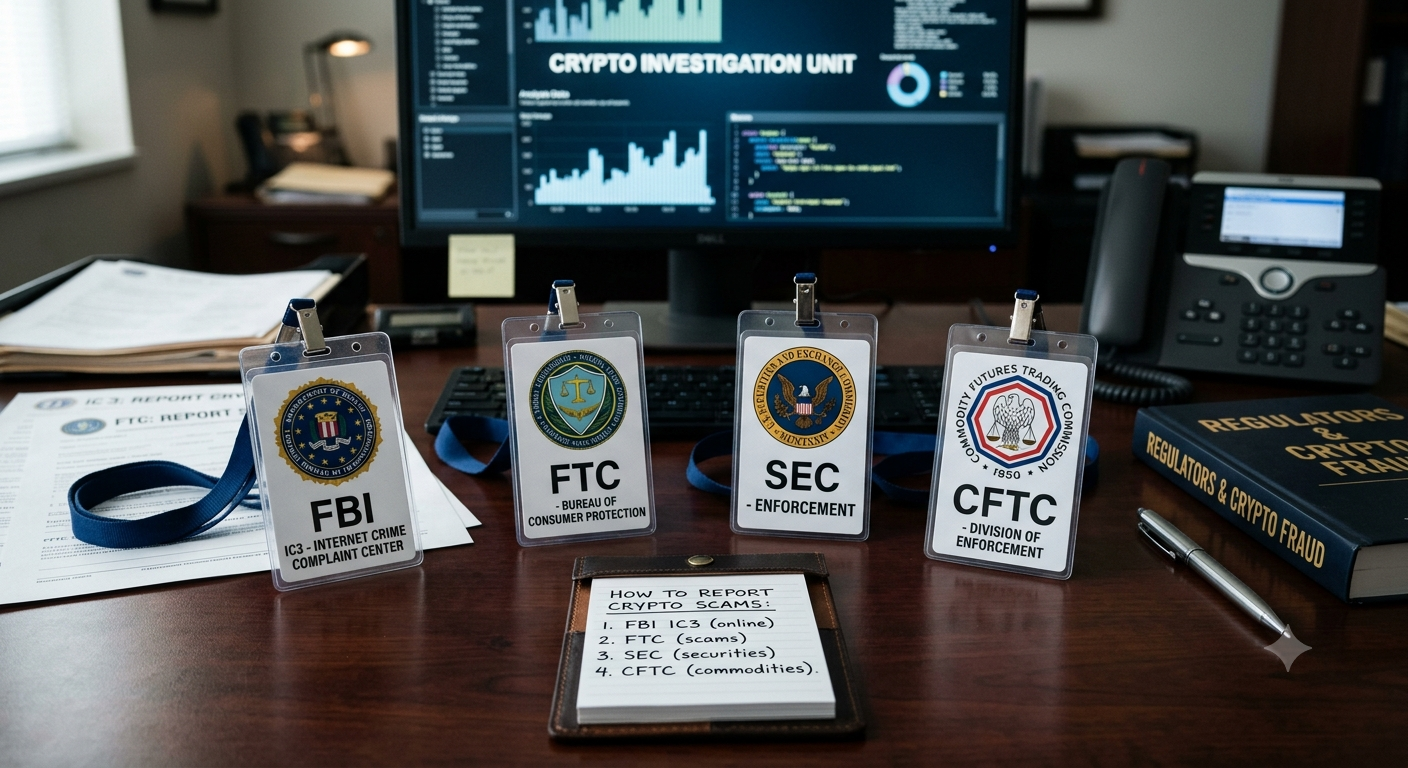
If you’ve lost money to a cryptocurrency scam, knowing how to report it is an important first step. Reports help authorities spot patterns, link cases, and sometimes act against the people behind the fraud. Before you submit anything, preserve your evidence. Scam websites disappear, chats get deleted, and accounts are closed quickly.
Reporting is not the same as recovery. This guide covers where to report in the United States, what to prepare, and how blockchain tracing fits in. It is general information, not legal advice.
What Should You Do Before Reporting a Crypto Scam?
Collect and save the following, keeping the original files rather than only screenshots of them:
- Transaction hashes (transaction IDs)
- Sending and receiving wallet addresses
- The blockchain or network used (Bitcoin, Ethereum, Tron, etc.)
- The amount and type of cryptocurrency, plus the date and time
- Exchange account details and statements
- Screenshots, emails, and messages
- Scam website URLs and social media profiles
- Phone numbers, usernames, and email addresses used by the scammer
- Bank, card, or other payment records
Originals keep metadata such as timestamps and headers, which investigators and exchanges may need. Don’t delete conversations, and don’t keep engaging with the scammer.
Where Can You Report a Crypto Scam in the United States?
Different agencies handle different situations. You can report to more than one, and the same facts may fit several channels. Official reporting pages change over time, so confirm each one directly before relying on it.
FBI Internet Crime Complaint Center (IC3)
IC3 is the FBI’s portal for internet-enabled crime. An FBI crypto scam report is appropriate for investment scams, romance or “pig-butchering” schemes, impersonation fraud, extortion, or theft involving cryptocurrency. IC3 complaints are used to identify trends and support investigations, but a submission does not guarantee a case will be opened.
Federal Trade Commission (FTC)
Consumers can file at ReportFraud.ftc.gov for scams such as fake investment platforms, impersonation, online shopping fraud, and romance scams. The FTC uses reports to track fraud and take enforcement action, but it does not resolve individual complaints or recover money for each victim.
Securities and Exchange Commission (SEC)
The SEC may be relevant when a crypto-related scheme involves securities, such as investment contracts, unregistered offerings, or Ponzi-style schemes. Tips can be submitted through the SEC’s Tips, Complaints and Referrals portal. Not every crypto scam involves a security, so the SEC is not the right channel for every case.
Commodity Futures Trading Commission (CFTC)
The CFTC oversees derivatives markets and has asserted authority over fraud and manipulation involving some digital-asset commodities. Complaints about leveraged or derivatives-style crypto trading, or about fraud in digital-asset commodity markets, may be relevant. Submit through the CFTC’s complaint and tip page. As with the SEC, jurisdiction depends on the facts.
State Regulators and State Attorneys General
State securities regulators can receive complaints about local fraud, unregistered sellers, and consumer protection violations. State authorities sometimes act when federal agencies cannot, and local police may also take a report. If you’re outside the U.S., report to your own country’s police and financial regulator instead.
What Information Do Crypto Scam Reports Need?
Use this checklist when filing:
- Your contact details and a short timeline of events
- How the scammer first contacted you
- Scammer identifiers: names, aliases, emails, phone numbers, websites, social accounts
- Wallet addresses and transaction hashes
- Amounts, dates, times, and the network or exchange used
- Payment methods and any bank or card transactions
- Copies of communications
Transaction hashes and wallet addresses are especially useful because they are permanent, public identifiers. They let investigators see where funds went and compare addresses across multiple reports.
Can Reporting a Crypto Scam Freeze the Stolen Cryptocurrency?
Not automatically. Blockchain transactions generally can’t be reversed, and no regulator will freeze funds simply because a form was submitted.
Still, speed matters. If stolen funds reach a centralized exchange, that platform may be able to review the deposit, restrict an account under its own policies, or respond to a lawful request from authorities. Whether it does depends on the exchange, the jurisdiction, and the evidence.
Tracing is useful here because it can show whether funds reached an exchange and which deposit address and transaction are involved. That gives you specific information to include in a report. Freezing is never guaranteed, and neither is recovery.
Can You Trace Cryptocurrency After Reporting a Scam?
Yes, often to a meaningful extent. Public blockchains record every transfer, so analysts can follow funds using:
- Wallet-to-wallet transfers from your wallet onward
- Transaction hashes as fixed reference points
- Exchange deposits, which may be points where an exchange holds account information
- Multiple hops through intermediary wallets, often used to obscure the trail
- Cross-chain movement, where funds are swapped or bridged to another network
Tracing helps identify useful points in the trail. It does not automatically reveal who owns a wallet. Real-world identity generally becomes available only through exchange records or legal process, and only if authorities or courts pursue it. Learn more about cryptocurrency tracing.
What Is the Difference Between Reporting a Crypto Scam and a Crypto Investigation?
Reporting means notifying authorities or relevant organizations about suspected fraud.
Investigation and tracing means analyzing blockchain transactions and available evidence to understand where funds moved and what information may support further action.
They work best together: a report alerts authorities, while an investigation helps organize the facts behind it. FintechLegals offers Crypto Assets Tracing and Crypto Investigation services to help analyze transaction movements and structure evidence. These services don’t guarantee recovery or a legal outcome. (For background, see our guide on crypto asset recovery versus crypto asset tracing.)
What If the Scammer Has Already Moved the Crypto?
Report it anyway. Funds that have passed through many wallets still leave a record, and your complete transaction history may link to other victims or to known addresses. Preserve every transaction hash, including intermediate ones you learn about, along with timestamps and the full communication record. A gap in the history can make later analysis harder.
Should You Contact the Exchange That Received the Funds?
If tracing shows funds reached an exchange, contacting its compliance or fraud team may be worthwhile. Provide the transaction hash, deposit address, date and amount, and a copy of your police or IC3 report if you have one. The exchange may not share account details with you, but it can note the report internally.
Be careful: scammers often pose as “recovery agents,” exchange staff, or law enforcement, and demand upfront fees or access to your wallet. Genuine agencies don’t charge to recover funds, and no one legitimate needs your seed phrase. Contact exchanges only through the official channels on their own websites.
What Happens After You Report a Crypto Scam?
You may receive an automated confirmation, and little else. Agencies use reports for investigations, regulatory action, and intelligence, but they typically don’t update individual complainants. Don’t assume a report guarantees an investigation, an asset freeze, or a refund. Keep copies of everything you submit and any reference numbers.
Frequently Asked Questions
1. Where should I report a crypto scam?
In the U.S., start with the FBI’s IC3 and the FTC, and consider your state attorney general or securities regulator. Depending on the scheme, the SEC or CFTC may also be relevant. Also report to the exchange involved and local police if appropriate.
2. Can I report a crypto scam to the FBI?
Yes. You can file a complaint with the FBI’s Internet Crime Complaint Center (IC3) online. Include wallet addresses, transaction hashes, and communications. The FBI uses complaints for investigations and trend analysis, but filing does not guarantee that your case will be investigated or funds returned.
3. Should I report a crypto scam to the FTC?
Generally yes, especially for fake investments, impersonation, or romance scams. FTC reports feed a database used by law enforcement and for consumer protection enforcement. The FTC doesn’t resolve individual disputes, so treat the report as one step among several.
4. When should I contact the SEC about a crypto scam?
Consider the SEC if the scheme resembles an investment offering, such as pooled investments, promised returns from others’ efforts, or a Ponzi-style structure. Not every crypto scam involves securities, so the SEC may not be the right agency for simple theft or impersonation.
5. Can the CFTC investigate cryptocurrency fraud?
Sometimes. The CFTC has pursued fraud and manipulation involving digital-asset commodities and derivatives. It may be relevant to leveraged or futures-style crypto trading schemes. Its authority depends on the facts, so it isn’t the right channel for every cryptocurrency fraud.
6. What evidence do I need to report a crypto scam?
Gather transaction hashes, wallet addresses, the network used, amounts, dates, exchange records, scam website URLs, social accounts, and all messages and emails. Keep original files, not just screenshots, and record a clear timeline of events. More specific detail makes a report more useful.
7. Can reporting a crypto scam get my money back?
Not on its own. Reports help authorities, and in some cases exchanges act on information about deposited funds, but there is no guarantee of a freeze or refund. Recovery depends on where the funds went, how quickly action occurred, and the legal process available.
8. Can stolen cryptocurrency still be traced after I report it?
Yes. Public blockchains keep permanent records of transfers, so analysts can often follow funds across wallets, exchanges, and sometimes other networks. Tracing shows movement, not owner identity, and it doesn’t guarantee recovery.
Next Steps
If you need help analyzing cryptocurrency transactions or organizing evidence after a suspected scam, learn more about FintechLegals’ Crypto Assets Tracing and Crypto Investigation services. Tracing can clarify what happened to your funds, but it cannot promise recovery or a particular outcome.
For more updates, follow us on LinkedIn.
Leave a Reply