


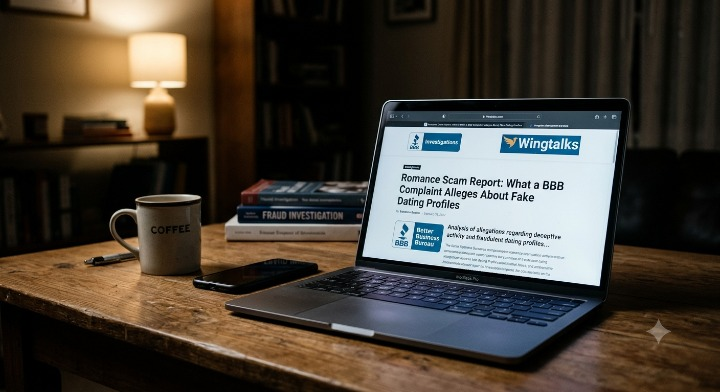
A consumer in Raleigh, North Carolina, filed a Better Business Bureau (BBB) Scam Tracker report on October 30, 2026, about the Wingtalks dating website (Wingtalks.com). The complainant says she paid a membership fee and then received a flood of romantic emails she believes came from fake dating profiles and automated messaging. These are one person’s unverified allegations, but they show warning signs worth knowing before you pay for any dating service.
What Is the Wingtalks.com Romance Scam Report About?
The report (BBB Scam Tracker ID 1464915) is a romance-category complaint against Wingtalks. The complainant says she signed up after seeing an ad promising a chance to meet local men. She says she paid the site’s minimum fee, though she doesn’t state the amount, and that the messages she received convinced her the site was not what it advertised.
The report lists the scammer’s location as California, with no email address or phone number. Like all Scam Tracker entries, it reflects the experience of the person who submitted it.
How Did the Reported Dating Platform Activity Raise Suspicion?
The complainant says emails arrived almost immediately after she uploaded a photo. She describes the senders as men in their 70s, many claiming to be California doctors, with several using Spanish names and one saying he lived in Madrid. The messages, she says, were intensely affectionate for strangers.
Her concern was that the profiles seemed to share the same template: similar ages, similar professions and similar language. None of this has been independently confirmed, and it shouldn’t be assumed that every Wingtalks profile is fake.
Why Did the Complainant Suspect Fake Dating Profiles?
She suspected automation because the messages kept arriving even after she changed her photo to one showing missing front-tooth crowns. Some senders reportedly said they had seen her photo and made her a favorite. She took this as a sign the senders weren’t reading or reacting to her profile, which led her to conclude the messages were bot-generated.
Repetitive, flattering messages that ignore context are a recognized red flag on dating platforms. Still, her conclusion is an inference, and the report doesn’t establish that bots were used.
What Happened When the Complainant Requested Account Deletion?
According to the complainant, she asked the site to delete her account and remove her photograph, and it refused. She says emails continued at roughly 20 a day. This is her account alone. The report includes no response from the business, and the page notes that a business named in a report can dispute it.
What Are the Warning Signs of Online Romance and Dating Scams?
Common warning signs include affectionate messages from strangers, large volumes of unsolicited romantic email, and profiles whose details can’t be verified. Others are repetitive scripted language, payment demands before you can communicate, and trouble deleting accounts or photos.
Fraud researchers treat these as general indicators, not proof about any specific website. A single sign may have an innocent explanation, but several together justify caution. Romance scams can also escalate: once a conversation begins, scammers often move toward requests for money, gift cards or personal information.
How Can Users Protect Themselves From Fake Dating Websites?
Research a platform before paying, and use these habits:
- Search for complaints and reviews on the BBB, consumer forums and regulators’ sites.
- Run a reverse image search on suspicious profile photos.
- Withhold sensitive details such as your address, financial information and ID documents.
- Read the terms for cancellation, data deletion and recurring billing before entering payment details.
- Screenshot messages and profile pages, with dates visible.
- Check the payment terms so you know what you’ll be charged and when.
- Report suspected fraud to your national consumer protection authority. In the U.S., that includes the BBB Scam Tracker and the Federal Trade Commission.
What Should Users Do If a Dating Website Refuses to Delete Their Account?
Keep a record of everything. Save your deletion request, any replies and the continuing messages, and send follow-up requests in writing so there’s a timestamped trail. Review the site’s privacy policy for its stated deletion process, as some jurisdictions give users legal data-removal rights.
If billing is involved, contact your card issuer or payment provider about disputing the charge. You can also report potentially deceptive practices to consumer protection agencies.
How Can FintechLegals Help With Online Fraud Investigations?
FintechLegals provides services in financial fraud investigations, digital forensic analysis, due diligence, claims and disputes, and cyber intelligence. Those capabilities are relevant when someone needs to examine suspicious online activity, digital communications, impersonation or questionable platform operations.
Relevant services include:
- Fraud Investigations for suspected deceptive schemes
- Forensics and Data Analysis for examining digital evidence such as messages and account records
- Cyber Threat Intelligence for identifying patterns in online threats
- Due Diligence Services for vetting a platform before engaging with it
- Online Defamation Services for harmful or false online content
FintechLegals has not investigated Wingtalks or verified the claims in this report, and no service can guarantee outcomes, compensation or fee recovery. If you’ve had a similar experience, you can contact FintechLegals to discuss which investigation services fit your situation.

Leave a Reply