


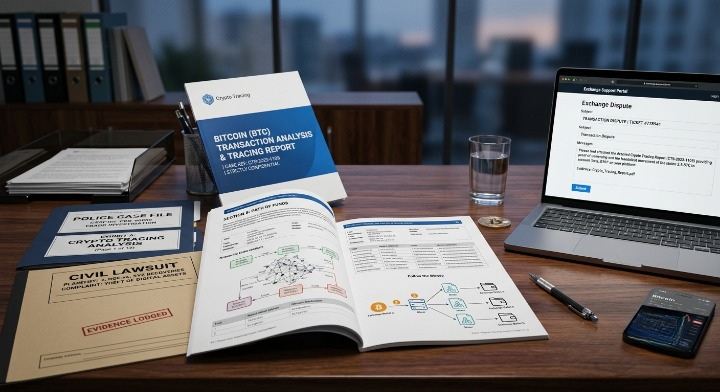
A crypto tracing report organises blockchain transaction evidence into a clear, reviewable record showing where funds moved. It can support a police complaint, help a lawyer assess a civil claim, and back an exchange dispute. It does not prove who owns a wallet, establish guilt, or guarantee recovery.
Transaction records alone rarely tell the full story. A list of hashes and wallet addresses is hard for a police officer, lawyer, or exchange analyst to read. Crypto asset tracing turns that raw data into a structured account of what happened, which is the main value of a tracing report.
What Does a Crypto Tracing Report Contain?
A crypto tracing report sets out the on-chain facts of a transaction trail, plus the method used to reach them. It typically includes:
- Relevant transaction IDs (hashes) and timestamps
- Sending and receiving wallet addresses
- Transaction paths and intermediary wallets
- Possible links to known exchange or service-provider wallets, where evidence supports them
- The methodology, source data, assumptions, and limitations
Cryptocurrency transaction tracing can show patterns and possible connections. It does not automatically reveal who controls a wallet. For background, see how investigators follow crypto funds across exchanges and wallets. Tracing is often one part of a broader crypto investigation into suspicious activity.
How to Use a Crypto Tracing Report in a Police Complaint
A tracing report helps you present suspected crypto fraud in an organised, checkable way. It supports your complaint but does not replace the official investigation. To prepare:
- Build a timeline of events, from first contact to the last transfer.
- Record the asset, amounts, transaction IDs, wallet addresses, and dates.
- Attach exchange statements, wallet records, messages, and payment receipts.
- Summarise the tracing findings in plain, non-technical language.
- Keep the original records and a copy of everything you submit.
Reporting procedures and evidence requirements vary by jurisdiction, so check the agency’s own guidance. Our guide on how to report a crypto scam covers the main channels. If your case involves wider deception, such as fake platforms or impersonation, fraud investigations can help document that context.
How to Present a Crypto Tracing Report in a Civil Lawsuit
In a civil matter, a tracing report gives your lawyer a transaction chronology to assess. It can help to:
- Establish a clear sequence of events
- Identify which transactions are relevant to the dispute
- Organise supporting documents for legal review
- Flag questions that may need further investigation or disclosure
- Check whether the report’s methodology suits the intended legal process
A specialist team handling claims and disputes can help assess and organise evidence for a disputed transaction. Admissibility, evidentiary weight, expert-evidence requirements, and disclosure obligations depend on the court and jurisdiction. The report does not independently prove liability or guarantee an outcome.
How to Use a Tracing Report in a Crypto Exchange Dispute
A report can support a complaint when the relevant transactions touch an exchange’s platform or wallets. Include:
- Transaction IDs, timestamps, wallet addresses, and amounts
- A concise explanation of the suspected unauthorised or fraudulent transfers
- Account records and correspondence
- A clear request for review, preservation of relevant records where appropriate, and escalation through the exchange’s official dispute process
Exchanges face legal, privacy, security, and operational limits on what they can disclose or do. A report does not guarantee a freeze or reversal. See can a crypto exchange freeze stolen funds for and what to expect.
What Documents Should Accompany a Crypto Tracing Report?
Pair the report with the source documents behind it. A practical checklist:
- Blockchain transaction hashes
- Wallet and exchange account records
- Bank or payment-provider statements, where relevant
- Messages, emails, contracts, invoices, and investment-platform communications
- Dates and amounts of transfers
- Previous complaints and exchange correspondence
Exact requirements depend on the police, lawyer, court, or exchange receiving them. Our guide to what evidence is needed for a cryptocurrency investigation goes into more detail. Where the counterparty’s identity or legitimacy is in question, due diligence services can add background checks and verification alongside transaction analysis.
Common Mistakes to Avoid When Submitting a Crypto Tracing Report
- Treating a wallet association as definitive proof of identity
- Making accusations the evidence does not support
- Submitting incomplete or inconsistent transaction records
- Editing original evidence without preserving the source files
- Assuming tracing findings guarantee recovery
- Sharing private keys, seed phrases, or passwords with anyone. No legitimate investigator or support agent needs them.
How FintechLegals Can Help With Crypto Tracing and Dispute Documentation
FintechLegals provides crypto asset tracing and investigation-related services. Professional tracing can organise blockchain findings and supporting information for further review. Where appropriate, the findings can be shared with your lawyer, a relevant authority, or an exchange as part of the applicable process. FintechLegals does not guarantee fund recovery, legal success, exchange action, or acceptance of a report by a court or law enforcement agency.
If you need your transactions documented, learn more about our cryptocurrency tracing services.
Frequently Asked Questions
Can a crypto tracing report be used in a police complaint?
Yes, it can help organise transaction details for a complaint. It supports your account but does not replace the official investigation. Procedures and evidence requirements vary by jurisdiction, so check the receiving agency’s guidance first.
Is a crypto tracing report enough to file a civil lawsuit?
Usually not on its own. It helps a lawyer assess the transaction chronology, but a claim also needs supporting documents and a legal basis. Whether to sue, and how, depends on the facts and the jurisdiction.
Can a crypto exchange act on a blockchain tracing report?
It may review one, but it isn’t obliged to freeze funds or reverse transactions. Exchanges operate within legal, privacy, and security limits, and their response depends on their policies and the facts of the case.
What evidence should accompany a cryptocurrency tracing report?
Include transaction hashes, wallet and exchange records, payment statements, communications, contracts or invoices, transfer dates and amounts, and earlier complaints. The exact documents depend on whether the recipient is police, a lawyer, a court, or an exchange.
Does a crypto tracing report prove who owns a wallet?
No. Tracing can show patterns and possible links to known services, but wallet addresses are pseudonymous. Identifying an owner generally needs additional evidence, such as exchange records obtained through proper legal channels.
Can a tracing report guarantee the recovery of stolen cryptocurrency?
No. A report shows where funds appear to have moved. Recovery depends on many factors, including where the funds ended up, who is involved, and what legal options are available in the relevant jurisdiction.
Conclusion
A crypto tracing report can help organise blockchain evidence for a police complaint, civil claim, or exchange dispute. Its usefulness depends on the quality of the analysis, the supporting documents, and the requirements of whoever receives it. To discuss your situation, visit our crypto asset tracing page.
For more updates, follow us on LinkedIn.

Leave a Reply