


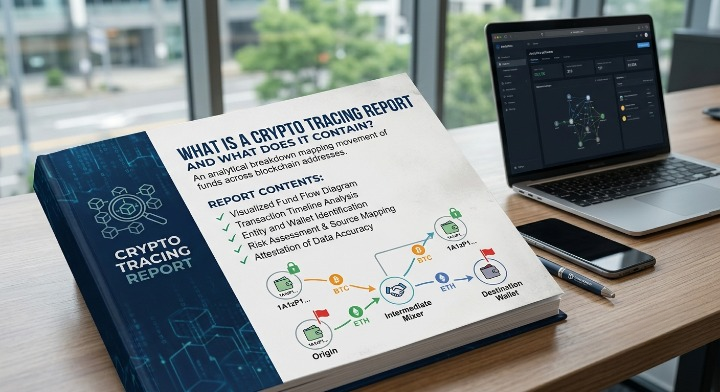
A crypto tracing report is a structured document that records how cryptocurrency moved between blockchain addresses after a suspected scam, theft, or disputed transaction. It sets out the transaction details, maps the flow of funds, and explains what the evidence does and does not show. When funds have passed through several wallets, a cryptocurrency tracing report can turn scattered blockchain data into something lawyers, investigators, and affected parties can read and act on.
What Is a Crypto Tracing Report?
A crypto tracing report is a structured analysis of cryptocurrency transactions. It documents how digital assets moved across blockchain addresses and relevant services. Public blockchains record transfers permanently, but raw ledger data is hard to interpret, especially when funds are split, consolidated, or moved repeatedly.
The scope of any report depends on the available evidence, the blockchain network, the transaction history, and the investigation undertaken. A single transfer to one address will produce a shorter report than funds scattered across dozens of wallets.
What Information Does a Crypto Tracing Report Contain?
Not every report contains every item, but a blockchain tracing report commonly includes:
- Case background and investigation scope
- Cryptocurrency type and blockchain network
- Relevant wallet addresses
- Transaction hashes (the unique ID of each transfer)
- Dates, timestamps, and amounts
- Transaction flows between addresses
- Exchange or service interactions, where identifiable
- Transaction diagrams or flowcharts
- Supporting blockchain records
- Analytical findings and limitations
- References to the evidence relied upon
A well-prepared report separates verified on-chain records, such as a hash, amount, or timestamp, from analytical interpretation, such as a view that two addresses are probably connected. That distinction matters to anyone relying on the findings.
How Is a Crypto Tracing Report Prepared?
No two investigations are identical, but the process generally runs at a high level as follows:
- Collect transaction hashes, wallet addresses, and supporting records.
- Verify the relevant transactions on the blockchain.
- Reconstruct the transaction sequence.
- Examine subsequent transfers.
- Review identifiable exchanges or other services, where relevant.
- Organize the findings and supporting evidence.
- Document assumptions, uncertainties, and limitations.
For a closer look at the later stages, see how investigators follow crypto funds across exchanges and wallets.
Can a Crypto Tracing Report Identify Who Owns a Wallet?
Not by itself. Tracing shows where funds went. It does not automatically show who controls an address. Public blockchain data records addresses and transactions, not real-world identities.
Linking an address to a person may sometimes involve additional records, such as exchange account data obtained through lawful process, or other evidence. These are not always available. A report should therefore describe what the blockchain shows and be clear about what remains unknown.
Can a Crypto Tracing Report Be Used in Court?
A report may help a lawyer, investigator, or tribunal understand complex transaction evidence by organizing it clearly. Whether it is accepted, and how much weight it carries, depends on the circumstances and on the relevant court or authority.
Factors that typically matter include:
- A transparent methodology
- Traceable source records
- Accuracy and documentation
- The jurisdiction
- The applicable evidentiary rules, including those on authentication and expert evidence
No report is automatically admissible. Ask a qualified lawyer how your court would treat one. For more on supporting material, read what legal evidence is needed to investigate a cryptocurrency scam.
What Is the Difference Between a Crypto Tracing Report and a Police Report?
A tracing report analyzes cryptocurrency transactions. A police report records an incident you have reported to law enforcement. They serve different purposes. A police report starts an official record, while a tracing report documents the movement of funds. The transaction analysis may support a complaint or investigation by giving authorities clearer, better-organized information.
When Might You Need a Crypto Tracing Report?
A report may be relevant in situations such as:
- Cryptocurrency investment fraud
- Unauthorized wallet transfers
- Suspected stolen Bitcoin or USDT
- Funds moved across multiple wallets
- Disputes over cryptocurrency payments
- Business or counterparty investigations
- Legal disputes needing transaction documentation
Suitability depends on the facts and your objectives. Where the question is broader than “where did the funds go,” a wider crypto investigation may be more appropriate.
What Information Should You Provide to a Crypto Tracing Professional?
Gather the following and don’t delete anything:
- Transaction hashes and wallet addresses (yours and the recipient’s)
- The blockchain network and token used
- Amounts and timestamps
- Screenshots and communications with the other party
- Exchange or platform records
- Relevant website URLs
Never share your seed phrase, private keys, passwords, or authentication codes with anyone claiming to investigate your case. A genuine tracing analysis does not need them.
Does a Crypto Tracing Report Guarantee Recovery?
No. Tracing funds, identifying potentially relevant services, taking legal action, and getting assets back are separate stages. A report may support further action, but it does not guarantee a freeze, a return of funds, the identification of a suspect, or a successful legal outcome. Read more in crypto asset recovery vs. crypto asset tracing.
Frequently Asked Questions
1. What is a crypto tracing report?
It is a structured document analyzing how cryptocurrency moved between blockchain addresses and relevant services. It records transactions, maps fund flows, and notes limitations, helping lawyers, investigators, and affected parties understand what happened after a suspected scam or theft.
2. What information does a cryptocurrency tracing report contain?
Typically, the case background, blockchain network, wallet addresses, transaction hashes, timestamps, amounts, fund flows, identifiable exchange interactions, diagrams, and findings with limitations. Contents vary with the evidence and scope, so not every report includes every item.
3. Can a crypto tracing report identify a wallet owner?
Not on its own. Blockchain data shows addresses and transactions, not identities. Attribution may sometimes involve exchange records or other evidence obtained through lawful channels, but identification is never guaranteed.
4. Can a crypto tracing report be used in court?
It may help organize transaction evidence for lawyers and proceedings. Admissibility and weight depend on methodology, source records, accuracy, jurisdiction, and the rules of the relevant court or authority. It is not automatically accepted.
5. How long does it take to prepare a crypto tracing report?
It varies. Timelines depend on the number of wallets and transactions, the blockchains involved, and how much evidence is available. Simple matters generally take less time than complex, multi-wallet cases.
6. What information is needed for crypto tracing?
Transaction hashes, wallet addresses, the blockchain network, amounts, and timestamps are the core items. Screenshots, communications, exchange records, and website URLs also help. Never provide seed phrases or private keys.
7. Is a crypto tracing report the same as a police report?
No. A tracing report analyzes cryptocurrency transactions. A police report records an incident reported to law enforcement. The tracing analysis may supply supporting information for a complaint or investigation.
8. Does a crypto tracing report guarantee recovery?
No. It documents fund movements and may support further action, but it cannot guarantee a freeze, return of funds, identification of a suspect, or legal success.
Next Steps
FintechLegals provides crypto asset tracing and cryptocurrency investigation services. Professional analysis can help organize transaction flows, document relevant blockchain activity, and prepare findings for further investigation or legal review. If you need documented tracing findings, explore these services or contact the team to discuss what information you have.
For more updates, follow us on LinkedIn.

Leave a Reply