


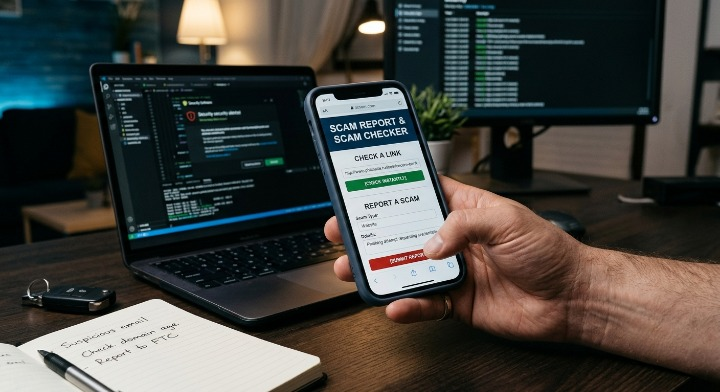
To check if a website is a scam, verify the company with a financial regulator, review the domain’s age and ownership, and search official warning lists. A scam checker highlights red flags but cannot guarantee safety. If you suspect fraud, report it to the official authority in your country.
Fraudsters copy real firms, build convincing websites and push people to pay quickly. Verifying a site or company before you send money or personal data is the most effective protection. This guide explains where an online scam checker fits into that process, which official services take reports, and what to do when something looks wrong.
What Is a Scam Checker?
A scam checker is any resource that helps you assess whether a website, company, investment platform, email or online offer shows signs of fraud. It might be a regulator’s warning list, a company register, a domain lookup or a database of consumer reports.
No checker can prove a site is legitimate or fraudulent. ASIC, for example, states that a name missing from its Investor Alert List does not mean the business can be trusted. Treat each result as one piece of evidence, not a verdict.
How to Check Whether a Website or Company Is a Scam
Work through these checks together, because any single one is rarely conclusive.
- Domain registration and history. Check when the domain was registered and whether ownership details are hidden or have changed. ASIC notes that scam websites are often online only briefly before moving to a new address. A domain ownership investigation can go further than a public lookup.
- Company registration and ownership. Search the official register in the country the firm claims. Confirm that the name, address and registration number match the website.
- Regulator warnings. To verify a company in the UK, use the FCA Firm Checker and Warning List. In Australia, use ASIC’s registers and Investor Alert List. Clone firms copy genuine firms’ details, so the FCA advises replying only through the contact details on its register.
- Unverified investment promises. Guaranteed returns, “risk-free” profits and pressure to act fast are classic scam warning signs.
- Suspicious contact information. Look for addresses, phone numbers or emails that differ from the official register.
- Fake reviews and impersonation. Scammers can build supporting ads, news articles and reviews. The FBI advises searching the URL and app screenshots, not just the brand name, before using a trading platform.
- Payment methods. Be wary of requests for cryptocurrency, wallet transfers, personal bank accounts or cash handed to a courier.
Best Official Scam Checker and Reporting Resources
Which service applies depends on your country and the type of fraud.
- FTC ReportFraud (US). Accepts reports of scams and bad business practices and shares them with law enforcement. The FTC says it cannot resolve individual reports.
- FBI IC3 (US). Takes complaints about internet-enabled crime, including cryptocurrency investment fraud. A complaint supports investigations but does not guarantee recovery.
- UK Action Fraud / Report Fraud. The City of London Police replaced Action Fraud with Report Fraud on 4 December 2025. Report at reportfraud.police.uk.
- FCA Warning List (UK). Lists unauthorised and clone firms the FCA knows about. It is not exhaustive, and it does not recover money.
- ASIC Moneysmart (Australia). Hosts the Investor Alert List and directs scam reports to Scamwatch, which shares information with ASIC and ReportCyber.
- BBB Scam Tracker (US and Canada). A public database of consumer-submitted reports. Treat entries as signals to investigate, not verified findings.
How to Submit a Scams Report
A strong scams report is specific and documented. Gather:
- Website URLs and domain names
- Emails and screenshots, including app screens
- Transaction IDs and payment receipts
- Wallet addresses and transaction hashes for crypto cases
- Communication records (messages, call logs, usernames)
- Dates and a short timeline of events
The FBI asks reporters to include the contact’s name, communication methods, bank accounts, wallet addresses and screenshots. File with the portal for your country, then contact your bank or payment provider. To report fraudulent websites or suspicious emails, include full headers or screenshots where possible. If the firm claims regulatory status, also notify that regulator.
Real Examples of Reported Online Scams
These cases come from official publications. They are alerts and warnings, not court findings against named individuals.
- Fake recovery law firms (FBI, 24 June 2024). The FBI warned that fraudsters posing as lawyers target crypto scam victims, sometimes through fake websites, and ask for upfront fees. IC3 reported victim losses above $9.9 million between February 2023 and February 2024.
- Cash couriers in crypto investment scams (FBI, 15 June 2026). The FBI described scammers who show victims fictitious returns, then send couriers to collect cash for supposed fees or taxes.
- Clone firm impersonation (FCA). The FCA warns that a firm using the name Flagstone Investment Management is a clone of an FCA-authorised firm with no connection to the genuine one. The IOSCO alerts portal records the FCA publication date as 6 October 2026.
- Chat-app investment scam (ASIC). ASIC warned of social media ads leading people into WhatsApp groups promoting unlicensed crypto trading. It listed entities named Juhbz and Ptounx on its Investor Alert List after consumers reported being unable to withdraw funds.
What Should You Do If a Scam Checker Flags a Website?
- Verify the warning independently. Open the regulator’s page directly rather than through the site’s links.
- Stop paying. Do not send further “fees”, “taxes” or “unlock” payments; the FBI notes these are common repeat-payment tactics.
- Preserve evidence. Save pages, messages and transaction data before they disappear.
- Contact your bank or payment provider immediately to ask about disputes or holds.
- Report it to the relevant authority.
Avoid anyone promising guaranteed recovery. The FBI says law enforcement does not charge victims a fee to investigate. For complex fund-tracing or entity questions, FintechLegals’ fraud investigations and crypto investigation services may help.
Limitations of Online Scam Checkers
Checker results can mislead in both directions. Legitimate businesses can be flagged by mistake (false positives), and brand-new scam domains won’t appear on any list yet. Ownership can change after a site is reviewed, and cloned websites can copy genuine firms’ names and reference numbers. ASIC cautions that its list is not exhaustive and details may have changed. A clean result never establishes legitimacy.
FAQs
How can I check whether a website is a scam?
Check the domain’s age and ownership, confirm company registration, search regulator warning lists and look for the warning signs above.
Is there a free scam checker?
Yes. The FCA Warning List, ASIC’s Investor Alert List and BBB Scam Tracker are free to search. Each covers only what has been reported or listed.
Where can I report an online scam?
Use your national portal: FTC ReportFraud or FBI IC3 (US), Report Fraud (UK) or Scamwatch (Australia).
Can I report a cryptocurrency scam?
Yes. In the US, IC3 accepts cryptocurrency fraud complaints. Include wallet addresses and transaction hashes.
What information should I include in a scam report?
URLs, screenshots, transaction IDs, receipts, wallet addresses, communications and a dated timeline.
Can a scam checker guarantee that a company is safe?
No. It can only show warnings or authorisation status at one moment in time.
Need Help With a Suspected Scam?
If a website, platform or company looks suspicious, or you have already lost money, preserve your evidence and report it to the official authority in your country first. Then talk to FintechLegals about a fraud investigation, a crypto investigation or a domain ownership investigation. Contact FintechLegals to discuss your case.
For more updates, follow us on LinkedIn.

Leave a Reply